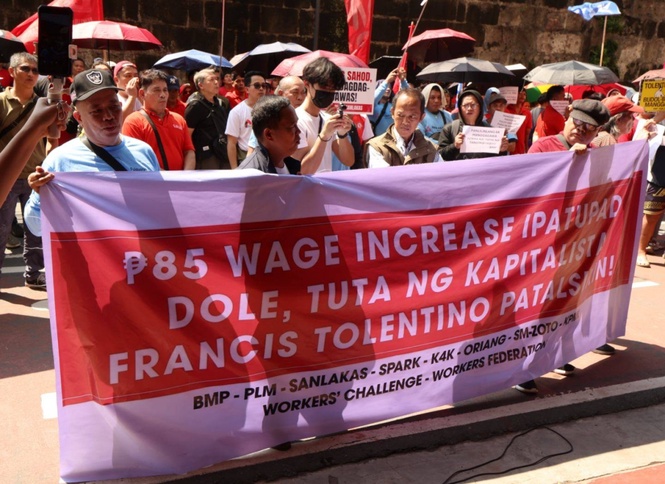
A LABOR group accused the Department of Labor and Employment (DOLE) of favoring employers over workers in the legal dispute surrounding the salary increase in the National Capital Region (NCR).
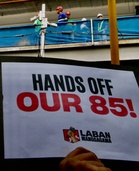
In a statement on Monday, Sanlakas criticized Labor Secretary Francis Tolentino over the department’s handling of Wage Order 27, which provides a P85 pay rise for minimum wage earners in NCR.
The group described the alleged failure to fully enforce the wage order as a “declaration of war against the working class.”
It also criticized the court orders that temporarily halted the implementation of the wage order following petitions from employers.
“DOLE’s decision is not just deference to the courts. It is a proud declaration of its class bias — that despite the clear mandate to safeguard the well-being of the country’s workers,” Sanlakas said.
It said the wage hike remains inadequate amid rising living costs.
The first P60 tranche of the salary increase took effect on July 25, raising the daily minimum wage for non-agricultural workers from P695 to P755.
The remaining P25 is scheduled to take effect on Jan. 20, 2027, bringing the daily minimum wage for non-agricultural workers to P780.
Workers in agriculture, service and retail establishments employing 15 or fewer workers, and manufacturing establishments with fewer than 10 regular workers are covered by wage rates.
Sanlakas also questioned the issuance of a subsequent wage order providing a P60 increase, claiming that it effectively reduced the P85 increase granted under the earlier order.
Sanlakas invoked the Labor Code and Republic Act 6727, or the Wage Rationalization Act, in arguing that wage-setting is primarily assigned to wage boards and labor authorities rather than the courts.
The group also said the government’s call for “industrial peace” amounted to silencing labor unrest instead of addressing workers’ concerns.
Also on Monday, Sen. Raffy Tulfo urged the DOLE to pursue in court the previous wage order of P85 for Metro Manila workers.
Tulfo, vice chairman of the Senate Committee on Labor and Employment, acknowledged the issuance by the Regional Tripartite Wages and Productivity Board (RTWPB) of the National Capital Region (NCR) Wage Order 28, which provides a P60 wage increase in Metro Manila.
However, he said that while the increase would provide some relief to workers, the new P60 wage hike is lower than the P85 that was supposed to be granted under Wage Order NCR-27.
"It is the workers’ right to receive the wage increase they deserve, especially amid the continuing rise in the prices of basic goods," Tulfo said in a statement. "For now, I hope that the scheduled wage increase will be properly implemented, but this should not be where it all ends."
Tulfo is again seeking the support of fellow senators for the passage of his Senate Bill 2372, which seeks to amend Article 126 of the Labor Code to prohibit regular courts from issuing TROs against any wage hike.
“The issuance of a Wage Order is a product of rigorous public hearings, economic studies, and tripartite consultations involving the government, the labor sector, and the employers,” Tulfo said in the bill’s explanatory note.
“However, the timely implementation of these much-needed wage adjustments is frequently derailed. Aggrieved parties often resort to filing petitions for Temporary Restraining Orders (TROs) or preliminary injunctions before regular courts to halt the enforcement of newly published Wage Orders,” he said.
The proposed measure seeks to amend Article 126 of the Labor Code to expressly bar the issuance of TROs or injunctions against the issuance, publication, implementation, enforcement or effectivity of any wage order issued by the National Wages and Productivity Commission (NWPC) or the RTWPBs.
Tulfo said the measure aims to close a legal loophole that allows parties to seek court intervention after wage orders have already been issued.
He said while Article 126 of the Labor Code already prohibits injunctions against “proceedings” before the NWPC or RTWPBs, the provision may be narrowly interpreted as applying only to hearings and deliberations before these agencies.
Because of this, parties have been able to obtain court orders preventing the implementation and enforcement of final wage orders, Tulfo said.