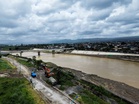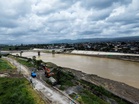
PUBLIC Works and Highways Secretary Vince Dizon announced Thursday the plan to build detention basins to prevent overflow of the San Juan River during heavy rains.
Dizon said that during the recent torrential rains, water from the Greenhills-Ortigas area was pumped toward the San Juan River, causing it to overflow.
“When this is already full, there is nowhere else for us to put the water,” Dizon said.
He added that while the river’s capacity could be increased through dredging, it is better to implement long-term measures.
Dizon said that detention basins would hold water before it reaches the San Juan River, reducing the risk of overflow.
He identified an area in Sitio Kaingin Bukid in Barangay Apolonio Samson, Quezon City, as a possible site for a detention basin, but noted the presence of informal settlers in the place needs to be addressed first.
“We need to coordinate with the local government, especially with its Drainage Master Plan. Once we identify how much land is available, then we can properly design it,” Dizon said.
He also stressed the need for proper waste disposal.
“For me, it’s about everyone helping each other. We just need a little discipline in disposing of garbage. Don’t throw it into the esteros or the drainage systems,” he said.
In a related development, Presidential Communications Office Undersecretary Claire Castro said Thursday that President Ferdinand Marcos Jr. has directed concerned agencies to come up with flood-mitigating measures, among them the construction of 39 water cisterns that could recycle floodwaters for use during the dry season.
She said that based on the government’s estimate, the floodwaters accumulated during the past days of torrential rains could fill up at least 50,000 Olympic-sized swimming pools.
“In relation to this, the president emphasized that the government must also study water management, or effective ways to utilize the water collected in rainwater cisterns,” Castro said in Filipino during a press briefing.
“The president does not want the harvested rainwater to just be pumped out, but rather used during times of drought. Also included in the government’s eyed solutions is the continuous upgrading of seawalls,” she added.
Castro said at least 39 sites have been identified as water catchment basins, such as at Camp Aguinaldo in Quezon City, Baseco Lagoon and Rizal Memorial Baseball Stadium in Manila, Chino Roces Ave. in Makati, Cultural Center of the Philippines in Pasay City, and Malabon Sports Complex.
The number of proposed water cisterns per city is as follows: Caloocan (2), Las Piñas (2), Makati (2), Malabon (2), Manila (4), Mandaluyong (2), Marikina (2), Muntinlupa (2), Navotas (2), Parañaque (2), Pasay (2), Pasig (2), Pateros (2), Quezon City (5), San Juan (1), Taguig (2), and Valenzuela (2).
Marcos earlier ordered the Department of Public Works and Highways to sustain regular waterway maintenance and cleaning, including implementing Oplan Kontra Baha and Bayanihan sa Estero, replacing old drainage systems, and upgrading seawalls and other floodwater management structures.
He ordered the implementation of long-term flood mitigation measures, such as desiltation, water impounding, and the relocation of affected communities.
All efforts are being undertaken in coordination with the Metropolitan Manila Development Authority to review and update the Flood Control Master Plan and complete the detailed engineering for underground water storage facilities at 39 sites.