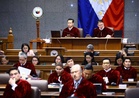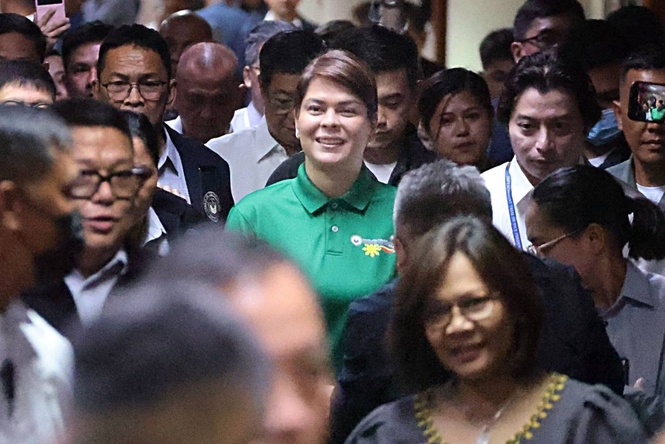
THE impeachment trial of Vice President Sara Duterte could continue until mid-February next year at its current pace, but may be sped up if the prosecution and defense agree to streamline the presentation of witnesses and evidence, impeachment court spokesman Reginald Tongol said Saturday.
The assessment came as a Palace spokesman accused the vice president’s defense team of deliberately slowing down the trial.
Both sides have a say
In a radio interview on Saturday, Tongol said the impeachment court cannot unilaterally expedite the proceedings because it is largely dependent on the actions and prerogatives of the prosecution and defense, particularly in presenting witnesses and establishing their respective cases.
“The impeachment court is just reliant on the parties,” Tongol said over radio DZBB.
He noted that while the court can set trial schedules, regulate time, and encourage stipulations, the parties retain control over how they present their evidence.
His remarks came after Vice President Duterte — who has attended none of the hearings — called for the impeachment proceedings to be expedited amid discussions on possible changes to the trial schedule.
Tongol said the House prosecution panel has listed 27 witnesses in its pretrial submissions.
The court, he explained, must generally allow the parties to present their witnesses in keeping with due process unless the parties themselves agree to reduce or streamline their presentation.
“If the parties agree, then there it is; it will be expedited,” Tongol said, emphasizing that speeding up the trial is not solely the responsibility of the impeachment court.
He also explained that stipulations between the parties could help shorten proceedings by eliminating the need to establish facts or authenticate documents that both sides agree are genuine and admissible.
However, Tongol stressed that stipulations cannot simply be imposed by the court because they require the consent of the parties.
While stipulations may be discussed during pretrial, they can also be entered into later in the proceedings when circumstances warrant, he said.
Tongol cited the testimony of Marivic Pareja as an example. The House prosecution sought judicial notice concerning matters involving the witness, allowing some documents to be presented without the usual identification and authentication process.
Although the request was made several weeks into the trial, it helped shorten the witness’ presentation.
Still, Tongol said the impeachment court’s primary responsibility is to ensure due process and uncover the truth rather than simply finish the proceedings as quickly as possible.
“The courts are more concerned with getting the truth out, following our rules, more than the speed and then the convenience of the parties,” he said.
Meanwhile, Tongol confirmed that Col. Raymund Dante Lachica, who has figured prominently in recent hearings, remains on the House prosecution’s list of witnesses.
Lachica, a Philippine Army officer who served with the Vice-Presidential Security and Protection Group, has been identified in the prosecution’s pretrial order as one of the 27 witnesses it intends to present.
However, Tongol said the prosecution has yet to request a subpoena for Lachica, so the court has no definite schedule for his appearance.
On the overall timeline, Tongol said the court initially plotted the trial to last about 90 days, with proceedings held three days a week.
At 12 trial days per month under that schedule, the proceedings are projected to conclude by mid-February next year.
He said Senate President Sherwin Gatchalian is considering possible adjustments to the schedule, including moving sessions from morning to afternoon or extending trial hours.
Any changes, however, would depend largely on developments during the hearings, including whether the number of witnesses can be reduced and whether some witnesses would provide merely corroborative testimony.
Tongol said the court could avoid unnecessary presentations if both sides agree that certain witnesses or evidence are merely repetitive.
The Senate, sitting as the impeachment court, resumed proceedings on Aug. 20 for the continuation of the House prosecution’s presentation of its case against Duterte.
The trial stems from the articles of impeachment transmitted by the House of Representatives, with the prosecution seeking to establish the allegations against the vice president while the defense is expected to challenge the charges and evidence presented against her.
Cause of delay
Meanwhile, Palace Press Officer Undersecretary Claire Castro accused the camp of Vice President Duterte of deliberately slowing down her impeachment trial.
This comes after the vice president said she wants to hasten the Senate impeachment trial.
However, Duterte maintained that her personal physical attendance at the hearings was not necessary because her defense lawyers were fully representing her.
In her YouTube podcast on Saturday, Castro said Duterte’s call is a strategic public relations move meant to sway public opinion and shield her defense team from responsibility for the trial's slow pace.
“The point she wants to convey is that she is ready for the hearing and the process; it is only the impeachment trial that is moving slowly... trolls will once again use this to claim that the process is sluggish and that the delay is supposedly intentional, to her disadvantage,” she said in Filipino.
Castro pointed out that while Duterte publicly demands a swift resolution, her legal representatives have engaged in procedural tactics that directly prolong the proceedings.
Among these actions, she highlighted the defense’s insistence on playing full-length video recordings during hearings rather than focused excerpts, as well as their refusal to stipulate on common exhibits.
“So the defense is the one that takes longer. It takes longer for the hearing to have a smooth flow. If you have almost the same document, you shouldn't take that long,” she said.
Aside from this, she said both parties were ordered by the court to compare documents; however, counsel to the prosecution, Lorna Kapunan previously claimed that they were “ghosted” by the defense team.
She noted that by refusing to agree on common markings for identical documents — including thousands of acknowledgment receipts from the Office of the Vice President and the Department of Education — the defense has forced the court into a laborious, item-by-item marking process.
“The defense panel keeps refusing stipulations — despite the thousands of acknowledgment receipts for the OVP and DepEd that need to be marked — while also causing issues with scheduling, delays, and limited availability; the constant filing of manifestations slows things down. So, if you look at what is actually stalling the process, you can see it stems from VP Sara's defense team,” Castro accused.
Additionally, Castro noted that the defense failed to supply the Senate impeachment court with required physical copies of their marked exhibits, forcing senator-judges and court staff to conduct manual document comparisons themselves.
But defense counsel Michael Wesley Poa said Saturday that the defense team is prepared to follow whatever schedule the Senate impeachment court sets as senator-judges move to adjust the trial to speed up its proceedings.
“The defense will comply with whatever schedule the impeachment court may decide upon,” Poa said, responding to The Manila Times.