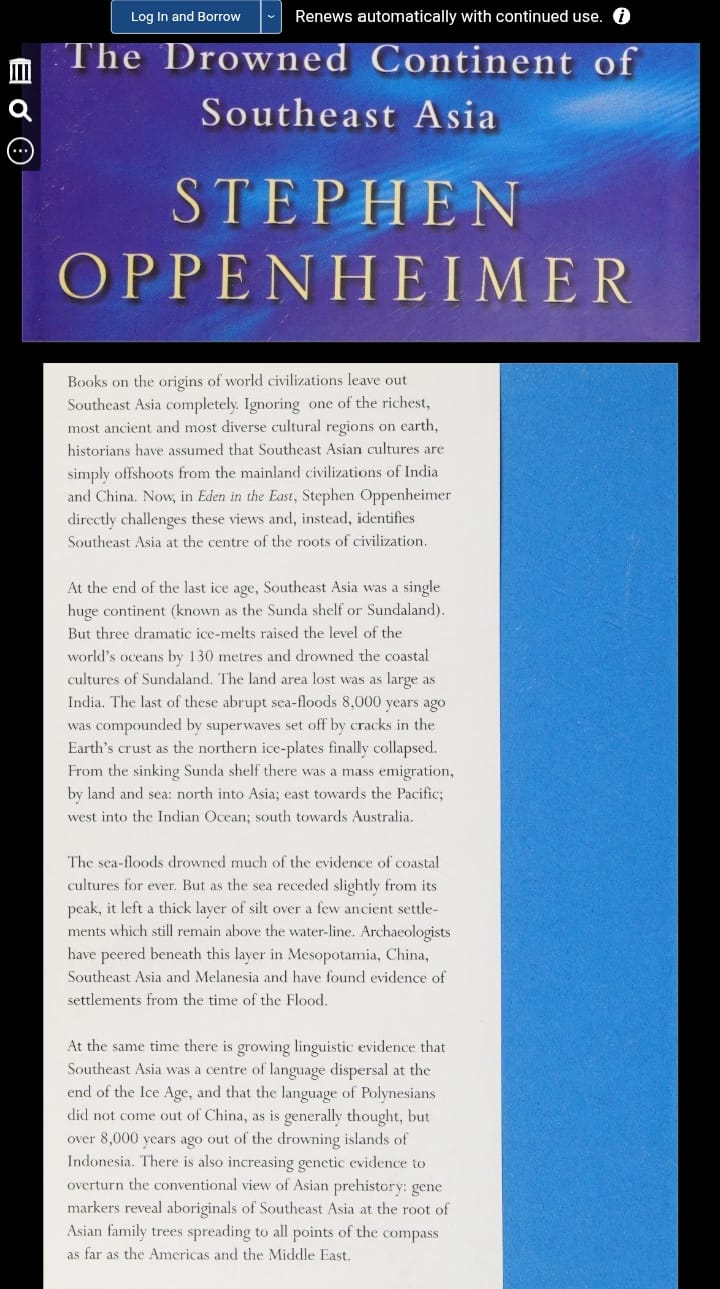
Some books challenge our understanding of the past. Eden in the East by Stephen Oppenheimer doesn't just challenge it—it submerges it beneath 300 feet of water and asks us to look again. Published in 1998, this ambitious work argues that the cradle of civilization wasn't Mesopotamia, but a lost continent in Southeast Asia called Sundaland, now lying beneath the South China Sea.
The Continent That Vanished
At the end of the last Ice Age, Southeast Asia looked nothing like it does today. The South China Sea, the Gulf of Thailand, and the Java Sea were dry plains connecting Indochina, Borneo, Sumatra, and Java into a landmass twice the size of India. This was Sundaland—a continent that supported thriving coastal civilizations for millennia.
Then came the floods. Not the gentle, gradual rise we might imagine, but three catastrophic pulses of sea-level rise around 14,000, 11,500, and 8,000 years ago. Each pulse drowned vast territories, forcing mass migrations that carried the seeds of civilization in all directions—west to India and Mesopotamia, north to China, east into the Pacific.
Oppenheimer's central thesis is audacious: the Biblical flood isn't myth—it's memory. The story of Noah, along with hundreds of flood myths scattered across cultures, preserves the trauma of Sundaland's drowning. But the book's true gold lies in details less frequently discussed.
The Golden Truths That Deserve More Attention
The Rice Revolution Started in Malaysia
Most history books place rice domestication in China around 6,000 BCE. Oppenheimer pushes this back further, locating the first systematic cultivation of rice in the Malay Peninsula approximately 9,000 years ago. This wasn't a minor agricultural innovation—it was the foundation upon which civilizations were built. The refugees from Sundaland didn't just flee with their lives; they carried their knowledge of cultivation across the Indian Ocean.
Seafaring Before Farming
Here's a detail that overturns conventional timelines: evidence from the Solomon Islands suggests deliberate long-distance sailing existed 30,000 years ago. These weren't simple rafts hugging coastlines—these were ocean-going vessels capable of crossing open water. Sundaland's people were maritime pioneers long before the Egyptians built their first boats. They carried domesticated animals in large canoes, establishing trading networks that fertilized the great cultures of the ancient world.
The World's First Pots Came From Japan—But Why?
Oppenheimer notes that the world's first pottery, dated to 12,500 years ago, comes from Japan. The question—rarely asked—is how this technology arrived there. His answer: it spread from Sundaland's refugees moving north. This places Southeast Asia at the center of a vast cultural diffusion that conventional archaeology has attributed to multiple independent inventions.
Genetics Tells a Story of Migration
The book draws extensively on DNA evidence, using both Y-chromosome and mitochondrial DNA tracking to map population dispersals from Sundaland. Oppenheimer challenges established geneticists like Cavalli-Sforza, arguing that the statistical methods used to trace human migrations have been misinterpreted. The "Polynesian motif"—a genetic marker once thought to originate in China—actually traces back to Indonesia more than 8,000 years ago.
The Americas Were Reached by Sea
Perhaps Oppenheimer's most provocative claim concerns the peopling of the Americas. Contrary to the "Clovis First" model of big-game hunters crossing the Bering land bridge, he argues that migration happened along the coasts of East Asia, with seafarers moving up to the Bering Strait and across. This maritime route theory has gained traction in recent years, but Oppenheimer was arguing it before it became fashionable.
Sundaland's Legacy in Mythology
The flood myth connections are well-known, but Oppenheimer goes further. He identifies specific mythic elements—the cosmic egg, the creative wind, the earth/sky dichotomy, and the "Cain and Abel" motif—that appear across cultures from Southeast Asia to the Middle East. His claim isn't that these stories traveled intact, but that they preserve fragments of a shared cultural heritage from the Sundaland diaspora.
Why the Book Remains Controversial
Not everyone is convinced. Critics point to the lack of physical evidence—where are the underwater settlements? Others argue that Oppenheimer overinterprets myth, particularly in West Malaysia where recent floods (like those in 1926 and 1971) have shaped local stories more than the Ice Age cataclysm. Some geneticists challenge his population models, suggesting that the colonization of the Americas traces to Lake Baikal, not Southeast Asia.
Yet even his skeptics acknowledge the book's ambition. One reviewer called it "remarkably well researched" and full of "astonishing array of evidence," even if not entirely persuasive. Another described it as "absorbing, meticulously researched, limpidly written, and authoritative".
The Bigger Picture
What makes Eden in the East valuable isn't whether every detail is correct—it's the way it forces us to rethink the geography of human civilization. The standard narrative places the "birth of civilization" firmly in the Middle East. Oppenheimer asks: what if that's just where the writing survived? What if the real story lies underwater, preserved in DNA, language, and myth rather than stone tablets?
The book belongs to a tradition of "diffusionist" thinking that became unfashionable after early 20th-century excesses. But Oppenheimer's version is grounded in hard science—oceanography, genetics, linguistics—not speculation. He doesn't invoke lost advanced technologies or aliens. He simply asks us to consider that climate change destroyed a civilization, and the survivors rebuilt the world we know.
In an era where sea levels are rising again, that lesson feels more relevant than ever. The "lost Eden" may be underwater, but the story of its people—our ancestors—deserves to be told.
Dr Kavesh (kaveshdr@gmail.com) is a content creator under the Newswav Creator programme, where you get to express yourself, be a citizen journalist, and at the same time monetize your content & reach millions of users on Newswav. Log in to creator.newswav.com and become a Newswav Creator now!
The User Content (as defined on Newswav Terms of Use) above including the views expressed and media (pictures, videos, citations etc) were submitted & posted by the author. Newswav is solely an aggregation platform that hosts the User Content. If you have any questions about the content, copyright or other issues of the work, please contact creator@newswav.com.