.jpeg)
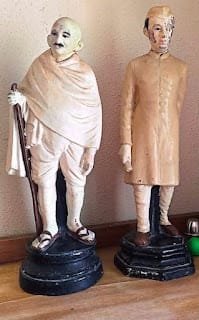
During one Thaipusam celebration, before I was aware of my surroundings, I was told that Amma had bought two earthen statuettes from one of the stalls set up around the Waterfall Murugan Temple in Penang. She later explained her choice of Gandhi and Nehru over people like Meerabhai, Annathurai and MGR.
She wanted her children to emulate these two Indian freedom fighters. Amma was hoping they would become, like her hero, a soul so divine that they would unite the nation on a bigger path, fit to be called a Mahathma (great soul). Perhaps no other leader could be so erudite and capable, bringing a nation to dizzying heights.
She would tell us stories about how Gandhi kept the promise he made to his mother on his departure for London to maintain his vegetarianism, and he stuck to it. Other tales of him were about his steadfast stand against social injustice, too. Nehru, in his eyes, was to be revered for his eloquence and ability to stand shoulder to shoulder with the white men to demand what the nation needed: self-rule. He did not flinch when the colonists imprisoned him for his defiance. In fact, he read and wrote books.
That was pretty much what was fed to us. Gandhi and Nehru were up there on pedestals as our role models for our future endeavours.
As the years went on and we, the children, were slowly exposed to the affairs of the world, we became aware that there were two sides of the story. We decided to stay mum rather than burst Mum's bubble. By then, Gandhi and Nehru had been with us for more than 40 years, ridden with battle-wound scars of the curse of time, wear and tear, and the stress of moving houses. The statues had had a cosmetic paint job and a patch job for chipped limbs.
It stands majestically in the living room of my parents' house to this day, waiting to be handed down as a family heirloom.
Now, more than 55 years on, many Indians do not look at these figures the way Amma did. Gandhi is accused of being a lackey of the British, playing to the British at all times. His passive-aggressive way of combating invaders only needlessly sacrificed Indian lives, with no bearing on eventual independence. In the end, it was the raw aggression of the Indian National Army and World War II that ended the British Raj rule. Gandhi may have facilitated the splitting of the sub-continent into two nations. His blackmailing of the nation through fasting only helped the enemies with their personal agendas. Gandhi's obnoxious social experiments with his grandnieces were not befitting someone of his stature, they say.
The great leader of the largest democracy, with his "tryst with destiny" at the stroke of midnight speech, turned out to be not a great role model either. When India was playing catch-up to keep the princely states within the Indian Union, Nehru was busy catching up, writing flowery, passionate, romantic letters to someone's wife, Edwina Mountbatten, daily throughout 1948 and 1960, up to her death.
Coming to Malaysia, the man who was labelled 'Father of Modernisation' brought visible changes to Malaysia's skyline. The world viewed Malaysia of the 90s as another emerging economic powerhouse. It seemed nothing could go wrong.
In the mid-90s, when I was in the UK for a professional examination, I was coached by seniors who had already passed theirs. Even then, there was an aversion to brown people. It seemed that the older boomers, who essentially were most of the examiners, were not comfortable with the increasing number of doctors from the Indian sub-continent clogging up the NHS. So, the seniors told us that we needed to hint to the examiners at any opportunity that we were Malaysians. Malaysians generally passed the examination and left to practice at home.
On the day of reckoning, when presented with a patient, I was asked, "Doctor, how would you treat such a patient in your country?"
Bullseye.
"Well, back home in Malaysia, I would ..." I started before I was interjected.
"Ah, Malaysia, did you say? That is a prosperous country, and you have a dynamic leader, Dr Mahathir..." And the rest of the viva voce went well.
Fast-forward 30 years, and the man is no longer put on a dais to be hailed. In fact, in the last general election, he not only lost his parliamentary seat in his home state but also lost his deposit.
That is how the world functions. We are all given a brief moment in the limelight to showcase our talents. In that short window of opportunity, we should strut our stuff and take a bow gracefully. It is time for others to carry the torch. When we overstay our welcome, the response can be pretty ugly. People are fickle, and anyone can fall from hero to zero in no time.
(P.S. Mother Theresa can be added to the list as well. There was a time when no other soul could be more virtuous than Mother Teresa; that is why she was canonised. The narrative about her these days is quite negative. Accusations of substandard medical care in her hospice, questionable financial practices, and the controversial nature of her hospices have cropped up. Lately, allegations that her institution is siphoning donations to the Vatican have been raised.)
Share hidden facts about Malaysia and stand a chance to win prizes worth up to RM4,300! Find out how to join here. T&Cs apply.
Farouk Gulsara (asokansham@gmail.com) is a content creator under the Newswav Creator programme, where you get to express yourself, be a citizen journalist, and at the same time monetize your content & reach millions of users on Newswav. Log in to creator.newswav.com and become a Newswav Creator now!
The User Content (as defined on Newswav Terms of Use) above including the views expressed and media (pictures, videos, citations etc) were submitted & posted by the author. Newswav is solely an aggregation platform that hosts the User Content. If you have any questions about the content, copyright or other issues of the work, please contact creator@newswav.com.