.jpg)

Have you been following what our unity government have been doing recently? Fret not if you aren't aware, let me give you a brief update.
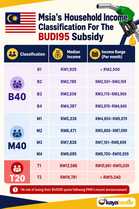
Our Malaysian government has been gradually reforming our subsidy system, including rationalising blanket subsidies like our fuel subsidies, followed by a gradual move towards targeted assistance such as cash aid for lower-income groups. More recently, attention has turned to improving targeting further, including discussions on whether higher-income groups, such as parts of the T20, should continue to benefit from broad subsidy structures. However, this has raised a much deeper issuer than it appears, the way income groups are defined may be far too simplistic to support fair policy decisions.

On paper, the T20 classification refers to the top 20% of earners in the country. It is often assumed that this group is broadly “well-off” and therefore more capable of absorbing subsidy reductions. However, a recent reflection circulating on LinkedIn highlights a key flaw in this assumption, that the T20 bracket is extremely wide, and it contains households with very different financial realities.

The LinkedIn author Yie Hahn Hwong mentioned that a household earning around RM12,000 a month can already fall into the national T20 category. This might sound comfortable at first glance, especially when compared to lower-income groups. But when broken down, this income is often stretched across housing loans, car repayments, children’s education, insurance, daily living expenses, petrol, and financial support for parents. In high-cost cities like Kuala Lumpur, the remaining disposable income can shrink significantly.
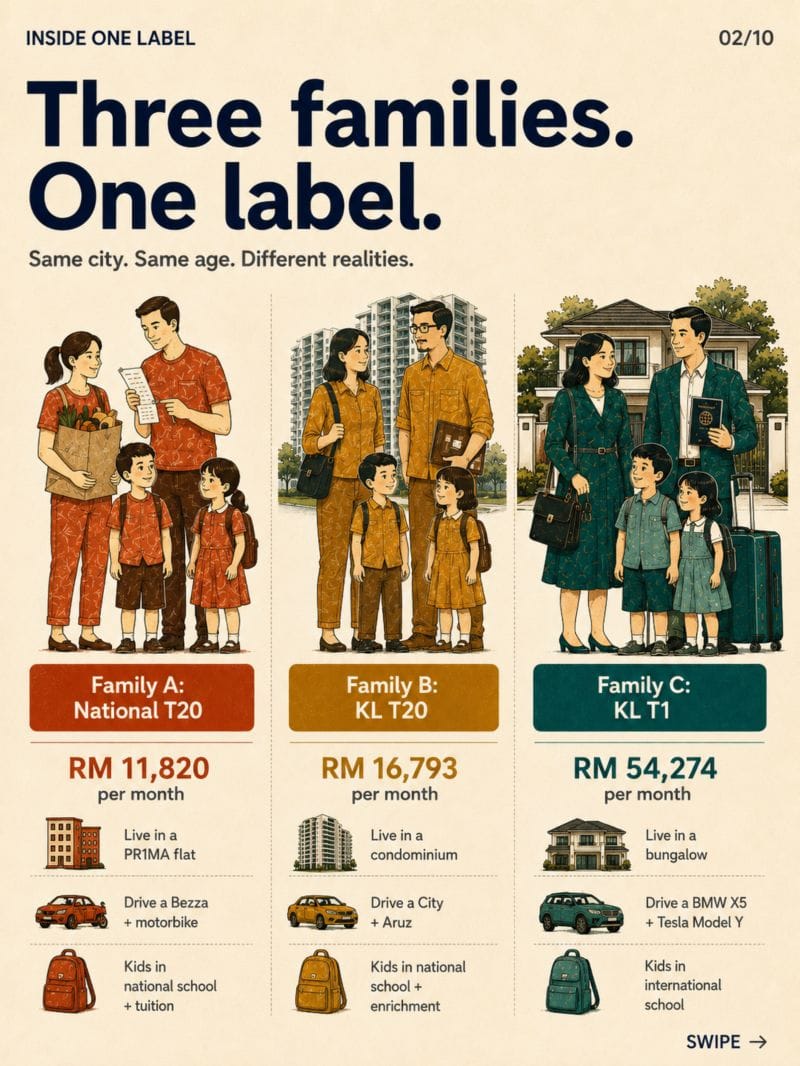
In his post, Yie created a presentation called “Inside One Label,” which compares three fictional households based in Kuala Lumpur. In the first case, a family earns RM11,820 per month, while the second earns RM16,793, and the third brings in RM54,274 monthly. Although all three are classified within higher-income brackets, Yie’s analysis highlights that such labels do not necessarily reflect true financial comfort or flexibility. After accounting for essential living costs in Kuala Lumpur, including housing, transportation, food, education, healthcare, and other recurring expenses, the differences in disposable income become stark.
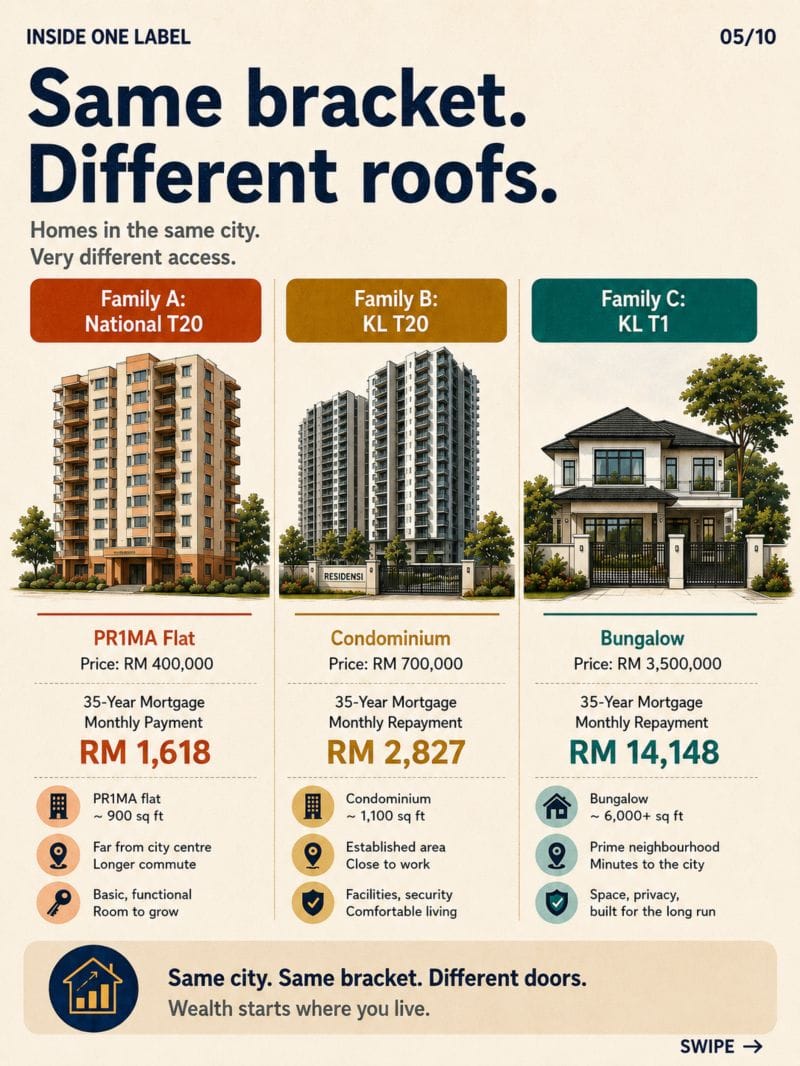
The first household is left with only about RM300 in monthly savings, showing how tight their budget remains despite their classification. The second family retains approximately RM600 after expenses, offering slightly more breathing room but still relatively limited financial flexibility. In contrast, the third household is able to save around RM10,000 each month, reflecting a significantly higher level of financial security and surplus. These examples demonstrate that grouping households under broad income categories can obscure meaningful differences in real-world living standards, spending pressures, and financial resilience.
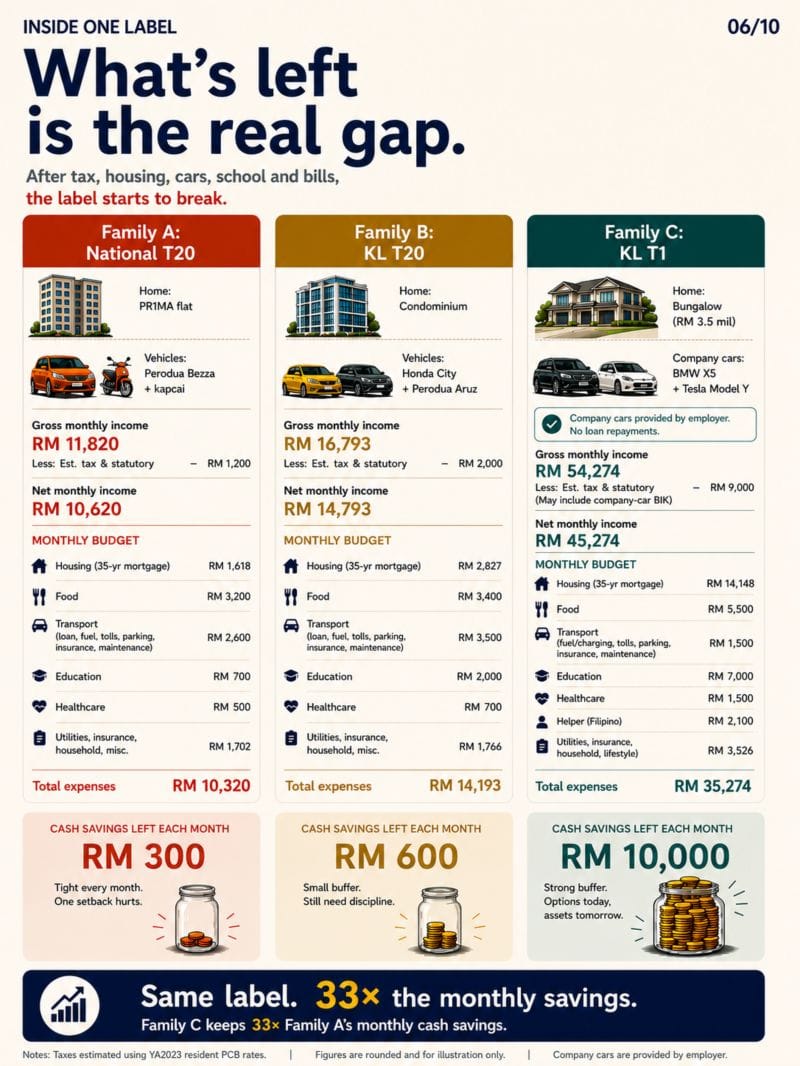
This becomes especially important when discussing subsidy rationalisation. A policy change worth RM400, for instance, will not affect everyone equally. For some households, it can meaningfully reduce already tight monthly buffers. For others, it may be a minor inconvenience. And for the highest earners within the bracket, it may barely be noticeable at all.
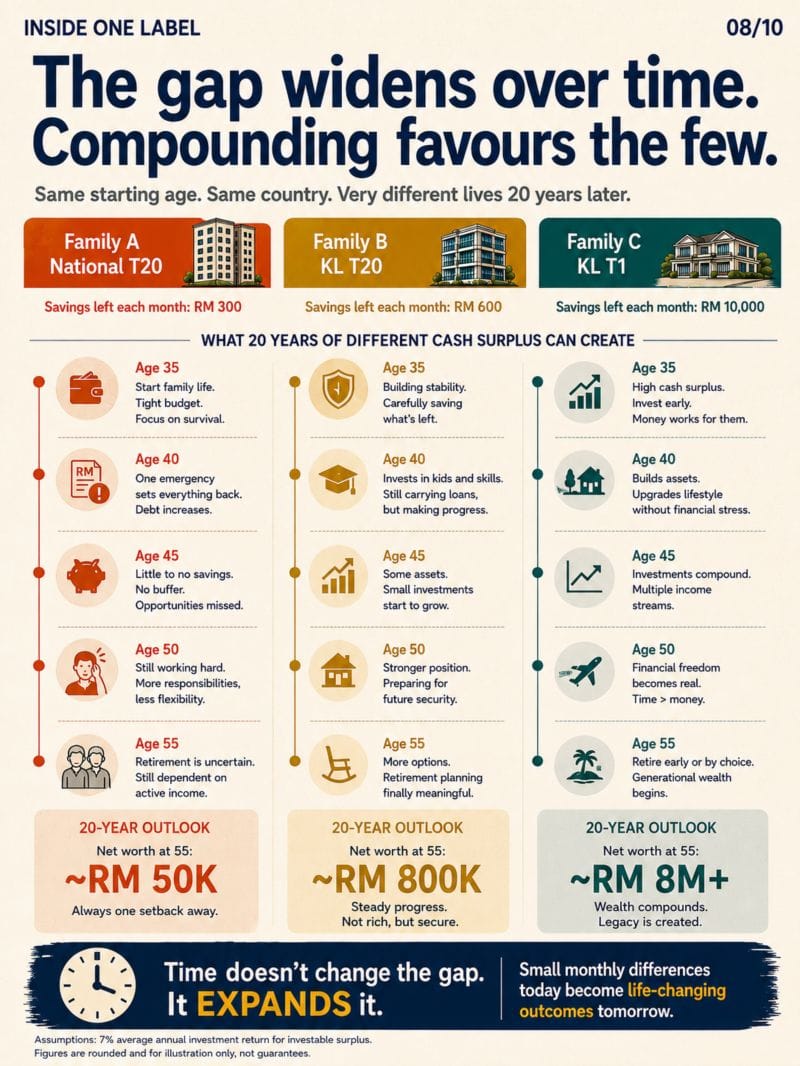
The core issue, then, is not simply how much someone earns, but how much financial “breathing room” they actually have. A household’s ability to absorb unexpected expenses, survive a bad month, or manage emergencies often matters more than gross income alone. Even within the T20 group, financial stability can vary widely depending on debt levels, number of dependents, lifestyle commitments, and cost of living in different locations.
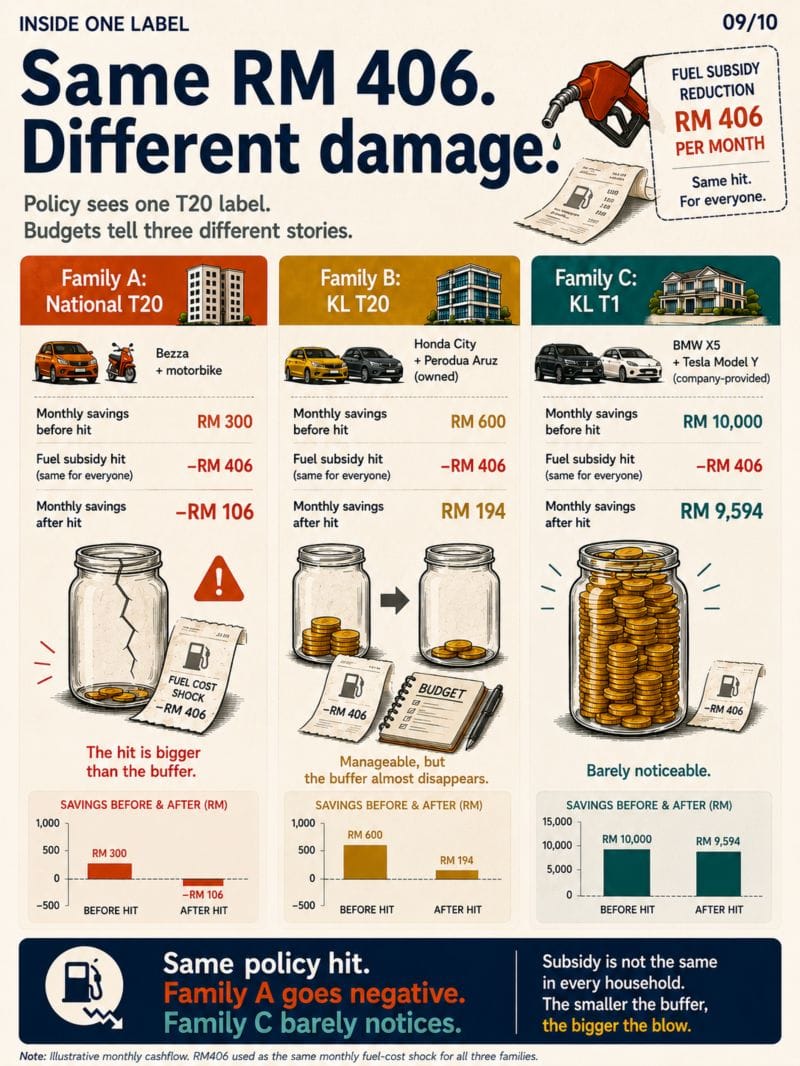
This raises an important policy question: is the current income-based classification still fit for purpose?
Critics argue that relying solely on broad categories like B40, M40, and T20 risks oversimplifying the complexity of real household finances. It may lead to blanket policies that treat very different groups of people as though they are financially identical. As a result, some households who are technically “T20” may still feel financial pressure, while others at the top end of the spectrum experience minimal impact from subsidy adjustments.
This is why the debate around subsidy rationalisation is becoming more nuanced. The question is no longer simply whether subsidies should be reduced for higher earners, but rather, which segment of higher earners are we actually targeting?

A more refined approach may be needed, one that reclassifies the Malaysian household landscape without relying on traditional B40, M40 and T20 categories, one that distinguishes between households that are comfortably wealthy and those that are merely classified as high-income on paper. Without this nuance, policy changes risk being either too blunt or unintentionally unfair.
Ultimately, the discussion is not just about whether income matters, but whether a single label like “T20” is sufficient to guide policies that affect millions of households with very different financial realities. Comment and share your thoughts below.
Reference: LinkedIn

Share hidden facts about Malaysia and stand a chance to win prizes worth up to RM4,300! Find out how to join here. T&Cs apply.
QueenSxndrx (sandragxn@gmail.com) is a content creator under the Newswav Creator programme, where you get to express yourself, be a citizen journalist, and at the same time monetize your content & reach millions of users on Newswav. Log in to creator.newswav.com and become a Newswav Creator now!
The User Content (as defined on Newswav Terms of Use) above including the views expressed and media (pictures, videos, citations etc) were submitted & posted by the author. Newswav is solely an aggregation platform that hosts the User Content. If you have any questions about the content, copyright or other issues of the work, please contact creator@newswav.com.