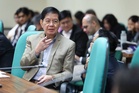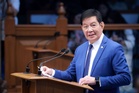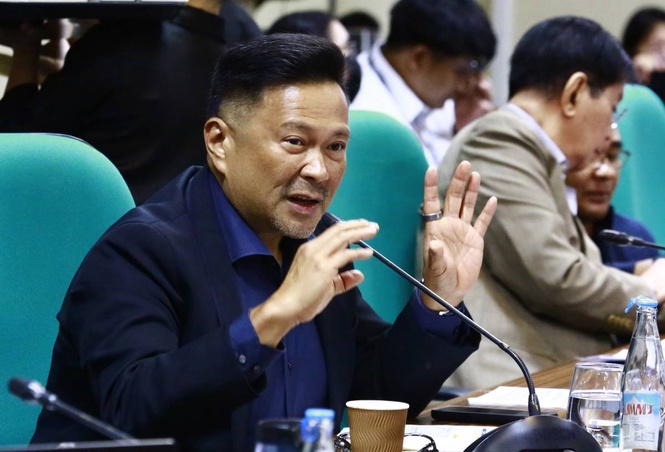
SENATE Finance Committee Chairman JV Ejercito is pushing for a “back to basics” approach in the proposed 2027 national budget, emphasizing the need to prioritize essential services and programs that directly address the needs of ordinary Filipinos.
In his sponsorship speech for House Bill 10858, or the proposed 2027 General Appropriations Act (GAA), on Monday, Ejercito said the government must focus its limited resources on fundamental public needs, particularly health care, food security, education, employment and public safety.
“Health, food, education, jobs and security. These are the priorities we want to focus on as we craft and deliberate on the 2027 national budget. Back to basics,” Ejercito said.
“Before we focus on complicated matters, we should focus on using our limited resources to ensure that the basic needs of our people are met,” he added.
Ejercito said that providing basic services must go hand in hand with economic recovery.
“We cannot sustain the delivery of basic services without a strong economy. And no one will appreciate economic growth if it does not translate into better basic services,” he said.
As author and principal sponsor of the Universal Health Care (UHC) Act, Ejercito underscored the importance of investing in the health care system.
Under the Senate version of the proposed 2027 budget, P378.6 billion was allocated for the Department of Health and its attached agencies and corporations.
Of this amount, P5.4 billion was earmarked for the Health Facilities Enhancement Program (HFEP), which supports the construction and improvement of hospitals and other health facilities, as well as the acquisition of medical equipment.
Ejercito said strengthening provincial and locally funded hospitals would help bring specialized medical services closer to communities, reduce the need for patients to travel to Metro Manila for treatment, and ease congestion in major referral hospitals.
The Senate also increased PhilHealth subsidies by P19.8 billion, bringing the total allocation to P94.2 billion.
The funding will support indirect contributors, expand health benefit packages, and strengthen the implementation of the Zero Balance Billing (ZBB) program.
He assured the public that the reduction in the Medical Assistance Program (MAP) allocation should not be a cause for concern, explaining that a substantial portion of its funding had been realigned directly to hospitals to make assistance more accessible to patients.
“Our goal is simple: to ease the worries of every patient. They should no longer have to think about where to get money to pay for their medical treatment. Their only concern should be getting well,” he said.
“This will also reduce the need for patients to line up and go from one government office to another just to request guarantee letters to cover their hospital bills,” he added.
To strengthen food security amid the looming threat of a Super El Niño, the Senate version allocated about P251 billion for the Department of Agriculture (DA), its attached agencies and corporations, and irrigation support.
The funding is intended to support farmers throughout the agricultural production cycle, from planting and fertilization to harvesting and marketing.
The Senate also realigned more than P4 billion for the National Rice Program to boost domestic rice production, provided P250 million for the Agri-Recover Program to assist farmers affected by drought, and augmented the DA’s Quick Response Fund (QRF) by P1 billion.
Additionally, P47.5 billion in subsidies was allocated for the National Irrigation Administration to sustain irrigation services and support agricultural productivity.
To address post-harvest losses, more than P1 billion was earmarked for the establishment of the Benguet Agri-Pinoy Trading Center and a cold storage facility in Barlig, Mountain Province.
Another P200 million was allocated for a cold storage facility in Oriental Mindoro.
Ejercito said these facilities would help vegetable farmers preserve their produce, reduce spoilage, and secure better prices for their harvests.
For education, the Department of Education will receive P915.4 billion under the proposed 2027 budget.
This includes an additional P11 billion for the School-Based Feeding Program, which will benefit Kindergarten to Grade 1 pupils in public elementary schools.
Meanwhile, state universities and colleges (SUCs) will receive a combined P138.2 billion to support their operations, academic programs, and the construction, rehabilitation and improvement of school facilities.
Each SUC will also receive P7.5 million under the Smart Campus Project to improve internet connectivity and support digital learning across more than 100 campuses nationwide.
Ejercito said providing students with better learning facilities and digital access would help equip them with the skills needed to enter the workforce and contribute to the economy.
The senator said infrastructure development remains essential to restoring economic momentum, generating employment and attracting investments.
He said the government should aim for at least 5 percent to 6 percent gross domestic product (GDP) growth while ensuring that economic gains translate into better employment opportunities and improved public services.
The Department of Public Works and Highways will receive more than P587 billion for infrastructure projects in 2027.
The Senate Committee on Finance also restored P33.097 billion in funding for foreign-assisted projects, including the Bataan-Cavite Interlink Bridge, Laguna Lakeshore Road Network, and Pasig-Marikina River Channel Improvement Project.
In the transportation sector, the Senate restored P4.7 billion in government counterpart funding for foreign-assisted projects, along with P15 billion each for the continued construction of the Metro Manila Subway Project and the North-South Commuter Railway.
A combined P146.5 million was also provided for the NCR Busway Project, Active Transport Bike Share System, and Safe Pathways Program to improve daily commuting.
The proposed budget of the Department of Transportation stands at P294.57 billion.
The Department of Labor and Employment will receive P53.8 billion to support programs for workers’ welfare and protection.
The Senate version also provides an additional P250 million for the Department of Migrant Workers’ Aksyon Fund and P600 million for the Emergency Repatriation Fund of the Overseas Workers Welfare Administration to ensure immediate assistance and repatriation for overseas Filipino workers affected by crises abroad.
Ejercito also highlighted the P20-million allocation for the Sugarcane Workers’ Assistance Scholarship, which will provide educational assistance to sugarcane industry workers, farmers and their dependents.
For government employees, the Senate version includes a proposed P1,000 increase in the monthly Personnel Economic Relief Allowance (PERA), alongside efforts to increase teachers’ salaries.
Meanwhile, the Department of Human Settlements and Urban Development and its attached agencies and corporations will receive a total of P6.4 billion.
The allocation includes additional funding for the National Housing Corp. and Social Housing Finance Corp., as well as support for community mortgage and housing projects under the National Housing Authority.
Ejercito said the government must expand access to decent and affordable housing and provide Filipino families with more opportunities to own homes.
To strengthen the country’s defense capabilities, the Senate increased the proposed budget of the Department of National Defense by P1.73 billion, bringing its total allocation to P326.9 billion.
This is on top of the P50 billion earmarked for the continued modernization of the Armed Forces of the Philippines.
The Philippine Navy will receive an additional P750 million, bringing its budget to P71.2 billion.
The allocation will support nine key infrastructure projects in the Kalayaan Island Group, including Pag-asa Island, to improve facilities and strengthen the country’s presence in the West Philippine Sea.
The Philippine Coast Guard, meanwhile, will receive P45.6 billion, including an additional P146.8 million for the acquisition of training helicopters.
“The presence of our Navy and Coast Guard gives our fishermen confidence as they peacefully earn an honest living in the West Philippine Sea, free from threats and intimidation,” Ejercito said.
For the Philippine National Police, the Senate Committee on Finance augmented its proposed budget by P2.9 billion, bringing the total to P245.2 billion.
The funding will support police operations, facility upgrades, and efforts to combat terrorism and other security threats.
The Senate also increased the budget of the Bureau of Fire Protection by P922 million to P39.3 billion, which will support the hiring of 2,000 additional firefighters, the purchase of ambulances, and improvements in emergency response capabilities.