
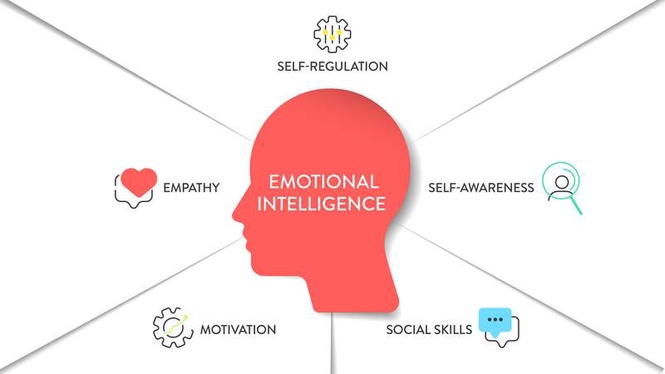
Emotional intelligence (EI), popularised by psychologist Daniel Goleman in 1995, is the ability to perceive, understand, manage and effectively use emotions, both your own and those of others. Goleman identified five core components: self-awareness, self-regulation, motivation, empathy and social skills.
Where traditional intelligence (IQ) measures cognitive ability, emotional intelligence measures relational and interpersonal competence. In administration and governance, where decisions affect millions and stakeholder conflicts are daily realities, EI is not a soft skill, it is a strategic asset.
Know thyself: Self-awareness and self-regulation in public service
A civil servant who lacks self-awareness may confuse personal bias with professional judgement. Self-awareness, the ability to recognise one’s emotions, triggers and blind spots, enables administrators to separate policy reasoning from emotional reaction. An IAS officer facilitating a land acquisition dispute, for instance, must recognise if personal discomfort with confrontation is causing avoidance of a legally necessary decision.
Self-regulation, the ability to control impulsive responses and think before acting, is equally vital. Governance involves high-pressure environments: parliamentary questions, media scrutiny, public protests. A self-regulated administrator does not issue reactive press statements, scapegoat subordinates or make populist decisions under pressure. Instead, they exercise what Goleman calls ‘emotional restraint’, a mark of institutional maturity.
Together, these two components form the internal pillar of emotional intelligence in governance.
Empathy in action: Listening to citizens as policy input
Empathy, the capacity to understand the emotional state of another, is perhaps the most transformative EI component in public administration. Governance failures in India and globally are often not failures of law or finance, but failures of empathy: policies drafted without consulting affected communities, welfare schemes designed without understanding lived poverty or policing strategies built on fear rather than trust.
Empathetic governance means listening before legislating. It means a district magistrate conducting a gram sabha understanding not just what people say, but why they are saying it — reading the anxiety behind an irrigation complaint or the dignity issues beneath a demand for better roads. When empathy informs need-assessment, public spending becomes more efficient and public trust increases.
At the institutional level, empathy-driven governance has produced measurable results: community policing models, participatory budgeting exercises and grievance redressal mechanisms that actually redress grievances.
Motivation and social skills: The engine of administrative leadership
Intrinsic motivation, pursuing goals for reasons beyond personal reward, defines the emotionally intelligent leader. In governance, this translates into mission-driven public servants who remain effective even within bureaucratic inertia. They do not need an external crisis to perform; they bring energy to routine work because they connect their role to public purpose.
Social skills, the fifth component, encompass conflict resolution, negotiation, team-building and communication. A senior administrator managing inter-departmental coordination, an IPS officer defusing communal tension, or a diplomat navigating bilateral negotiations, all depend primarily on social intelligence. The ability to read a room, manage disagreement without alienating stakeholders and build coalitions is the difference between policy success and institutional gridlock.
From theory to governance: EI in real administrative scenarios
Emotional intelligence finds practical application across governance domains:
- Disaster management: An emotionally intelligent district collector in a flood-affected area stabilises panicking communities through calm, empathetic communication, preventing stampedes and misinformation.
- Policy implementation: Schemes like MGNREGS or PM Awas Yojana succeed at the ground level when field officers use empathy to understand beneficiary hesitation and social skill to navigate local power structures.
- Conflict resolution: In regions experiencing ethnic or agrarian conflict, EI-driven administration builds dialogue rather than defaulting to enforcement.
- Personnel management: Supervisors with high EI reduce burnout, increase subordinate performance and build ethically stronger teams.
Why governance systems must institutionalise EI training
Despite its importance, emotional intelligence remains absent from most civil services training curricula. LBSNAA and state academies focus heavily on procedure, law and finance — all essential, but insufficient. Nations that have integrated EI training into leadership development, including Singapore and Finland, consistently rank higher in governance effectiveness and citizen satisfaction indices.
India’s governance challenges — caste conflict, agrarian distress, urban migration and administrative corruption — are not merely structural. Many are relational. Solving them requires civil servants who understand human behaviour as well as they understand statutes.
Emotional intelligence is not about being emotionally soft. It is about being emotionally smart, channelling the full spectrum of human understanding into the act of governing justly.
Mains practice questions
Q1. “Emotional intelligence is as critical as intellectual ability for effective public administration.” Critically examine this statement with reference to the components of emotional intelligence and their relevance to governance in India. (250 words)
Q2. Discuss the role of empathy and self-regulation in conflict-sensitive administration. How can the Indian civil services institutionalise emotional intelligence training to improve governance outcomes? (250 words)

SEO keywords: emotional intelligence in governance, EI in public administration, Daniel Goleman five components, self-awareness in civil services, empathy in governance, emotional intelligence UPSC, administrative leadership skills, civil services emotional intelligence, IAS officer soft skills, emotional intelligence India governance, EI and policy implementation, empathetic administration, self-regulation in bureaucracy, emotional intelligence mains questions, UPSC GS Paper 4 ethics

