
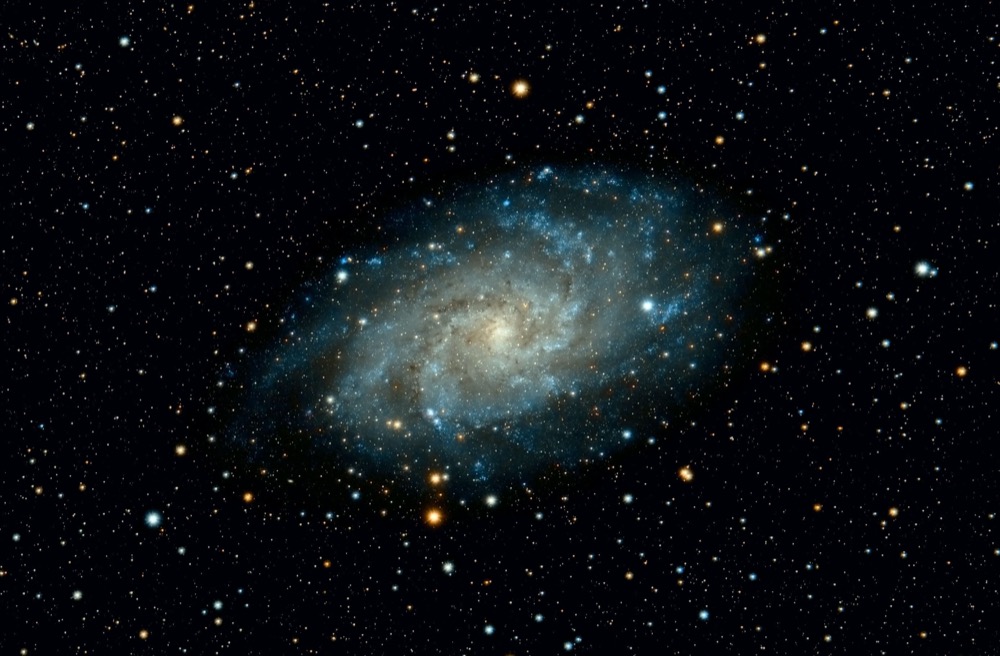
The European Space Agency (ESA) has officially adopted its new galactic archaeology mission, Arrakihs, set to launch by the end of 2030. This ambitious mission aims to capture the faint, elusive light from galaxy haloes, regions that hold critical clues about how galaxies, including our own Milky Way, formed and evolved over billions of years (ESA).
Unveiling The Hidden Haloes Of Galaxies
When we imagine a galaxy, the glowing spiral of stars often comes to mind. Yet surrounding this visible disc lies a vast, spherical region known as the galaxy halo, largely invisible to traditional telescopes. Composed mainly of dark matter, which acts as the galaxy’s gravitational scaffold, and diffuse stars and gas, these haloes contain hidden records of past cosmic events. Arrakihs will focus on these faint structures, including stellar streams, remnants of smaller galaxies torn apart during mergers. By mapping these streams, scientists hope to reconstruct the complex history of galaxy formation, understanding how galaxies like the Milky Way grew over time. This mission promises to illuminate the unseen architecture of the universe, filling gaps in our models of galaxy evolution and the role of dark matter.
Advanced Instruments Designed To See The Unseen
Detecting objects with extremely low surface brightness requires cutting-edge technology. Arrakihs will carry one instrument composed of two binocular telescopes, totaling four cameras sensitive across multiple wavelengths, from near-ultraviolet to near-infrared. This configuration allows the spacecraft to capture light that is too faint for other missions. A European consortium led by Spain, with contributions from Switzerland, Austria, Belgium, Norway, Portugal, and Sweden, is developing the instrument. The collaboration exemplifies ESA’s approach to pooling expertise across member states, ensuring that every photon collected translates into new cosmic insights. Supported through ESA’s Prodex programme, these cameras are meticulously designed to deliver precision data critical for unraveling the hidden story of galaxy haloes.
Tracing Cosmic History Through Stellar Streams
Galaxy haloes are not merely ethereal spheres, they are living records of past mergers and interactions. By studying at least 80 galaxies similar in mass tothe Milky Way, Arrakihs will collect enough data to analyze statistical trends, revealing whether our galaxy is typical or exceptional. “Arrakihs is a ground-breaking and unique galactic archaeology mission. By uncovering hard-to-see galaxy haloes, it will reveal new details of how galaxies form and whether the Milky Way galaxy is unique. Its rapid development showcases the flexibility and breadth of ESA’s Science Programme,” says Professor Carole Mundell, ESA’s Director of Science. Each stellar stream mapped will offer a snapshot of cosmic cannibalism, showing how stars are stripped from smaller galaxies during mergers, gradually building the massive structures we see today.
A Rapid Mission With Cosmic Vision
Arrakihs represents ESA’s second “F-class” or fast mission under the Cosmic Vision programme, selected in 2022 and now adopted for full implementation. This classification emphasizes accelerated development timelines, with less than ten years from selection to launch. Adoption marks the transition from feasibility studies to the construction, integration, and testing phase of the spacecraft and its instruments. The mission will join ESA’s fleet of Cosmic Observers, addressing foundational questions about the universe’s origin, composition, and fundamental physical laws. ESA emphasizes that Arrakihs’ rapid development reflects not only technical innovation but also the agency’s ability to adapt to new scientific priorities with agility and precision.