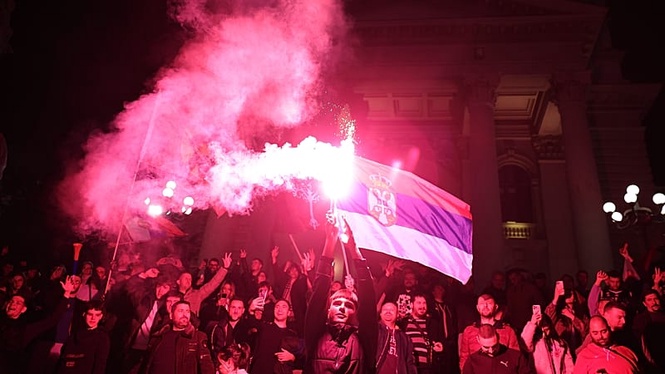
EU leaders have welcomed the Student List’s election victory in Serbia, ending Aleksandar Vučić’s 12-year grip on power and raising hopes of a reset in relations with Brussels.
European Council President António Costa and European Commission President Ursula von der Leyen were quick to welcome the result, which saw a student-led protest movement win a parliamentary majority.
“We stand ready to support reforms on the rule of law, media freedom, the fight against corruption and strong democratic institutions, and to work together to advance Serbia’s future in the European Union,” Costa and von der Leyen said in a joint statement.
Serbia, the largest and most influential country in the region, has a fraught history with the EU. Its accession bid stalled after Russia’s full-scale invasion of Ukraine, as Belgrade kept up friendly relations with Moscow.
In July, the Commission tried to open a new accession cluster, but eight member states blocked the move over Serbia’s failure to align with EU sanctions on Russia and its rule of law record.
More recently, the funeral of convicted war criminal Ratko Mladić, attended by senior Serbian officials and held with military honours, further soured relations with the EU.
“After nearly two years of protests for democracy, the rule of law, and the fight against corruption, Serbians turned out in historic numbers,” Enlargement Commissioner Marta Kos wrote on X. “A new chapter can begin for Serbia. The door to the EU is open, and we are ready to move forward together.”
Whether the change in Belgrade will give fresh momentum to the stalled accession bid remains hard to predict. Brussels, however, notes that the Student List grew out of a pro-democracy, rule of law movement, fuelling hopes that Belgrade will now align with EU values and reforms.
“Now is the time for the rule of law, reforms, and institutions that serve all citizens. That should be the path toward the EU,” Tonino Picula (Croatia/S&D), the European Parliament’s rapporteur for Serbia, wrote on social media.