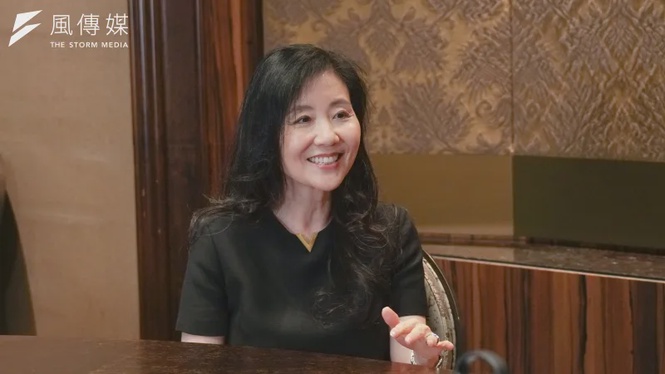
The woman who broke the wine world's glass ceiling says the hardest judgment she ever made was not about a bottle. It was about how hard to push her four daughters.
Jeannie Cho Lee, who in 2008 became the first Asian Master of Wine, says the parenting philosophy that guided her through raising four daughters came from an unlikely teacher: the grapevine. In an exclusive interview with Storm Media's English-language outlet and 1%Style on September 13, 2026, the Hong Kong-based critic and academic said the vineyard taught her that comfort produces mediocrity.
“Great wine, all great wine, requires a certain level of stress,” she said. “If you put a grapevine in an environment where it's sunny all the time, everything is easy, it grows easily, it has no character, and the quality can only be at a certain level. It's only when the grapes and the vine have stress in their life — from the land being poor, from the weather not being stable all the time — that the grapes can achieve greatness.”
Lee passed the Institute of Masters of Wine examination, widely regarded as the most difficult qualification in the drinks trade, in 2008. In 2021 the French government appointed her a Knight of the National Order of the Legion of Honour. She is a professor at the School of Hotel and Tourism Management at The Hong Kong Polytechnic University, where she helped launch Asia's first Master of Science program in International Wine Management in 2012, and she has advised Singapore Airlines on its wine program since 2009. Before any of that, she was a Korean-American mother raising four small children, negotiating the distance between the high-pressure schooling she grew up around and the instinct to make life easier for her own children.
What A Grapevine Taught Her About Raising Daughters
Asked to rank her roles, Lee does not hesitate. “The biggest role, most important role in my life, is being a mother,” she said. “Everything else is second. Master of Wine, friend, wife — that's all secondary.”
She has kept a wine diary since 1992. She began a separate diary for each daughter while she was still pregnant, and each of the four now has at least three or four handwritten volumes. One form of writing preserves a flavor that disappears in seconds; the other preserves a childhood. Both, she said, taught her the same lesson about what produces character.
The difficulty is calibration. On one side sits the instruction to do the best you can because you must. On the other sits the offer to step in and smooth the path.
“As a mother I think it's actually easier to say, let me do it for you, let me make it easier for you, because it makes you feel better,” she said. Watching a child struggle through a punishing exam or a bad stretch is the harder option. “It breaks your heart.”
Where Amy Chua's Tiger Mother Model Falls Short
Lee has read Battle Hymn of the Tiger Mother, the memoir by Chinese-American law professor Amy Chua that made strict Asian-style parenting a global argument. Asked how a parent distinguishes the challenge that builds a child from the pressure that breaks one, she offered no formula.
“Each child is different — how much pressure they can take,” she said. “It's the parent's sensitivity to how much you know your child can take.”
As a Korean-American mother she is blunt about the culture she inherited. Korean academic competition, she said, is “very, very, very hard,” and its extreme version is not one she endorses. Her own parents found a different setting: they insisted that school mattered, and she delivered, taking a bachelor's degree at Smith College, a master's at Harvard University and later a doctorate at The Hong Kong Polytechnic University. What they never let her doubt was the affection underneath.
She concedes the calibration is never clean. It can be too much or not enough. But the only way to locate the line, she said, is to approach it. “The only way to find out is to almost test the limit, to see whether they can be more independent or harder working.”
The motive behind the pressure is what decides whether it works. If a child reads the demand as being about grades, money or possessions, Lee said, it tends to backfire.
Her Mother Scolded Her, Then Held Her
Her model is her own mother. “She would scold me if I got anything below an A. She would say, ‘Why A-minus? Why not A?'” Lee recalled. “But then afterwards she would hug me, and she would say, ‘I love you. You did well, but you can do better.' So it's tough love. But it's love.”
With her own daughters she names the reason out loud. The pressure, she tells them, is not about achievement and not about a comfortable life. It is about the size of the field they will one day get to choose from.
“I want you to have opportunities and choices,” she said. “Success is your own making. Happiness is your own definition. But as a mother I want you to have as many choices, as many options, as many opportunities as you can.”
Whatever the result, she ends the same way: “No matter what, I'm here. I love you. And the only reason I'm doing this is because I love you so much that I want you to have opportunity.”
The vine metaphor carries its own warning, and Lee knows it. Stress makes greatness, but too much of it kills the plant. The hardest part of the job is knowing where that line sits — and what carries a child across it is never the discipline itself, but the certainty of what is behind it.
A Writer's Ambition That Never Left Her
The philosophy came out of a career that took an indirect route. At 10, Lee told her parents she wanted to be a writer.
“I loved expressing myself creatively. I loved being able to share my point of view about how I saw the world. I loved telling stories. I loved communicating,” she said. “Looking back at my life, a lot of what I've done is about communication, is about sharing.”
Her mother pushed her toward the other half of her career without meaning to. A formidable home cook, she trained her daughter's palate on a dinner table crowded every night with small dishes — the Korean banchan tradition, which Lee sees as a close cousin of Taiwan's xiaochi culture. Ten different flavors in one sitting was normal.
“That's why I felt, when I started to enjoy wine and discover wine, that that's what attracted me,” she said. “It was my mother, and feeling that I understand flavor and I appreciate these flavors.”
The two halves met on the only ground she was ever interested in. “I've never sold wine — never. So I've never been in the commercial side,” she said. What held her was education: getting the people around her to appreciate a bottle at a different level because they understood the story, the history, the culture or the winemaking behind it.
Four Small Children And The Wine Trade's Hardest Exam
The version of Lee the industry sees is a professor, an author of three award-winning books — Asian Palate, Mastering Wine for the Asian Palate and The 100 Burgundy — and a consultant to Singapore Airlines, Korea's Shinsegae, Vietnam's Sun Hospitality Group and the Sotheby's-run Hospices de Beaune charity auction.
View this post on Instagram
Less well known is what the Master of Wine years actually looked like. She was raising four young children, freelancing for Wine Spectator, Decanter and other titles, and working as a journalist for the Far Eastern Economic Review. Wine was still the thing she did around a full-time job.
Study time came in fragments. “It was when they were sleeping, or when they had their naps, or when I had to find and carve time in between,” she said. “Job, family, Master of Wine. I think that was the most challenging part.”
She was not chasing a record. She knew three or four Japanese candidates who had already been on the program for five or six years when she started. “So why would I assume I'm going to be the first?” she said. “That was not a consideration.”
She Was The Last To Notice The Glass Ceiling
The significance landed only after the certificate did.
“Only then did I realize, oh, actually this is a big deal, because it's a little bit like realizing that you broke the glass ceiling,” she said. “There was a glass ceiling of how far Asian wine professionals were going.” Colleagues began telling her what the result meant to them: “Jeannie, we're so happy and proud of you, because you're representing Chinese, or Koreans, or Asians, or women — all the minorities that were not represented in the Master of Wine program.”
Recognition came attached to an obligation. “If I am representing the great continent of Asia, and women, I must do it professionally, responsibly, and the best that I can, so there is absolutely no doubt in anyone's mind that I work hard, that I know what I'm doing, that I'm a professional, and that I set the standard for all wine professionals after me.”
The standard she wants the next arrivals to inherit is a specific one: “Wine professionals from Asia can know so much, can at the same time be humble and open and learning.”
Nearly two decades on, the room has not changed as much as the record suggests. “Oftentimes I'm the only Asian person in the room. I'm sometimes the only woman in the room,” she said. “Whatever I do reflects on who I'm representing at the time.”