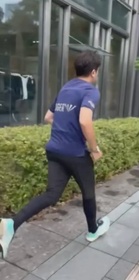
Democratic Progressive Party (DPP) candidate Puma Shen has cut Taipei Mayor Chiang Wan-an's lead to single digits ahead of the November 28 election, and Kuomintang (KMT) politicians told Storm Media their camp is losing the fight online as Taiwan People's Party (TPP) supporters fall silent.
A recent TVBS poll put Chiang, the KMT incumbent seeking a second term, at 49% and Shen at 41%. The gap stood at 28 percentage points in May. A race for Taiwan's capital that many once assumed Chiang could win without breaking a sweat has turned into a genuine contest.
How Chiang's Tainted Oil Offensive Backfired
Several KMT elected officials in Taipei trace the shift to the toxic cooking oil scandal. Chiang took on the DPP central government and President Lai Ching-te over the affair and called supporters onto the streets for a July 25 protest. For a while he looked like the undisputed leader of the blue camp, and there was even talk of a 2028 presidential run.
That momentum did not last. The protest movement came to an abrupt halt after Chiang called for a no-confidence vote to bring down the Cabinet. One city councilor believes that by putting himself on the front line of a blue-versus-green fight, Chiang gave DPP voters in Taipei, who had kept a low profile, a reason to come out openly for Shen.
When the Taipei City Council opened its session, DPP councilors went after City Hall on smoking areas, a child abuse case, mushroom-shaped sun umbrellas, and the free school lunch program. DPP Councilor Chien Shu-pei alleged a "mass food poisoning" at Jinhua Junior High School, a claim that collapsed after the city's education and health departments found that all ingredients and retained meal samples passed laboratory tests.
Even so, KMT officials concede that the sustained assault, carried out with what they described as presidential-level intensity, left voters with an impression of weak governance. Chiang spent the session on defense while Shen and the DPP went on offense, several Taipei KMT representatives said.
KMT Says Yang Wave Rallies Loyalists, Not Converts
Then came the "Yang Wave," a nickname for the buzz around Shen that plays on the "yang" in his Chinese given name, Po-yang, and the Chinese word for an ocean current. KMT representatives in Taichung, Taoyuan, and Taipei told Storm Media that the crowds are nothing like the 2018 "Han Wave" that swept KMT politician Han Kuo-yu into the Kaohsiung mayor's office.
By their account, the turnout is driven largely by DPP core supporters and campaign workers who hand out small gifts to draw bystanders into chanting "dongsuan," Taiwanese for "get elected." Local DPP councilors hire sound trucks to drive around neighborhoods two or three days before Shen arrives, and faces familiar from the 2025 mass recall campaign against KMT lawmakers have shown up at his Taipei events. The KMT view is that the wave has not broken out of the DPP base, but it will sharply raise DPP supporters' willingness to vote.
Shen's October 4 rally outside DPP headquarters on Beiping East Road drew a large crowd, but KMT observers said many in attendance were not Taipei residents. Veteran councilors in Taipei, New Taipei, and Taoyuan who rely on grassroots networks expect little impact on the race. Younger councilors who campaign mainly online are less relaxed: if backing Shen becomes something young people see as cool, they warned, the situation would turn very dangerous.
KMT sources also point to Hsinchu County as evidence that the wave has limits. DPP nominee Cheng Chao-fang, running in a county where the KMT base outnumbers the DPP's, has toned down his party identity, rarely shows the DPP logo in his advertising, and has not invited Shen to campaign for him. If the wave were winning over centrist and apolitical voters, a local figure argued, Cheng would be asking for Shen, just as KMT candidates across Taiwan competed for Han's appearances in 2018.
Commuter Belt Could Carry Shen Effect Into New Taipei And Keelung
Strategists who run mayoral campaigns see a different risk from the one councilors describe. Taipei, New Taipei, Keelung, and Taoyuan form a single metropolitan area, and roughly 700,000 New Taipei residents and about 100,000 Keelung residents commute into Taipei for work. The Keelung figure amounts to more than a third of that city's population.
These commuters spend their days in Taipei and return home mostly at night, one strategist said, so Taipei issues may shape their views as strongly as anything happening where they live or are registered to vote. With the Taoyuan race relatively stable, the strategist warned, the Yang Wave could spill over into New Taipei and Keelung.
Little Grass Goes Quiet As Threads Turns Green
On the ground, Shen's crowds may be modest. Online, KMT councilors who use social media heavily, especially younger ones, say the Yang Wave is taking territory fast. Memes, fan remixes, and AI-generated content keep coming, and many young people on Meta's Threads platform who never followed politics have recently started seeing Shen content in their recommendations, whether because of an algorithm change or because the other side has put money behind it. The blue camp, never strong online, now risks a rout there, they said.
One KMT councilor noted that in the 2024 presidential election, the KMT and the TPP fought the DPP together online. This year, the online energy of the "Little Grass," as TPP supporters are known, has failed to materialize, leaving the KMT-TPP alliance on the back foot on the internet even though the two parties are cooperating in the elections. Younger and online-focused KMT politicians are urging the party to change its approach on social media, especially Threads, before the wave spreads unchecked to apolitical voters.
Not everyone in the party is alarmed. A KMT figure familiar with the online landscape said Threads is dominated by "Bluebirds," young pro-DPP activists, and is not worth worrying about. The 2025 mass recall, which failed, showed that quiet KMT and TPP supporters still turn out, and that apolitical voters are not automatically swayed by Green messaging, the figure added.
A strategist who has run campaigns for KMT mayors and county chiefs offered a blunter view. "An election is about momentum. Whether the Yang Wave is real or fake is not the point now. The point is that the DPP has already built its momentum, and the KMT cannot take it lightly."
Chiang Campaign Questions Whether The Wave Is Organic
Chiang's campaign office drew a sharp line between the two phenomena. The Han Wave, it said, never produced 300,000 comments flooding the internet in a single night, nor did the same faces turn up three times at one event asking for photos. The office said every team has its own campaign rhythm and ways of mobilizing, which it respects, and that it believes Taipei residents "will make their own judgment" about the Yang Wave.
The campaign also took aim at what it called Shen's shifting positions on drugs and the death penalty, saying they may have disappointed many of his supporters. It urged Shen to explain his views clearly and stay consistent in order to live up to the "support and expectations" of the Yang Wave.
Chiang is putting city business first and holding campaign events after work hours and on weekends, visiting communities to hear from residents, the office said, adding that he has felt strong support and encouragement from the public. "There is no room for complacency in an election," it said, pledging that the team will stick to its plan and campaign all out on its record and policy proposals.
Social Media Links & Editor Tag - Penny