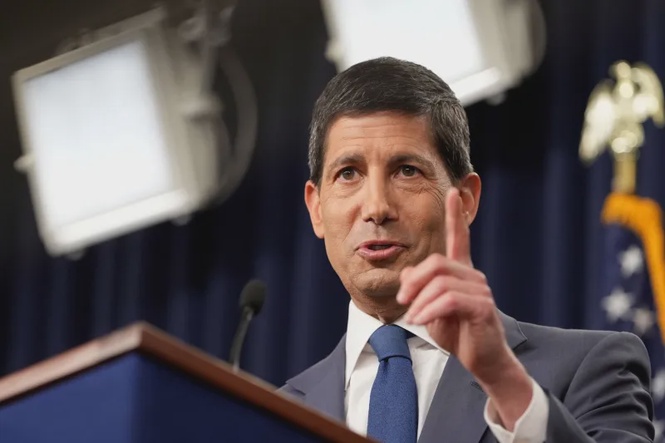
Federal Reserve Chair Kevin Warsh has raised the possibility that artificial intelligence could do to American service workers what cheap Chinese imports did to factory workers two decades ago: push prices down while wiping out jobs.
Warsh made the comparison on November 16 at a conference in San Francisco on AI, productivity, and jobs, where he moderated three of the four sessions, CNBC reported. The answer matters for interest rates: an AI productivity boom could give the Fed room to cut, while a wave of job losses or an investment bust would pose very different problems.
Warsh Sees A Hinge Point But No Productivity Takeoff Yet
In his opening remarks, Warsh said the United States leads the world in generating ideas and called "super intelligence" the defining general-purpose technology of the era. Unlike electricity or the combustion engine, he argued, it could automate the creation of ideas itself, and that could keep U.S. growth well above its long-run average.
He also said the evidence is not there yet. Productivity growth has been reasonably strong in recent quarters, but it has not clearly moved to a durable, structurally higher trend. "Our aim today is a humble one: to ask the right questions," he said.
By the end of the day, Warsh called the moment a hinge point for the U.S. economy and said he was cautiously optimistic, Fortune reported.
A Services Version Of The China Shock
Warsh kept coming back to the "China shock." After China joined the World Trade Organization in 2001 and ramped up low-cost manufacturing, Americans paid less for clothes and furniture, but the country lost about 1 million manufacturing jobs and 2.4 million jobs overall, according to a widely cited estimate.
AI could produce a similar shock in services such as legal and administrative work, Warsh suggested, cutting costs for companies and consumers while making many workers unnecessary. He asked the panel whether the United States should expect AI to bring disinflation in services over the medium term. Panelists largely said it was possible, CNBC reported.
Marc Andreessen, the venture capitalist who co-leads the Fed's AI task force, argued that regulation will slow the shift. Heavily regulated fields such as health care and education limit how far technology can replace workers, he said. In a purely free market, extremely rapid job displacement might be possible, but "we've mostly outlawed the kind of job transition" that both AI optimists and pessimists talk about.
"My line has been both utopians and the doomers are going to be disappointed," Andreessen said.
Fed Staff Model Three Paths From Boom To Bust
Warsh laid out three illustrative scenarios built by Fed Board staff, stressing that they are not forecasts. In the first, productivity gains are broadly shared, growth runs above its long-run average, and employment stays near full. In the second, AI destroys jobs faster than it creates them, so growth stays strong but unemployment rises.
In the third, AI disappoints. After heavy investment and big stock market gains, expected returns fall, share prices drop, the economy slows, and unemployment rises before recovering without the hoped-for productivity gains.
AI Spending Adds To Pressure For A Rate Hike
In the near term, AI is pushing the other way. The data center boom has driven up demand for chips, electronics, electricity, and copper, and many of Warsh's colleagues blame it for faster price increases, The Associated Press reported. With inflation accelerating last month, many Fed officials have signaled support for raising rates, including at the December meeting. Warsh did not mention inflation in his remarks or say what the Fed would do next.
The AI buildout is also meeting resistance from voters. In the November 3 midterm elections, voters approved a range of state-level measures to slow data center construction. Former Commerce Secretary Gina Raimondo called that "a very troubling sign" and said stopping AI would be very bad for America, CNBC reported. Warsh did not say whether he agreed.
Task Force Report Due In The Coming Months
Andreessen co-leads the Productivity and Jobs Task Force with Stanford University economist Chad Jones, who is on leave at Anthropic, and Xbox CEO Asha Sharma. It is one of five outside task forces Warsh set up after taking charge of the Fed. The group is expected to deliver its recommendations in the coming months, after which Fed officials will debate whether and how to use them in setting policy.
The technology is not waiting for the report. Anthropic priced its initial public offering at $83 a share on November 18, the company said, completing the largest IPO in history. Its shares opened at $111.50 on the Nasdaq under the ticker ANT on November 19 and closed at $97.17, up 17% from the offer price, CBS News reported, a sign of how far AI now reaches into financial markets and the wider economy.