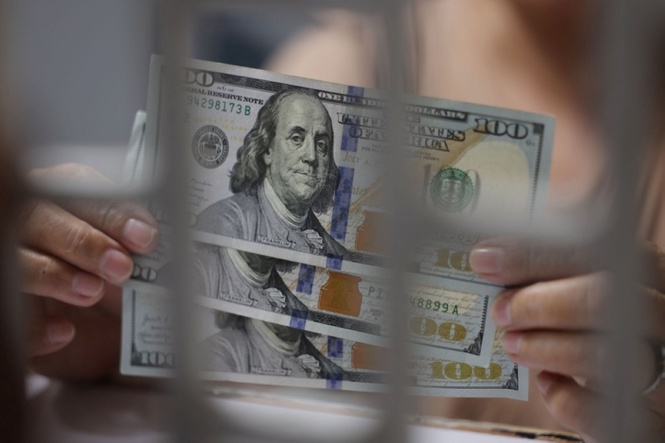
THE peso’s continued weakness against the US dollar could help revive the Philippines’ long-stagnant manufacturing sector by making locally produced goods more competitive against imports and more affordable to foreign buyers.
It can also be more valuable for Filipino families relying solely on the money sent by overseas Filipino workers as every dollar remitted may now be exchanged for more pesos.
The peso has weakened beyond the P63-per-dollar level this month, reflecting a combination of external pressures and domestic economic vulnerabilities. It closed at a record-low P63.615 against the dollar on Friday.
“A weaker peso can open new opportunities and, perhaps, be the bitter pill the Philippine economy eventually needs,” HSBC Global Research senior economist Aris Dacanay said in a commentary.
He said the depreciation can help boost growth by reinvigorating the economy’s manufacturing sector and by empowering remittances.
“All while narrowing the trade deficit,” he said.
According to Dacanay, the peso’s weakness, while painful for households facing higher prices for fuel and other imported goods, could create opportunities for local manufacturers by making Philippine-made products more affordable to foreign buyers and more competitive against imports.
He said the manufacturing sector was showing signs of a long-awaited revival, with 2026 marking the first time since 2018 that the Philippines had recorded material and sustained growth in manufacturing.
“This depreciation of the peso gave Philippine manufacturing a boost as local goods exports now look ‘cheaper’ for foreigners, supporting export demand,” Dacanay said.
He stressed that a weaker peso makes imports more “expensive” for locals, pushing consumers to buy locally produced goods rather than imported ones.
Dacanay said the peso had remained relatively strong against its Southeast Asian peers over the past two decades, partly because remittances from overseas Filipino workers supported the local currency.
Changing the dynamics
While remittances provide an important source of foreign exchange, Dacanay said the resulting currency strength had also weakened the competitiveness of Philippine manufacturers, both in export markets and in the domestic market, where they compete with cheaper imported products.
He likened this to a “Dutch disease”-like situation, in which strong foreign-currency inflows contribute to an appreciation of the local currency and undermine other export-oriented industries.
The peso’s depreciation has begun to change that dynamic, improving the relative affordability of Philippine goods compared with products from several Asian economies.
Based on HSBC’s analysis of real bilateral exchange rates, which adjust currency movements for differences in Philippine and US inflation, locally produced goods have become generally more affordable relative to goods from other Asian economies, with India, South Korea and Indonesia among the exceptions.
Dacanay also cited the nominal effective exchange rate, an index measuring the peso against a basket of currencies.
Based on an index set at 2010 levels, 2026 was the first year the peso became more competitive relative to the Malaysian ringgit, although it continued to lag the Indonesian rupiah.
Dacanay said overall Philippine export growth had remained resilient, reaching 14 percent year to date, despite the country’s relatively limited integration into the artificial intelligence global supply chain compared with some regional peers.
The combination of export opportunities and greater demand for domestic products, Dacanay said, could help sustain the manufacturing recovery, provided companies can manage their costs and maintain competitive selling prices.
Higher peso value
Dacanay also pointed to the benefits of peso depreciation for households receiving money from overseas Filipino workers.
“Whenever the peso depreciates, remittances from overseas Filipino workers (OFWs) become more valuable, since every dollar remitted can now be exchanged for more pesos,” Dacanay said.
“As a result, household purchasing power increases even if remittances in US dollar terms remain unchanged,” he added.
However, these gains must be weighed against the higher cost of imported goods and essential commodities, which can erode purchasing power.
For households that rely on imported fuel, food and other necessities, Dacanay said the increase in the cost of living could offset some of the additional income received from remittances.
Limited advantage
Dacanay, however, warned that the advantages of a weaker peso have limits, particularly when manufacturers depend on imported inputs.
While depreciation makes locally produced goods more attractive relative to imports, it also raises the peso cost of raw materials, components, machinery and other supplies purchased abroad.
Higher input costs can erode manufacturers’ profit margins, forcing companies to either absorb the additional expenses at the expense of earnings and investment capacity or pass them on to consumers through higher prices.
Such price increases could fuel inflation and weaken the competitive advantage gained from currency depreciation.
Dacanay said the Philippines continued to face a competitiveness disadvantage against regional peers, including Thailand, Malaysia and Indonesia, when differences in inflation were taken into account.
The real effective exchange rate, which adjusts the peso against trading partners’ currencies for relative price changes, provides a broader measure of competitiveness than the nominal exchange rate alone.
Dacanay said the government must complement the peso’s improved competitiveness with measures that bring down inflation and reduce the cost of doing business.
One option is to reduce tariff and non-tariff barriers to trade, which can lower the cost of imported goods and inputs and help ease domestic price pressures.
He pointed to the low-inflation environment in 2019 as an example of the potential benefits of lower trade barriers.
He also called for stronger action against market abuses, including smuggling, hoarding and cartels, which can restrict supply and contribute to higher prices.
“A weaker peso may be the bitter pill the Philippines needs to reinvigorate its manufacturing sector, but other policy remedies are needed to ensure these benefits are sustained in the long run,” Dacanay said.
“A competitive currency may look painful now, but it can also be an opportunity worth taking,” he added.