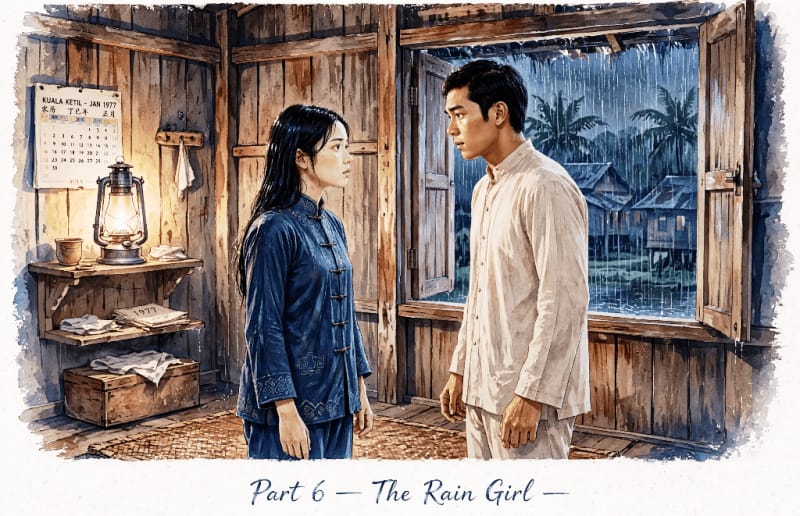
The rain that night in Kuala Ketil didn't fall. It poured in buckets.
Lina told it like she was still hearing it on the roof above her room above Ah Hock's sundry shop, where the wall sweated and cats fought in the back lane. But this was different rain. Penang rain is sea rain, fast and warm and gone. Kuala Ketil rain is paddy rain. It comes from far, from the hills in Baling, and it stays. It makes zinc roofs sing so loud you cannot hear your own father come home. It makes paddy fields disappear, flat water meeting flat sky, no line between.
"The kind of rain where a girl can leave her house and no one hears her bare feet," she said to Arjun.
They were still on the floor of his room behind the bar, the room Mr. Chew gave him in 1977 when he was eighteen with anger folded tight in shirt pocket. Nasi Kandar plates empty on the floor, steel plates stained yellow from kuah campur, fingers washed now, but smell faint still, like memory. Fan clicking every seventh turn same since 1941, same fan Whitby installed when he thought teak was teak but it was Chengal.
It was May 8th, afternoon, after 2:15 queue, after Muthu gave extra cabbage without asking. Outside, Georgetown was hot, 3 PM heat that makes tiles warm and geckos quiet. Inside, cooler, darker, because behind kitchen where Ah Lan pounded garlic since 6 AM.
"I just passed my seventeen birthday," she said to Arjun. Voice plain, not for pity, same voice she used in bar: Table 3 two Tiger beers one without ice.
Old enough to know what she was doing. Young enough to think rain could cover everything. That is seventeen, anywhere, but especially in Kuala Ketil where everyone knows everyone and sky too big to hide under.
Ah Man lived two houses down, with his old grandmother who slept early and deaf, which in village means everyone shouts and grandmother nods.
He was in his late twenties, tanned from sawmill where he worked carrying wood that was heavier than ice, good looking in way village boys aren't — quiet, not loud. In Kuala Ketil, most men were loud because loud was how you proved you were there. Ah Man was quiet, so people noticed.
He lived alone in back room, grandmother front. House on stilts, wood, floor that creaked only if you stepped middle.
"He had liked me since I started wearing the qipao not loose school one," Lina said. She said qipao, but in village they said Cheong Sam, tight at waist, not tight like city, but enough that when you walked to market, men looked.
She liked that he never called her Tsa-bóo or char bor like other men did, words that make girl into thing. He called her Lina, or sometimes nothing, just nod.
"He never touched me when others were around," she said. "That was why I trusted him."
That is how trust starts in village where touching is either grabbing or begging. Not touching when others around feels like respect.
That night, father out drinking. After mother gone a year, cancer three months, house full of air not hers. House full of people telling how to be, even when no people, because walls remember. So she took qipao, not good one, old one that clung when wet, and slipped out like cat. No umbrella. If you carry umbrella, people see you from kitchen window and ask where you going in rain.
Bare feet on mud, rain hammering, zinc roofs singing so loud you cannot hear bare feet. Two houses down is not far, but in rain it is far, because rain makes distance.
Ah Man's door was never locked. In Kuala Ketil, doors never locked because if you lock, people think you have something to hide, which you do, but you pretend you don't. Old grandmother's room dark, sound of coughing, then sleeping again.
His room smelled of joss sticks and wood and rain coming through window that had no glass, only wooden shutters that never shut properly. Bamboo board bed, traditional one his grandpa made, low, rough, made of bamboo strips tied with rattan.
Everyone had one. In hot season, you sleep on it because cool. In rainy season, you put mattress, but Ah Man didn't, because he liked rough.
"He was sitting on the bamboo board bed," she said. "When he saw me totally drenched, hair stuck, qipao sticking to my legs, he lost his words."
Arjun's hand was still in hers on floor between them, open, invitation not claim, yellow and brown stains washed but still faint. He didn't squeeze. He listened the way Chew listened to bottles letting it pour, the way bar listens.
"I didn't say anything either," Lina whispered. "If I had spoken, I would have run back."
So they didn't speak. Rain did speaking. Zinc roof singing, water dripping from eaves into bucket grandmother put for washing, frogs in paddy field that only sing when rain buckets.
He stood up, water dripping from her onto his floor, and hugged her. Not grabbed. Hugged. In village, men either grabbed or begged. This was neither. This was like someone trying to stop shivering that wasn't from cold.
His hands didn't shy. That was thing. That was why she remembered hands, not just rain.
She told Arjun, "In village, men either grab fast or they beg you to let them touch, like you doing them favor. Ah Man's hands were different. Slow. Like he was trying to learn a map he would need later."
She didn't describe map. She said map and left it there, because map is private, and because some things bar remembers in smell, not in words.
She said, "I just surrendered." Word plain, not dramatic, same way she said My room is empty, fact not complaint. "I lay down on bamboo board bed which was rough, you know? It scratches your back. But I liked that it scratched. It meant I would remember."
It was her first time being close to someone not because owed, not because father said daughter should take care, but because she chose to go out in rain with no umbrella. That matters. Choice matters.
Not way city books said, no soft bed, no music. Rain hammering roof, grandmother coughing next room, bamboo board rough on skin, his breath on neck that smelled of clove because he chewed clove for toothache, tea on small table cold.
After, he gave her towel to dry up and made tea. Tea was Lipton, sugar too much, but hot. He said, "You should go before rain stops." So she did. Because rain covering is only covering while raining. When rain stops, bare feet make sound, zinc stops singing, people hear.
A few more times after that, when it rained. She would watch sky in afternoon, paddy sky, and if clouds dark from Baling hills, she would know. She would take not good qipao that clung when wet, no umbrella, two houses down, door never locked, grandmother dark room, joss sticks and wood and rain through window.
Then she realized he liked rain girl, not day girl. When sunny and she passed his house carrying kueh to market, he looked away, or nodded quick, like nod to anyone. Rain girl was secret. Day girl was someone to not see.
"That's why I left Kuala Ketil," she said to Arjun now, in his room that had been his since eighteen, same cot, same mirror cracked same corner, same calendar 1972 pretty girl faded pink, same photo of mother face-up since May 5th. "Not just because of my father. Because I thought if a man only wants you when you are drenched and hiding, you will always be hiding. And I was tired of hiding. In my father's house I hid. In Ah Man's house I hid. I wanted a place where I don't need rain to come in."
She looked at Arjun now, dark eyes almost black in afternoon heat that came through wall even though room cooler.
Arjun lifted her hand, the one with crescent moon scar on wrist from zinc table edge when she fought to get away from father, not from Ah Man, different scar, same wrist, wrist that had held tray with four Tiger beers without spilling even when shaking.
He rolled it between his fingers. No curry stains now, just her, small, strong, sleeves pushed up so people could see she working.
"Here," he said, voice low, rough from lime and smoke and talking less than he listened, "you don't need rain to come in."
Outside, Georgetown still hot, but in small room behind bar that was founded by man who fled in 1941 with leather case and paper that said I LEAVE THIS JOINT TO CHEW with spelling wrong, run by man who stayed forty-two years counting limes, two people who both ran learned how to stay without hiding. Fan kept turning, seven minutes slow, like since 1936, like since 1941, click every seventh turn.
Lina cried then. Not loud. Lina never cried where people could see, but this was room behind bar, door closed, Nasi Kandar plates empty, only Arjun who knew how to listen the way Chew listened to bottles.
She cried not for Ah Man, not for father, but for seventeen-year-old girl who thought rain could cover everything and learned rain only covers while raining, and after you still have to walk home bare feet in mud.
Arjun didn't say sorry. Sorry cheap. He didn't say it will be okay, because okay is lie. He did what Muthu did with last ladle, what Chew did with towel for baby 1963, what bar did with extra cabbage.
He stayed. Hand open on floor, not grabbing.
She put head on his shoulder, which was bony, same shoulder that carried two blocks ice every morning at 7 AM, same shoulder that carried gas cylinders in story his mother told.
"Did you ever go back?" he asked, after rain in story stopped and only Georgetown heat left.
"Once," she said. "After eight months in Penang. I took bus, $8. I went to temple, left incense money for mother. I didn't go to father's house. I saw Ah Man from far at sawmill, carrying wood. He saw me, looked away. Like sunny day. I felt nothing. That was when I knew I was not rain girl anymore."
"Good," Arjun said.
"Good," she said.
They sat until 6 PM, when Ah Lan shouted Hokkien mee ready and Mr. Chew knocked three sharp raps on kitchen door, not counting what missing, but saying dinner ready, which in Chew language means I know you here, I know you stayed.
At dinner, Mr. Chew gave them extra rice without asking, like Muthu gave extra cabbage. Ah Lan gave them extra chili, because Ah Lan shows love with chili.
At 7 PM, bar opened. In daylight, Hotel Malaya Bar was just old wood and peeling paint. At night, with red emergency light on, it was heart.
Muthu's nephew's son, also Muthu, came for drink, not queue, and said, "Today you didn't come at 2:15, I saved stools, you didn't come."
Arjun said, "We ate early."
To be Continued
DISCLAIMER
This work is a work of pure fiction. All characters, names, incidents, dialogues, and locations including Hotel Malaya Bar, Mr. Chew, Lina, Arun, Shankar and all its regulars, staff and patrons are entirely fictitious and products of the author's imagination.
Any resemblance or connection to any actual place, whether still standing today, renovated, demolished, or bombed and destroyed during the Second World War, is purely coincidental.
Any resemblance to any person, whether alive, dead, buried, cremated, or committed to the sea, is also purely coincidental and unintentional.
No identification with actual persons, living or deceased, or with any existing establishment, is intended or should be inferred.
Nganasegaran (tapessam@gmail.com) is a content creator under the Newswav Creator programme, where you get to express yourself, be a citizen journalist, and at the same time monetize your content & reach millions of users on Newswav. Log in to creator.newswav.com and become a Newswav Creator now!
The User Content (as defined on Newswav Terms of Use) above including the views expressed and media (pictures, videos, citations etc) were submitted & posted by the author. Newswav is solely an aggregation platform that hosts the User Content. If you have any questions about the content, copyright or other issues of the work, please contact creator@newswav.com.