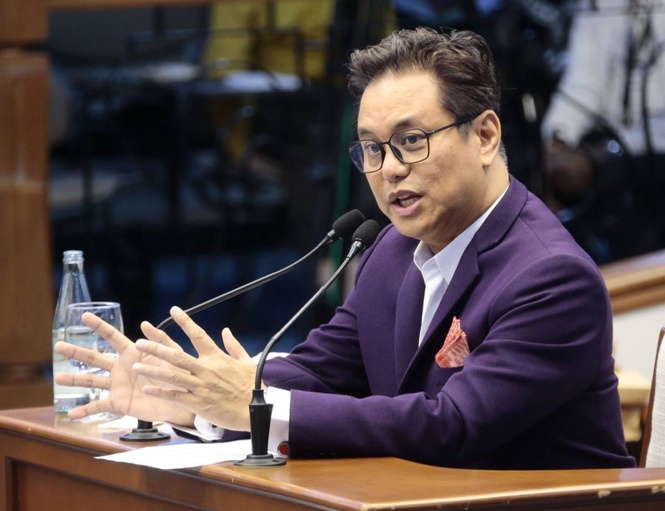
MANILA, Philippines — Forensic financial analyst Alexander Cabrera on Monday challenged Vice President Sara Duterte’s camp to submit documents that could clarify financial transactions involving companies linked to her and her husband, Manases Carpio, as a senator-judge questioned whether corporate funds had flowed into the couple’s personal bank accounts.
“If you’re hiding it, why don’t you show it to the other side?” Cabrera told Senator-judge Joel Villanueva during Monday’s hearing on the 38th day of Duterte’s impeachment trial.
Villanueva asked whether Cabrera had found documentary evidence that funds from companies such as Cale88 Foods Corp. and Gencorp Metro City had been transferred to the couple’s personal accounts, or whether his calculations were based only on their proportional share in the businesses.
Cabrera said he could not confirm whether the alleged unreported funds had entered their individual accounts.
“There are many outflows from the corporation. The problem is, this is all we can see,” Cabrera said, explaining that the records did not identify the sources of some incoming funds or the recipients and purposes of outgoing transactions.
He said a more comprehensive forensic investigation would be needed to trace the money and potentially build a criminal case.
Cabrera stressed that his engagement with the Senate was limited to determining whether Duterte’s wealth was manifestly disproportionate to her declared income, examining her business interests and assessing the accuracy of her statement of assets, liabilities and net worth (SALN).
Villanueva also questioned whether Cabrera’s report had counted Duterte’s personal income twice in calculating the alleged unexplained wealth.
The senator-judge pointed to figures in Bureau of Internal Revenue (BIR) records and Cabrera’s report that appeared to show the same personal income being added again for 2023 to 2025.
Cabrera acknowledged that his team may have counted both compensation income and a combined category covering compensation and business income.
He agreed that this could have resulted in double counting amounting to approximately P14.37 million.
Villanueva asked how the potential duplication affected Cabrera’s estimate of P817 million in alleged unexplained wealth.
Cabrera explained that if the income had been counted twice, the reported amount would be overstated by about P14 million.
He nevertheless maintained that the potential adjustment would not change his broader findings.
Cabrera said his team had handled certain figures conservatively in Duterte’s favor and that correcting the possible duplication would not negate his findings concerning alleged undeclared assets and wealth disproportionate to her income.
Villanueva said his questions were intended to establish the reliability of the report and determine how discrepancies might affect its conclusions.
The senator also flagged differences between two tables in Cabrera’s report presenting corporate income figures for companies linked to Duterte.
He asked Cabrera to explain discrepancies in the figures for 2022 and 2023, particularly those involving Cale88, Metro City and Gencorp.
Cabrera said supporting working papers were available, although he could not immediately identify the figures behind one discrepancy. He committed to reviewing the records and reconciling the differences.
Despite the discrepancies, Cabrera maintained that the adjustments would not change his overall findings.
Cabrera said he had expected Duterte’s camp to submit supporting documents in its answer before the House or during the Senate proceedings.
If the records justified adjustments, he said, he would deduct the relevant amounts from his computation.
“If the P817 million figure is wrong, I will admit it,” Cabrera said, reiterating his willingness to examine additional evidence.
He added that his conclusions would be based on the evidence available to him, without outside influence.
"Not scared"
Cabrera said he was “not scared” of potential violations of confidentiality laws when he received Duterte’s financial records, as the defense questioned whether bank and anti-money laundering documents had been disclosed without authorization from the Senate impeachment court.
During cross-examination Defense counsel Kristine Ferrer cited confidentiality provisions under the Anti-Money Laundering Act (AMLA), the Bank Secrecy Law and the National Internal Revenue Code and asked Cabrera whether he had considered the legal implications of receiving the subpoenaed records.
“When you received these subpoenaed documents, did it ever occur to you that you or the person who provided the documents — the bank officers, the AMLC officers, or the BIR officers — may be violating confidentiality laws?” Ferrer asked.
“I have no concern about that. My only concern is to receive the documents from the prosecution. I have no concern outside of that,” Cabrera said.
Ferrer then cited provisions of Republic Act (RA) 9160, or the AMLA, including restrictions on the disclosure of information by Anti-Money Laundering Council (AMLC) officials and employees, as well as penalties under the law’s amended provisions.
“I will no longer specify the penalties, but it includes imprisonment and a fine. This is not meant to scare you,” Ferrer said.
“I’m not scared,” Cabrera said.
Ferrer pressed Cabrera on whether he was concerned that furnishing him with AMLC documents and related information without authorization from the impeachment court could violate the provisions she had cited.
Cabrera said he believed it was acceptable to receive the documents because the matter had already been discussed in the House of Representatives.
“Because it had already been taken up and debated in the House, I thought it was okay to accept the documents,” he said.
Ferrer also cited Section 2 of the Bank Secrecy Law, which generally protects bank deposits from disclosure, and asked whether Cabrera was concerned about receiving bank documents without authorization from the impeachment court.
Cabrera invoked RA 3019, or the Anti-Graft and Corrupt Practices Act, to explain why he was not concerned.
“I am just explaining why I was not concerned, because bank deposits are covered by the law,” he said.
Cabrera began referring to Section 8 of RA 3019, which provides for the consideration of bank deposits in determining whether a public official’s property is manifestly disproportionate to their income, before Ferrer interrupted him.
Ferrer also questioned Cabrera about the timing of his engagement and his receipt of the financial records used in his examination.
Cabrera said he accepted the engagement in the first or second week of June 2026.
He received Duterte’s Statements of Assets, Liabilities and Net Worth covering 2022 to 2025, along with AMLC documents, that month.
Bank records and documents from the Securities and Exchange Commission and the Bureau of Internal Revenue obtained through subpoenas arrived in September, he said.
Cabrera reiterated that his primary concern was receiving the documents from the prosecution for examination.
Here is the edited copy checked for spelling, grammar, flow, brevity, and AP style compliance: