.png)
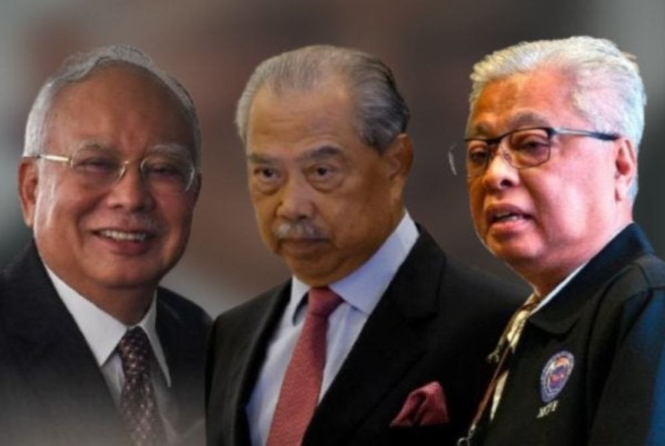
FOUR of the nine individuals who have held the office of Malaysia's prime minister have faced or are currently facing criminal proceedings. At almost half of all those who have held the country’s top political office, the number is significant enough to affect how Malaysia and its institutions are perceived.
Legal expert Haniff Khatri Abdulla said the four individuals are Datuk Seri Anwar Ibrahim, Datuk Seri Najib Razak, Tan Sri Muhyiddin Yassin and Datuk Seri Ismail Sabri Yaakob.
However, he stressed that the cases differ in terms of charges, timeframes and judicial status and should not be treated as proof that all the individuals involved are guilty.
"More than 40 per cent of Malaysia's prime ministers have faced or are facing court proceedings. That's an extremely high percentage.
"That doesn't mean I consider all of them guilty. The legal principle is clear — a person is presumed innocent until proven guilty," he told Sinar Harian.
Malaysia has had 10 prime ministers since independence, although the office has been held by only nine individuals. Tun Dr Mahathir Mohamad served as prime minister twice, first as the fourth and later as the seventh.
Najib was convicted and imprisoned in the SRC International case, while his conviction in the 1Malaysia Development Berhad (1MDB) case is currently under appeal.
Muhyiddin is currently facing trial over serious legal accusations linked to Jana Wibawa, while Ismail Sabri was recently charged with failing to declare his assets to the Malaysian Anti-Corruption Commission (MACC) and pleaded not guilty.
Anwar, meanwhile, has a history of imprisonment before becoming prime minister, including following his conviction in a criminal case during an earlier phase of his political career. He subsequently received a full royal pardon.
Haniff said the bigger question is not merely the political fate of the individuals involved, but also how the string of legal proceedings against the country's top leaders shapes perceptions of Malaysia.
“The stigma isn't just attached to the individual, the family or the political party they led at the time - the bigger impact is on Malaysian society, because it creates a negative image in the eyes of many.
“If a former prime minister or a former deputy prime minister is brought to court, it will be reported around the world,” he said.
He said high-profile cases involving corruption and abuse of power could raise investor concerns over governance and institutional integrity.
“Investors will ask themselves, if they want to invest, what happens if a leader abuses power or does something wrong to a foreign company?
“This worries foreign investors. Investment indices could be affected. The country's reputation could also be affected,” he said.
However, Haniff stressed that the fact that many senior leaders have been brought to court should not be used to conclude that the country's system has failed or that a person is guilty before the legal process has concluded.
Instead, he said, the credibility of the process depends on confidence that the police, the Malaysian Anti-Corruption Commission (MACC) and the Attorney General's Chambers act on the basis of evidence and the law, rather than political pressure.
“Enforcement agencies cannot bring someone to court arbitrarily or without legal grounds, and until the court has made a decision, they cannot be considered guilty.
“The public needs to see enforcement action against any politician, prime minister or former prime minister as being carried out in accordance with the law,” he said.
He added that enforcement integrity becomes even more important when a change in government can create the perception that legal processes are being used against political opponents.
As such, he said, prosecutorial power needs to be exercised with wisdom and integrity, with the public interest as the main consideration.
“Becoming attorney general isn't just about being good at law. You need wisdom. It's not just about being clever - you need to be wise.
“Second, you need integrity. Don't use the powers of the attorney general, the police or MACC against former political leaders simply because of orders from above,” he said.
He stressed that, ultimately, the court remains the institution that determines whether a person charged with an offence is guilty.
“It's the court that will determine whether a person is guilty or not once the trial concludes,” he said.