Authorities in Nepal on Sunday warned of possible fresh flooding, urging people in areas devastated by last week’s flash floods to remain on high alert as mountain rescue specialists more usually deployed to assist climbers on Himalayan peaks joined the search for hydropower workers trapped in tunnels.
The warning came after Chinese authorities alerted Nepal about surging water flow upstream in the Bhotekoshi river, Dharam Raj Uprety, chief of the National Disaster Risk Reduction and Management Authority, told the Associated Press.
The warning also came as survivors in displacement camps braced for another crisis of medicines and water running short.
The combined death toll from the disaster in Nepal and China rose to 908 on Monday, with more than 3,000 people still missing.
At least 590 foreign nationals from 39 countries are missing in Nepal after the devastating flood that struck the Himalayan nation last week, the Nepali foreign ministry said on Monday. So far, 323 foreign nationals have been rescued, spokesperson Lok Bahadur Chhetri said.
Chinese authorities reported 16 people dead and 546 missing on their side of the border in Tibet. The missing include, according to local reports, about 100 Nepalis, 49 Indians, 43 Australians, 33 Latvians, 18 Americans, and 15 Britons.
President Xi Jinping, on a state visit to Kyrgyzstan, said China was making every effort to search for the missing people.
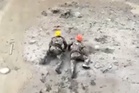
In Nepal, army rescuers drilled into a mud-filled tunnel at the Trishuli 3A hydropower project over the weekend, breaking through far enough to begin pumping in air and lowering a camera to where nearly 100 workers were believed to be trapped.
“We have already started sending air through the small opening and we will now begin excavation work and send the rescue team inside,” home minister Sudan Gurung said.
The trapped workers are among 933 people employed at hydel projects who remain missing, according to the National Disaster Risk Reduction and Management Authority, with rescue efforts also focused at the Trishuli 3B site.
The prime minister's office said rescue teams faced "continuous rainfall and difficult conditions" but worked nonstop, "making tireless efforts to search for and rescue those who may be trapped”.
Specialised tunnel-rescue teams from India and China joined the operation at Trishuli 3A site over the weekend, alongside Nepal's mountain rescue specialists, who were also deployed to another damaged hydropower site.
The Himalayan country, meanwhile, began mass burials of unidentified flood victims, whose bodies were swept away in the floods.
Authorities in Chitwan district dug up hundreds of graves in the Devghat forest for bodies that were decomposed beyond identification.
“We were left with no other option and had to take this step. Our concern was the risk to public health posed by the rapid decomposition of the bodies,” said Ganesh Arya, chief district officer in Baratpur, the Chitwan headquarters.
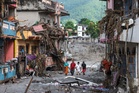
In the town of Galchhi, a group of people sought higher ground on a nearby bridge and watched the river roar past, pointing to boulders that had been washed downstream during the flash floods.
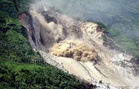
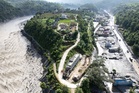
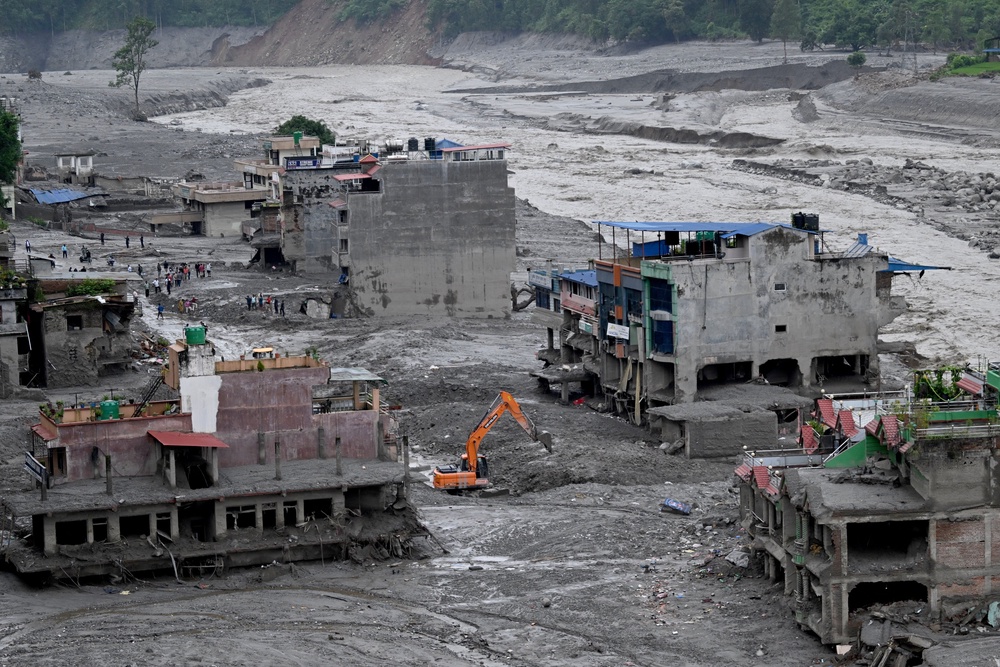
Homes, vehicles, and tractors were seen jutting from the thick grey-brown sediment that enveloped villages in the worst-hit areas and rice terraces along the riverbank lay collapsed into the water after landslides.
People in the affected villages said the repeated alerts were taking a toll of their own. "Sometimes they say a flood is coming, then we’ve to run again to higher ground, even at night. There is also rain," Govind Shreshta, a local resident, told the Associated Press.
"It's really difficult for me. I have a 72-year-old father and 70-year-old mom. I must carry them and I am exhausted. It's going on like this for those who are still alive."
Sattan Singh Tamang, 47, who was working near a bridge when the flash floods struck, described communities now cut off from one another after crossings were destroyed.
"Those that are there are now stuck there. Those who are here are stuck here," he told the news agency. "It's going to be very difficult."
Homes and businesses left standing were still without electricity on Sunday, with twisted power poles and tangled wires left lying in the mud.
The Nepal Electricity Authority said that 11 hydropower stations and one solar power station, with a combined capacity of 431MW, had stopped operating, representing about 10 per cent of the nation’s installed generating capacity. A further 15 power projects under construction, with a combined planned capacity of 470MW, were also damaged.
The Prithivi highway, a crucial supply route for food and fuel entering Kathmandu, remained mostly operational, though sections still required repair.

In Dhading, one of the worst-hit areas, some residents started returning to ruined homes on Sunday to see what could be salvaged.
Residents sat in homes with walls washed away by the floods, shovelling sludge-like mud and rubble off balconies or window frames. One man had returned for his chickens, which he found alive. He tied them up and put them in the cabin of his truck.
“Everything is finished,” said Sharmila Tamang, a Dhading resident who was trying to salvage anything that could be saved. “Nothing is left. Not even our home.”
In displacement camps, many survivors with long-term illnesses are forced to power through without adequate medical care or medications for diabetes, high blood pressure and thyroid diseases.
Raghubir, identified by his first name, told the Kathmandu Post that his sister-in-law went into labour while sheltering at the camp.
Trishuli Hospital could not handle the delivery, and after repeated appeals, she was airlifted on Saturday morning to the Paropakar Maternity and Women’s Hospital in Kathmandu.
At a displacement camp in Kolani, another flood victim Kopila Pariyar said her 62-year-old mother with asthma, had been without medications since the disaster, as the family continued to struggle with basic necessities.
“My mother has asthma and needs two or three medicines, but we have not been able to get all of them,” she told the Nepalese outlet. “There is no drinking water in the camp and we cannot even buy bottled water. We have no money, no clothes and there is almost nothing to buy in the Kolani market.
Doctors fear poor sanitation facilities and water shortage may trigger disease outbreaks in crowded camps.
Read More‘Miracle house’ that stood firm as floods wrecked Nepal becomes symbol of survival
Anxious families wait as rescuers try to reach over 900 missing in Nepal’s tunnels
Fifteen Britons among 261 foreigners missing in China after floods
Taliban minister says mineral-rich Afghanistan open to US investments
Pakistan to award nurse for risking her life to save newborn from hospital fire
No missing Britons among the hundreds rescued after Nepal flash floods