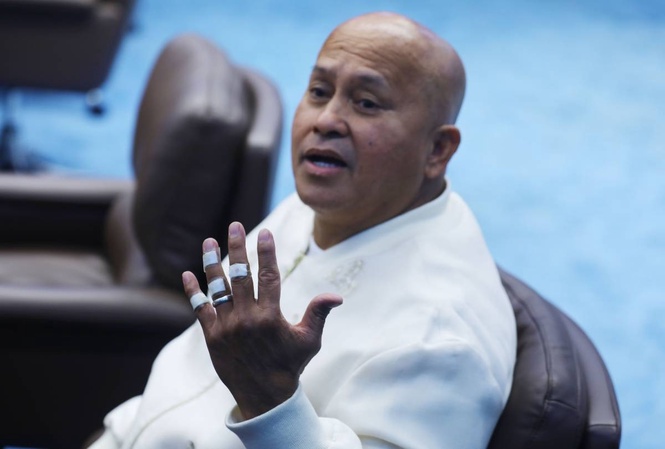
AN all-out police manhunt has been launched for Sen. Ronald dela Rosa after the deadline for his surrender lapsed on Friday.
The Philippine National Police (PNP) has formed tracker teams in all regions to arrest the fugitive lawmaker, Lt. Gen. Wilson Lopez, chief of the PNP’s Directorate for Intelligence, told in a press briefing at Camp Crame.
Lopez also said the PNP’s hotlines have been swamped with information on dela Rosa’s supposed whereabouts since the government offered P50 million for his arrest. He said each piece of information will be evaluated.
Lopez also said the PNP is still validating reports that dela Rosa is under the protection of a private armed group in Mindanao.
He said the senator has never sent surrender feelers to the government.
Lopez said the PNP’s latest information is that dela Rosa is still in the country, debunking reports that he has escaped through the country’s southern backdoor.
Dela Rosa is the subject of an arrest warrant from the International Criminal Court (ICC) that alleges he is a co-perpetrator in the Duterte administration’s controversial crackdown on drugs.
Malacañang on Thursday said dela Rosa’s world is “shrinking.”
Lopez agreed. “Alam niyo kapag may binigay na bounty na P50 million the possibility maraming tao ang pwedeng tumawag ang posibleng lokasyon (When a P50 million bounty is offered, there’s a strong possibility that many people might call in with potential locations),” he said.
In a related development, the ICC has transmitted applications involving 100 individuals seeking to participate as victims in the trial of former president Rodrigo Duterte.
In separate documents dated Oct. 28, the ICC Registry transmitted 46 applications covering 96 applicants classified under Group A and four applications classified under Group C to Trial Chamber III, which is hearing the case against Duterte.
The Group A applicants were assessed as clearly qualifying as victims under the court’s procedures, while the four Group C applications involve applicants whose eligibility the Registry could not clearly determine.
The transmissions were made pursuant to an oral instruction issued by the chamber during a status conference on May 27, 2026, and follow the ICC’s A-B-C approach to processing applications for victim participation.
The Registry’s classification assesses the applicants’ eligibility and does not, by itself, constitute a final judicial determination on every application.
Under the A-B-C approach, Group A covers applicants who clearly qualify as victims, Group B those who clearly do not qualify and Group C those whose eligibility cannot be clearly determined.
The system allows the court to distinguish applications that can be assessed more readily from those requiring further consideration.
The Registry classified the annexes accompanying the 46 Group A applications as confidential and available only to the Registry.
The four Group C applications were transmitted with annexes in a confidential version available only to the Registry and a confidential redacted version.
The Registry said two of the four applications contained forms completed in Tagalog, with English translations.
Because it lacked the capacity to apply word-for-word redactions to the Tagalog text in each application, the Registry redacted in full the portions completed in that language.
The public documents did not identify the applicants or disclose details of the incidents underlying their applications.
The Registry’s assessment of the Group C applications leaves their eligibility for victim participation subject to further consideration under the court’s procedures.
The victims’ participation in a trial is a feature of ICC proceedings that allows them to present their views and concerns through legal representatives.
Victims who are allowed to participate are not automatically prosecution witnesses.
Duterte faces charges of crimes against humanity in connection with killings linked to his administration’s antidrug campaign and alleged killings in Davao during the period covered by the case. He denies the allegations.
The ICC has scheduled the start of Duterte’s trial for Nov. 30 in The Hague, the Netherlands, where he has been detained since his arrest in March 2025.
On Friday, the Truth Commission investigating the killings during Duterte’s war on drugs called on the Professional Regulation Commission (PRC) and the Philippine Medical Association (PMA) to look into the “mis-certification” by medical doctors of the death certificates of several drug war victims.
“A death certificate is the official record of how a life ended. When it names the wrong cause, it can hide the violence and skew the country’s death statistics. It can also block a family’s search for the truth,” the commission said in a statement.
The victims’ families provided death certificates issued by five doctors, citing that the victims died of illness.
The commission said that the death certificates of at least 13 drug war cases cited either pneumonia or heart attack, despite forensic findings attributing their death to gunshot wounds.
It said the “mis-certifications” could just be the tip of the iceberg.
“These questionable certificates blame illness for at least 13 deaths but forensic findings in every one of these cases show the victims had been shot,” the commission said.
The commission is also asking the authorities “to correct the erroneous certificates so that families have an accurate record of how their relatives died.”
The panel has reviewed 13 cases from Caloocan City and Quezon City, which recorded 11 deaths in 2016 and two in 2018.
“The death certificates list pneumonia as the cause of death in six cases and heart attack in four. Of the remaining three, one cites sepsis and another high blood pressure. The last records a stroke with bleeding, along with high blood pressure,” the commission said.
Forensic pathologist Dr. Raquel Fortun, who also serves in the commission, said there were gunshot wounds in every case.
“Families deserve accurate death certificates, and the public deserves an honest account of how these men and women died,” commission chairman Raul Pangalangan said.
The doctors named by the commission included Caloocan Health Department medical officer Dr. Amadea Cruz, private physician Dr. Kathleen Timogan, Dr. Arnold Montero, Dr. Ramil Razon and Torres-Bugallon Health Center medical officer Dr. Leonilo Aquino.
The commission said naming these doctors is a call for investigation and not a finding of guilt.
“Given that these documents were produced during the ‘drug war,’ the commission is also cognizant of the possibility that the doctors may have been forced to fabricate information in the certificates, making them, in effect, victims of the ‘drug war’ themselves,” it said.
However, the commission said that the fact that they signed the questionable documents “warrants scrutiny and discipline based on due process.”
The commission called for the correcting of certificates by the Philippine Statistics Authority, the investigation of the doctors and the certification process by the PRC Board of Medicine and the PMA’s ethics committee on who is responsible, and protecting the evidence and checking of other cases.
The commission was established last May by civil society organizations and church groups.