Gas boilers have been the main sources of heating in UK homes for decades, and despite the growing popularity of alternatives, such as heat pumps, around 85 per cent of households still rely on gas to keep warm.
But with energy bills an ongoing concern for many and government incentives encouraging homeowners to switch to greener alternatives, it’s worth considering whether a heat pump could be a better long-term investment than a traditional gas boiler.
Heat pumps have the potential for greater energy efficiency and lower carbon emissions, but they typically cost more to install than a gas boiler and aren’t necessarily always cheaper to run. Gas boilers, on the other hand, remain a familiar and often more affordable option, particularly when replacing an existing system.
Which is the better choice for your home? Here we compare heat pumps and gas boilers on installation costs, running expenses, energy efficiency and practicality, to help you decide which heating system makes the most sense.
What is a gas boiler?
A gas boiler burns natural gas to heat water, which is then circulated through radiators or underfloor heating. Modern condensing boilers are far more efficient than older models, capturing heat that would previously have been lost through the flue.
A modern condensing boiler typically operates at around 85-90 per cent efficiency in real‑world use, depending on how it’s set up and used. Condensing boilers became mandatory in the UK in 2005, while in 2018 the Boiler Plus rules increased efficiency standards so that new boilers must be A-rated with a minimum efficiency rating of 92 per cent – but this is the rated figure, and real-world efficiency can be slightly lower.
Gas boilers are relatively inexpensive to install (at least compared to some heat pumps), familiar to most households and capable of delivering high temperatures quickly, which helps explain their continued popularity.
Most gas boilers last 10 to 15 years with regular servicing, after which replacement becomes increasingly likely.
What is a heat pump?
A heat pump doesn’t burn fuel. Instead, it extracts heat from the environment and raises its temperature for use in heating and hot water systems.
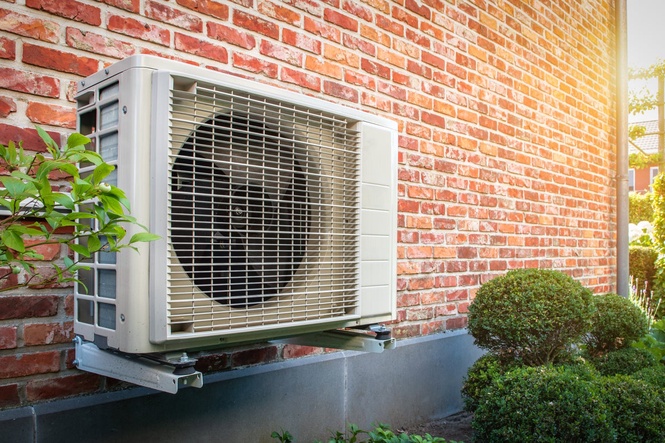
Most UK installations are air source heat pumps, which draw heat from the outside air via a fan unit installed outside the home. These systems work year‑round, even in cold weather, and are generally the most practical option for existing homes.
Ground source heat pumps work on the same principle but extract heat from the ground via buried pipes. They can be more efficient, especially during colder weather, but usually require a large garden or access to land for horizontal trenches, or deep boreholes drilled into the ground. This makes them more expensive and far less common in typical UK housing.
As a result, when most households talk about “getting a heat pump”, they are referring to an air source system.
Heat pumps are also highly efficient. The Energy Saving Trust and the International Energy Agency both state that air source heat pumps typically deliver three to four units of heat for every unit of electricity used – often described as 300-400 per cent efficiency, although performance varies with outdoor temperature, flow temperature and system design.
That doesn’t mean heat pumps produce more energy than they consume – rather, they move heat instead of generating it. This fundamental difference explains why electricity‑powered systems can still be cost‑effective, despite higher unit prices.
Heat pump vs gas boiler: Installation costs and grants
The upfront cost is one of the biggest differences between replacing a gas boiler and installing a heat pump.
According to the Energy Saving Trust, a like-for-like gas boiler replacement typically costs £3,500, which is the cost of replacing an old and inefficient G-rated gas boiler with a new A-rated model, including thermostatic radiator valves. Those valves automatically regulate room heating by sensing the ambient temperature and adjusting hot water flow to each radiator accordingly.
The total cost will depend on the boiler type and whether any pipework or controls need upgrading. But for many homes the work is straightforward, particularly if the existing system is in reasonable condition.
By contrast, the Energy Saving Trust says an air source heat pump usually costs around £12,000 installed before grants. The higher price reflects not just the unit itself, but the complexity of the installation. Heat pumps often require upgrades to radiators, changes to pipework and more time on site to design and balance the system properly.
In England and Wales, the Boiler Upgrade Scheme currently offers grants of up to £7,500 towards the cost of an air source heat pump, significantly reducing the upfront difference compared to a gas boiler. Homeowners in Scotland might also be entitled to an interest-free loan or a grant of up to £7,500.
While the grant can significantly lower the basic installation price, homeowners may still face additional costs if insulation improvements or electrical upgrades are needed to accommodate an air source heat pump.
It’s also worth noting that quotes can vary widely. Installer experience, property layout and regional labour costs all play a role, which is why independent assessments and multiple quotes are strongly recommended.
Is it cheaper to run a gas boiler or heat pump?
Although heat pumps are significantly more energy-efficient than gas boilers, that doesn’t necessarily make them cheaper to run. Electricity costs more per unit than gas, meaning the savings depend on the efficiency of the heating system, the property’s insulation, the energy tariff used, and whether solar panels are installed.
For example, data published by Octopus Energy shows that providing heating and hot water for a medium-sized UK home with a gas boiler costs approximately £582 a year, compared to £573 for one of its Cosy heat pumps on a standard variable electricity tariff. Switching to the company’s Cosy tariff reduces the estimated annual heat pump running cost to £468.
These figures are specific to Octopus Energy’s own heat pumps and tariffs, but demonstrate how energy prices can affect running costs. Gas standing charges are excluded from this comparison. Households could avoid those entirely if they switched to electric heating and disconnected their gas supply.
Insulation can have a significant effect on the running costs of both gas boilers and heat pumps, since any heat generated will be lost more quickly in a poorly insulated home. Homes with good insulation and correctly sized radiators and/or underfloor heating systems are better placed to see lower running costs.
Gas boilers can still be cheaper to run in some circumstances, particularly where a heat pump would struggle to achieve high enough efficiency or where electricity tariffs are less favourable. Heat pumps can become less efficient when undersized radiators require hotter water to keep rooms warm, or when outdoor temperatures are particularly low.
Can a heat pump replace a gas boiler?
In most cases, yes, but not always without changes to the home. Heat pumps work best in well-insulated properties with appropriately sized radiators or underfloor heating, as they deliver heat at lower temperatures than gas boilers.
Some homes may need insulation upgrades, radiator replacements, or both before a heat pump can operate effectively. Older or poorly insulated properties can still use heat pumps, but installation is more complex and costs tend to be higher.
You can use an online BTU (British Thermal Unit) calculator to work out what size, specification and quantity of radiators each room of your home needs to be heated correctly.
Which saves the most money in the long run?
Over the long term, heat pumps have the potential to be cheaper, particularly as gas prices fluctuate and the UK moves towards lower-carbon electricity.
Vaillant, a boiler and heat pump manufacturer, says with regular servicing a well-designed and installed heat pump should last over 15 years, and that a new gas boiler can also last for 15 years or more. Nibe, another heat pump company, says the typical lifespan is 20 to 25 years with proper maintenance.
Government grants significantly reduce upfront costs, and future policy changes could favour electric heating over fossil fuels. While savings are not guaranteed for every household, homes that are well-suited to heat pumps are more likely to see long-term financial benefits.
Carbon impact and future‑proofing
Burning gas for heating produces carbon dioxide at the point of use. Government conversion factors show that gas heating emits roughly 200g to 215g of CO2 per kilowatt-hour (kWh) of gas consumed.
Heat pumps produce no direct emissions in the home. According to Octopus Energy, switching from a gas boiler to a heat pump can reduce a home’s heating-related carbon emissions by approximately 82 per cent, based on typical household energy consumption and heating system efficiency.
While there’s no ban on the use or installation of gas boilers in existing homes, new-build properties in England will be required to use low-carbon heating from March 2027 under the Future Homes Standard, effectively ruling out gas boilers in those homes. Transitional arrangements mean some developers can continue using them after that date.
Which homes suit a heat pump?
Heat pumps are not a one-size-fits-all solution. Homes with EPC ratings of C or above are generally better candidates, as good insulation reduces heat loss and improves efficiency.
Larger radiators or underfloor heating help heat pumps operate at lower temperatures, while outdoor space is needed for the external unit. Ground source systems are usually limited to rural or larger properties, while air source heat pumps can be installed in a much wider range of homes, provided insulation and space requirements are met.
In some cases, improving insulation first can deliver immediate savings, regardless of the heating system.
One potential surprise for homeowners is that a heat pump doesn’t necessarily improve a property’s Energy Performance Certificate (EPC) rating. Under the traditional EPC methodology, ratings are heavily influenced by estimated energy costs. Because electricity is more expensive per unit than gas, even a highly efficient heat pump can sometimes result in a lower EPC rating than a less efficient gas boiler.
Which homes suit a gas boiler?
Gas boilers are far more forgiving, which helps explain why they remain the dominant heating system in the UK.
They can work effectively in older or less well-insulated homes, where higher flow temperatures are needed to heat rooms quickly. Properties with smaller radiators, limited outdoor space or irregular heating patterns, such as homes that are heated in short bursts rather than continuously, are often better suited to gas boilers.
Gas boilers can be easier to install in flats and terraced homes where outdoor space is limited, and typically require fewer changes to existing pipework and radiators. For households replacing a failed system quickly, a like-for-like boiler swap is usually the least disruptive option.
That said, even homes that suit gas boilers today may still benefit from insulation upgrades, improved controls or smarter heating schedules, which are cost-effective measures that can cut energy use regardless of the system in place.
Disruption, noise and everyday use
Replacing a gas boiler usually only takes one to two days. Installing a heat pump can take up to five days, particularly if radiators or pipework need upgrading.
Modern air source heat pumps are quieter than many people expect. Certification standards indicate outdoor units typically operate at 40-60 decibels, which is comparable to background conversation.
Day‑to‑day use is also different. Heat pumps work best when left running steadily, rather than being turned on and off for quick bursts of heat.
Living with an air source heat pump: First-hand experience
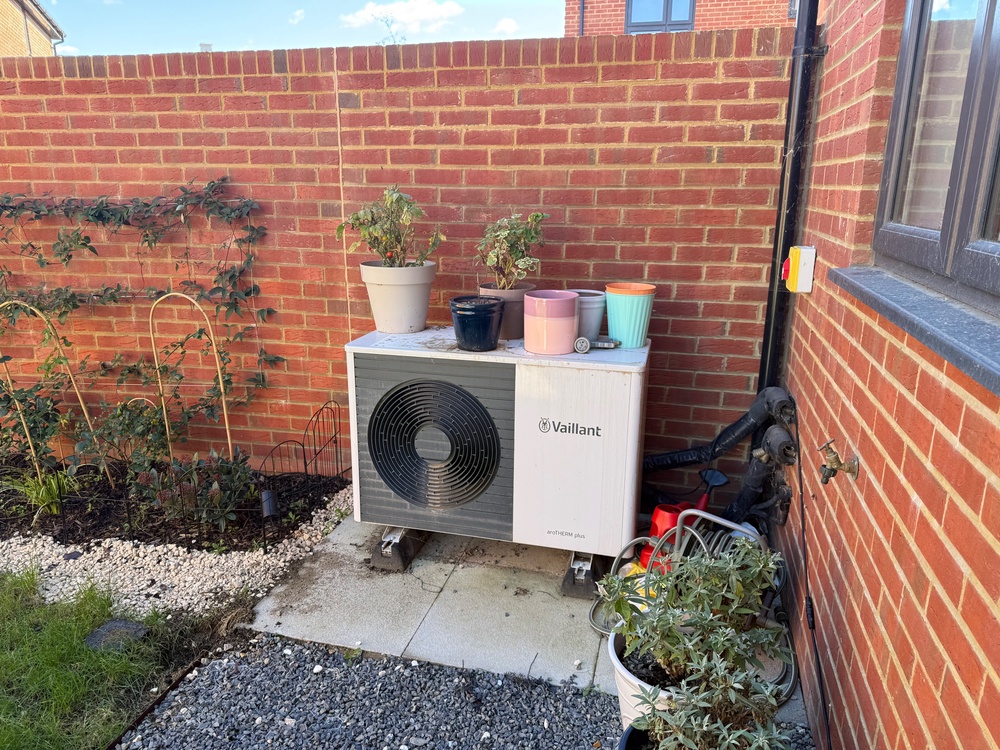
I’ve lived with an air source heat pump in my new-build house for the last 12 months. It’s located on the patio and warms water that is used for underfloor heating on the ground floor, radiators on the first floor, and our hot water.
We had moved from a Victorian flat with an ageing boiler and poor insulation. The first major difference is how the air source heat pump works at its best when left alone. No more constantly turning the heating on and off as required, or worrying that leaving it on for too long will result in a big bill.
These systems generally work more efficiently when set to a target comfortable temperature and left alone all through the colder months. We then significantly lowered the target temperature throughout the house in the spring and summer, since we discovered that a breeze through an open door can cool a wall-mounted thermostat and cause an unnecessary call for heating.
Air source heat pumps like mine are less capable of providing instant heat. If you wake up cold and crank up the thermostat, hot water won’t immediately flow to the radiators. It’s a more gradual change than that, and furthermore, our system is programmed to prioritise hot water for morning showers, so that task is completed before the radiators get a top-up of hot water.
Our heat pump is installed in a corner of the garden. The front vents cannot be fully covered, but slatted wooden structures can be bought to partially enclose the unit and soften the industrial aesthetic, provided they don’t restrict airflow. The unit runs quietly, gently humming when working as the fan spins, pushing out cold air across the patio. It feels like air conditioning, which can create quite a pleasant breeze when it’s working on an especially hot day.
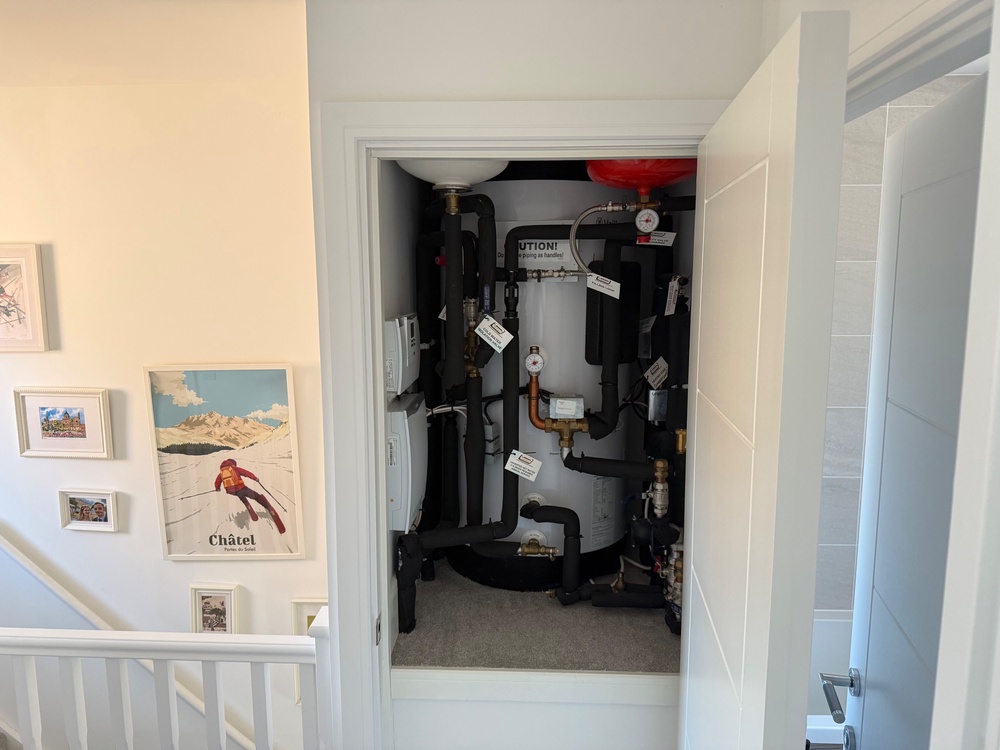
There’s an entire cupboard upstairs, dedicated to the system. It’s rather complicated, but everything is labelled and there’s never any need to do anything here when the heat pump is working correctly.
Overall, the system has worked well once we’d got over the initial learning curve. We have an electric car and an EV tariff, so the cheaper overnight electricity can be used to run the heat pump as well as charge the car.
What are the pros and cons of heat pumps vs gas boilers
Pros of heat pumps
- Heat pumps produce no direct emissions in the home and, according to the Climate Change Committee, typically generate significantly lower carbon emissions than gas heating – a gap that will widen as the electricity grid continues to decarbonise.
- Because heat pumps move heat rather than generate it, a well-designed system can deliver three to four units of heat for every unit of electricity used. In well-insulated homes, this can translate into lower overall energy demand.
- Heat pumps align with the long-term direction of UK energy policy. While existing gas boilers are not being banned, low-carbon heating is expected to play a growing role in domestic energy systems.
- With fewer moving parts and no combustion, heat pumps generally require less ongoing maintenance than gas boilers.
Cons of heat pumps
- Even with government grants, heat pumps typically cost more to install than a like-for-like gas boiler replacement. Additional upgrades to insulation or radiators can add to the overall cost.
- Heat pumps work best in well-insulated homes with low heat loss. In poorly insulated properties, performance and running costs may be less favourable.
- Heat pumps are designed to run steadily rather than provide short bursts of high heat. This can require changes to how households use their heating.
- Air source systems need space for an outdoor unit, while ground source systems require significant land access, limiting suitability for some homes.
Pros of gas boilers
- Gas boilers are generally cheaper to install, particularly when replacing an existing system. For households facing a sudden breakdown, a boiler swap is often the quickest and least disruptive option.
- Gas boilers are highly adaptable and can perform effectively in older or less well-insulated properties where higher flow temperatures are needed.
- Boilers provide rapid heat and hot water, and most households are already familiar with how they operate.
- There is an established network of Gas Safe engineers across the UK, making installation and servicing straightforward.
Cons of gas boilers
- Burning gas produces carbon dioxide at the point of use, making gas boilers a higher-emission option compared with heat pumps.
- Running costs are closely tied to gas prices, which have fluctuated significantly in recent years.
- While gas boilers remain widely used, they are not considered a long-term low-carbon solution, particularly in new homes.
- Most gas boilers last 10-15 years, after which replacement is typically required.
Gas boiler or heat pump: How to decide
Choosing between a gas boiler and a heat pump comes down to your answers to a few key questions:
- How well insulated is your home?
- Are you replacing a broken system now, or planning ahead?
- How long do you expect to stay in the property?
- Are you willing to make changes to radiators or heating habits?
For many households, the best choice will depend on the property’s suitability, the upfront installation cost and the likely running costs over the years ahead.
The bottom line
Gas boilers remain a practical and affordable option for many homes, particularly in the short term. Heat pumps, meanwhile, offer lower carbon emissions and the potential for long‑term savings – but only when installed in the right property and used correctly.
Before deciding, it’s worth looking at the whole picture: insulation, heating controls and tariffs matter just as much as the technology you choose.
Read MoreHow much energy and money do heat pumps really save?
How to choose the best heat pump for your home, according to an expert
What are heat pumps and could they help your home save energy?
8 budget-friendly ways to heat your home during a cold snap
Are heat pumps worth installing in your home? The Independent’s guide
How long solar panels actually last on a typical UK home as fuel prices soar