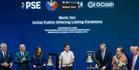
THIS is a capital markets public service. I was rather amused by some journalists opining and speculating on GCash’s share price closing on Day 1 at P6.60, or at offer price, and on Wednesday at P6.59. They are missing something critical that, in fairness, while it is standard industry practice, is not well-known outside the international side of the industry. This article is being sent on Thursday morning, so I don’t know GCash’s closing price on Thursday. I think the opining misses the main point, which is the “greenshoe” or overallotment option.
They speculate on whether the price will hold at the offer price and whether buyers will materialize. I got news for them: new institutional buyers will not materialize in the first few days or even weeks of trading if the stock is trading near, at or below the offer price. Why? Because that price means it is not a hot issue post-listing. That is even though GCash is a very good company with excellent shareholders. That is different from, is it an attractive stock to purchase today? With a flat stock price, a buyer has the luxury of waiting to see where it settles then decide whether, when and how much to buy. Contrast that if it traded decently above offer price, then it is a hot issue that buyers will want to get their position in before it moves higher.
What are potential buyers waiting for with a stock that is trading flat to its offering price? How much selling there is? How do they determine that? Watching the sell volume and if they can find out, who is selling? How do you make an educated guess on the latter without direct access to the trading book? The lot size on offer and which brokers are handling it. If the volume and lot sizes are medium or large, it is probably an institution even if they are trying to disguise the total. If small, then probably an individual order. If a lot of the buying is by the stabilization agent, it may be the greenshoe and not new buyers or existing adding to their position.
If institutions are largely the sellers, then who are the buyers? That is where I wish those financial journalists brushed up on industry practice or, at worst, asked someone in the know (not necessarily domestic investment bankers or brokers who might not understand the greenshoe). What is going on and who are buying the shares and at what price?
Look up “greenshoe,” which is also called the overallotment option and if the stock trades badly, the stabilization fund. Any real international investment banker, equity capital markets professional or institutional broker knows what this is. When I was at a major American investment bank, a managing director they hired from JP Morgan was subsequently let go, as he couldn’t even explain the very simple greenshoe properly to a client. The feeling was, if he was too dumb to get even this most basic of equity capital options, he did not belong at a major investment bank and rightly so.
Here is what a greenshoe is. It is the only United States Securities and Exchange Commission-sanctioned market stabilization measure and is pretty common in international equity deals, especially IPOs. It was first done in 1960 when the Greenshoe Manufacturing Co. listed in the US, hence the name. Up to a 15-percent greenshoe, or overallotment option, is allowed. Let’s give an illustration. Assume we have a $1-billion IPO. The international underwriters can place $1.15 billion worth of shares even though they have $1 billion to sell.
What happens after depends on how the stock performs. If it trades above offer price, all is good and at the end of the greenshoe period, which is a maximum of 20 trading days or a month, the underwriters get an additional 15 percent or in this example, $150 million to cover their short. So, with the overallotment option the deal is upsized to $1.15 billion. If it trades at or below the offer price then the stabilization agent (usually one or more of the lead international underwriters) buys stock and covers the short of the international underwriters from the greenshoe or overallotment. If the price performance is weak, they may use all or part of that 15 percent, in this case at P6.60 or lower.
If the stock trades above then at the close of the stabilization period, they exercise the “shoe” or overallotment portion and get the additional shares. If it trades at offer price or below, they may end up using all part of the 15 percent to stabilize the stock. If they use less than the 15 percent, the issuer provides the balance at the end of the period.
First, understand a greenshoe is not market manipulation but stabilization. The stabilization agent, usually one or two of the lead international underwriters, can only buy stock and cover their short at offer price, in this case P6.60, or lower. To buy above is market manipulation, and besides, the stabilization agent and underwriters will be losing money as they will be covering their short at P6.60 at a higher price. This is disclosed in the prospectus and standard international practice in international placings precisely for this purpose, to stabilize the price at offer price in their immediate post-listing period, which is the most fraught and unstable point.
To followers of GCash stock who may be waiting for an opportunity to buy, what should you look for? The cumulative total volume. If it exceeds 15 percent of the shares offered at the IPO or offering and the volume stays high, then the stabilization fund or greenshoe might be fully used up and the stock may end up even lower after the stabilization period of 20 trading days is over. If not all of the 15 percent is used, then it has stabilized at least in the short term, and the effort worked. If you like the stock, it is a decent entry price as the selling has dried up, and the weak hands who want out are probably done.
Smaller additional point, see if the stabilization agent allows the stock to trade below P6.60 for extended periods and volume. It means they are not too confident the 15 percent is sufficient or (and I am not accusing GCash’s stabilization agent of this, but it has happened with less scrupulous ones) they may want to make a little money as they are covering their short, which in this case is at P6.60, below that. Based on the first two days, I do not see that as they are covering their short and stabilizing at P6.59 and P6.60. So, watch volume at P6.60 and below, and you have a good gauge of what may be next.
The author is an independent director of the state-run Maharlika Investment Corp.