
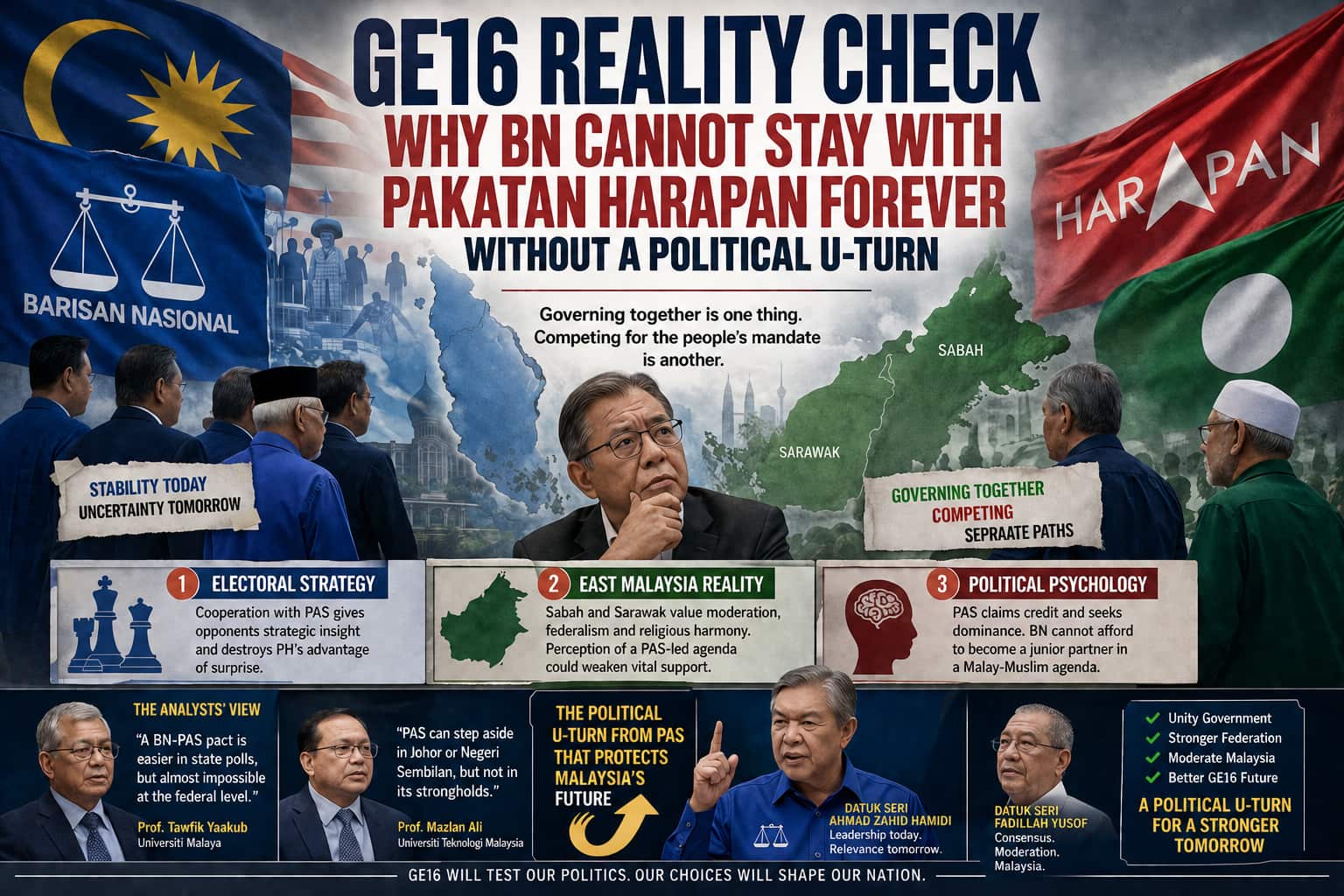
The growing electoral cooperation between Barisan Nasional (BN) and PAS has reignited debate over whether BN can realistically remain in the Unity Government with Pakatan Harapan (PH) all the way to the 16th General Election (GE16).
While the current administration has delivered political stability after years of uncertainty, many political observers argue that governing together and contesting elections together are two very different propositions.
Among those raising doubts is Dr. Phar Kim Beng, Professor of ASEAN Studies at the International Islamic University Malaysia, who believes the assumption that BN and PH can maintain their current political understanding without disruption until GE16 deserves much closer scrutiny.
According to Phar, the Unity Government was formed out of necessity to restore stability, but election campaigns operate under entirely different political dynamics. Coalitions that work together in government often become rivals once the contest for votes begins. In his view, three major structural realities make it increasingly difficult for BN and PH to remain politically aligned until GE16.
The first concerns electoral strategy. Successful election campaigns depend on organisation, timing and, most importantly, strategic surprise. If BN simultaneously maintains close electoral cooperation with PAS while remaining inside the Unity Government, PH risks exposing its campaign strategies and political calculations to an opposition that includes PAS.
Phar argues that PH's primary electoral challenge is not BN but PAS under Tan Sri Abdul Hadi Awang, whose political approach remains firmly rooted in conservative Islamist politics. Should PAS gain indirect access to the government's electoral planning through BN, PH would lose one of its biggest competitive advantages during a general election.
What works as a governing arrangement today, he suggests, could become a serious electoral liability once campaign season begins.
A second challenge lies in East Malaysia, where Sabah and Sarawak have become indispensable kingmakers in federal politics. No coalition can realistically form the federal government without strong support from the two Borneo states.
However, political values in Sabah and Sarawak differ significantly from those promoted by PAS. Leaders from both states have consistently defended moderation, constitutional federalism and religious harmony. Issues such as the long-standing use of the word "Allah" by Christian communities illustrate the cultural and religious differences between East Malaysia and parts of Peninsular Malaysia.
Any perception that BN is moving closer to a PAS-led political agenda could therefore create discomfort among East Malaysian leaders and voters, potentially weakening the partnership that currently underpins the Unity Government.
The third obstacle is political psychology.
Following BN's landslide victory in the Johor state election, PAS quickly claimed credit for helping deliver the result. Such assertions reinforce concerns that PAS increasingly portrays itself as the dominant force within any political partnership.
Phar believes that if this narrative continues, pressure may eventually mount for BN to recognise PAS as the senior partner in a broader Malay-Muslim political alliance. Such a development would be difficult for Umno to accept, given its long-standing position as the traditional leader of Malay politics.
Moreover, PAS has consistently called for Malay-Muslim political unity while urging BN to distance itself from PH, particularly DAP. Yet critics argue that Malaysia's Federal Constitution already safeguards Islam's special position while protecting the rights of other religions, making further ideological polarisation unnecessary for national governance.
This leaves Deputy Prime Minister Dato' Seri Ahmad Zahid Hamidi facing an increasingly delicate balancing act.
As BN president, Zahid must preserve BN's identity while remaining committed to the Unity Government. Moving too close to PAS risks undermining his credibility among PH partners and East Malaysian allies. Conversely, reaffirming BN's commitment to moderate politics and the Unity Government would strengthen his image as a leader capable of bridging political divides.
For Phar, this may ultimately require Zahid to execute a political U-turn away from any perception that BN is strategically dependent on PAS.
Failure to do so, he argues, could gradually elevate the standing of Deputy Prime Minister Datuk Seri Fadillah Yusof, whose consensus-based leadership style reflects the moderate political traditions of Sarawak and enjoys broad acceptance across the federation.
As Sabah and Sarawak continue to grow in importance, leaders who can unite diverse regions and communities may increasingly command greater influence than those appealing primarily to a single political constituency.
Political analysts broadly share the view that a permanent BN-PAS partnership at the federal level remains unlikely.
Universiti Malaya's Tawfik Yaakub said cooperation between BN and PAS is considerably easier in state elections than in general elections. While state polls revolve around local issues, parliamentary elections require difficult negotiations over seat distribution, the prime ministership, and the interests of BN component parties such as MCA and MIC.
He warned that moving too quickly towards a formal federal pact with PAS could create internal dissatisfaction within both Umno and BN, despite PAS's electoral value.
Universiti Teknologi Malaysia's Mazlan Ali also expressed scepticism that such an alliance could survive into GE16. He noted that while PAS could easily step aside for BN in Johor and Negeri Sembilan, the situation would be entirely different in PAS strongholds such as Kedah, Kelantan, Terengganu and Perlis, where neither side would willingly surrender seats.
Both analysts also downplayed suggestions that BN's recent electoral cooperation with PAS could immediately threaten Prime Minister Dato' Seri Anwar Ibrahim's administration. With the continued backing of Gabungan Parti Sarawak (GPS) and Gabungan Rakyat Sabah (GRS), the Unity Government would still command a parliamentary majority even if BN eventually withdrew its support.
Ultimately, GE16 will determine more than which coalition forms the next federal government. It will also test whether Malaysia's political future is best served by broad-based constitutional moderation built upon cooperation between Peninsular Malaysia, Sabah and Sarawak. Or by increasingly ideological political alignments centred on identity politics?
For BN, that decision may come down to one unavoidable reality: if it wishes to preserve both its place in the Unity Government and its long-term national relevance, a political U-turn away from strategic dependence on PAS may not simply be an option - it could become a necessity.
By: Kpost
Information Source:
Kpost (ckhorsk@gmail.com) is a content creator under the Newswav Creator programme, where you get to express yourself, be a citizen journalist, and at the same time monetize your content & reach millions of users on Newswav. Log in to creator.newswav.com and become a Newswav Creator now!
The User Content (as defined on Newswav Terms of Use) above including the views expressed and media (pictures, videos, citations etc) were submitted & posted by the author. Newswav is solely an aggregation platform that hosts the User Content. If you have any questions about the content, copyright or other issues of the work, please contact creator@newswav.com.
