.png)
RESCUE teams were searching on Thursday for more than 1,300 people reported missing after a catastrophic glacier collapse unleashed a wall of water, mud and debris across communities along the Nepal-China border, killing at least 168 people and leaving hundreds displaced.
Authorities said at least 165 people had died and 826 remained missing in Nepal, while three people were killed and another 558 were reported missing in Tibet.
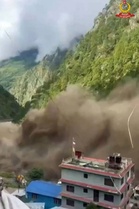
The disaster struck with little warning on Wednesday, sweeping through settlements, destroying buildings and bridges and cutting roads and communications across the Himalayan region.
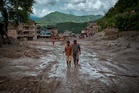
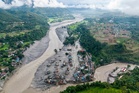
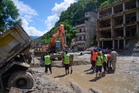
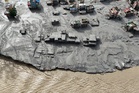
AP reported that dramatic footage showed floodwaters engulfing people as they attempted to flee, while buildings, vehicles and other infrastructure were swept away. Drone footage released on Thursday revealed the extent of the devastation, with thick mud covering parts of settlements and debris tangled in trees and power lines.
In Nuwakot, images showed what appeared to be the second floors of buildings buried in mud after the torrent tore through the area.
“When I reached Dhunge bazaar, in half an hour, the flood came and damaged all the market. People were preparing to go to the office then,” resident Shoyam Rajbhandari said. “How many people are missing or dead, we don’t know.”
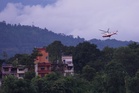
The Nepalese army said it had rescued more than 100 people from flood-hit areas by helicopter on Thursday morning, while at least eight foreign nationals were airlifted to Kathmandu for safety and medical treatment.
Army teams also evacuated people trapped inside facilities connected to the Trishuli hydropower project, while rescuers recovered bodies around 100 kilometres downstream in Chitwan district.
Dozens of injured survivors have been taken to Kathmandu for advanced medical care.
Bishal Kumar Bhandari, chairman of the Nepal Red Cross Society, said rescue operations were increasingly giving way to large-scale relief efforts in the worst-hit districts, with about 1,200 people displaced from at least three villages.
The disaster has also stranded or cut off foreign nationals in the region.
Nepalese officials earlier said hundreds of foreigners were missing, including Indian nationals travelling on pilgrimage to Mount Kailash in Tibet, one of Hinduism’s most sacred sites.
Australia’s Foreign Minister Penny Wong said on Thursday that at least 34 Australians on pilgrimages and hiking trips were missing.
Malaysia’s Foreign Ministry said 55 Malaysians in Kathmandu were currently unreachable, with severe damage to infrastructure hampering efforts to establish contact.
New Zealand’s Foreign Ministry said five of its nationals were believed to be in the affected area and their whereabouts remained unclear.
In Tibet, a massive mudslide struck near the Gyirong Port border crossing on Wednesday, leaving surrounding areas covered by an average of more than 1.5 metres of mud, according to Chinese state broadcaster CCTV. Some sections of road were buried under more than two metres of debris.
All roads leading to the port were damaged, while authorities warned that further collapses or landslides could occur as rain continued.
CCTV also reported the discovery of a barrier lake near the port, adding to concerns over further flooding and complicating rescue efforts. Chinese authorities deployed a large military transport aircraft to deliver a team to the disaster zone.
Electricity and communications had been restored in central parts of Gyirong town, but services remained disrupted in areas connected to the port.
The United States Geological Survey initially reported that a magnitude 4.4 earthquake had struck early Wednesday about 66 kilometres north of Kathmandu near the border.
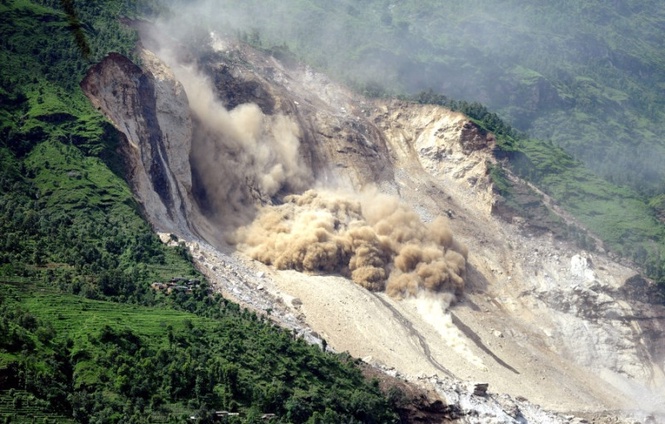
It later revised its assessment, saying the seismic event was instead a magnitude 5.2 glacier collapse that sent a huge volume of debris downstream. The USGS said its conclusion was based on data from nearby seismic stations, long-period seismic waves and satellite imagery, and confirmed that no earthquake had occurred.
Climate experts at the Kathmandu-based International Centre for Integrated Mountain Development said an avalanche from a glacier was the likely trigger for the flash flood.
“Hydrological observations indicate the exceptional speed and magnitude of the flood wave,” the experts said in an emailed statement, noting that water levels in the Trishuli River rose by as much as nine metres within half an hour.
They said the Lhende Khola River, a tributary of the Bhotekoshi, experienced exceptionally high flooding.
The scale of the disaster has renewed concerns over the growing instability of Himalayan glaciers as temperatures rise because of human-driven climate change.
Researchers in Kathmandu found earlier this year that glaciers across the Hindu Kush Himalaya region were melting at an accelerating rate, with ice loss having doubled since 2000.
The Himalayas stretch across several South Asian countries and contain many of the world's highest peaks and remaining glaciers. Their steep valleys and densely populated lowlands are particularly vulnerable to flash floods, landslides and other extreme weather events.
The latest disaster also echoes a deadly flood in August last year, when a glacial lake in Tibet overflowed amid high temperatures, killing nine people and damaging critical infrastructure, including a bridge linking Nepal and China. - August 27, 2026