THE Philippines must synchronize grid connectivity, port capabilities, and workforce upskilling across its maritime ecosystem to achieve commercial offshore wind deployment.
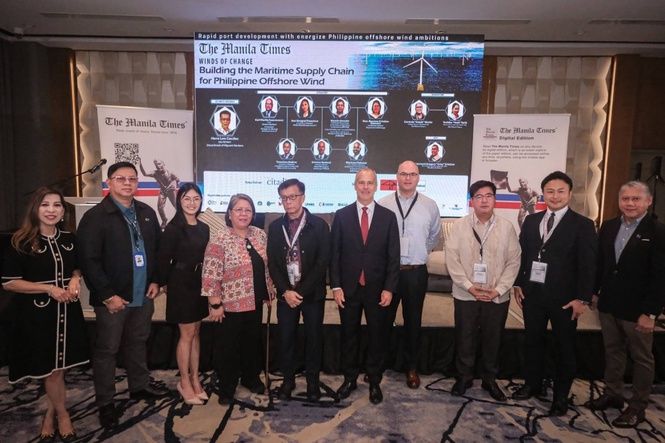
Government officials, foreign diplomats, and maritime industry leaders convened at Citadines Bay City Manila on Aug. 27 for The Manila Times’ Maritime and Offshore Wind Forum titled “Winds of Change: Building the Maritime Supply Chain for Philippine Offshore Wind.”
The forum framed the issue of whether the country’s supply chain and workforce are ready to convert its 36,000 kilometers of coastline into Asia’s next major offshore wind energy hub.
Energy Undersecretary Rowena Cristina Guevara said the Philippines has an estimated 178 GW in total technical offshore wind resource potential. There are 70.97 GW in Offshore Wind Service Contracts (OsWESCs) and Certificates of Authority (COAs), which includes a 16.65 GW priority development subset of front-runner projects and 1.65 GW in the active development stage.
Across the broader pipeline, 51.08 GW remain in pre-development and 18.23 GW hold COAs.
Global Wind Energy Council Country Manager Ann Margaret Francisco stressed that unlocking wind energy potential relies on transparent permitting processes, grid expansion, and sustained foreign investment confidence.
Guevara highlighted five primary delivery constraints facing the sector: limited transmission grid capacity, inadequate port staging facilities, complex marine spatial permitting, financial off-take viability, and supply chain readiness. In addition, there are portfolio churn and ownership adjustments across developers, such as BlueFloat and Domhain Earth ownership updates, CIP project vehicle transfers for Samar Norte and Dagupan, and WESC conversions to COAs.
Project counts will naturally narrow as technical, spatial, and commercial risks become clearer, Guevara said.
The primary challenge to advancing the clean energy transition is not wind resource availability, but synchronizing grid connections, quayside load capacities, and transmission pathways.
To bridge these technical gaps, international partnerships have gained significant momentum.
Norwegian Ambassador to the Philippines Kristian Netland shared insights from Norway’s pioneer floating wind projects such as Hywind, detailing how subsea engineering, rough-sea installation, and floating platform technology transfers can assist local developers in navigating deep waters.
Netland said the DOE recently discussed with the Norwegian embassy in Manila ways to advance technical collaboration across the 2028 to 2035 offshore wind and floating solar outlook.
The Philippines has established bilateral agreements with key international partners, including the United Kingdom under the UK PACT Philippines Country Fund, to refine evaluation standards for Green Energy Auctions (GEA-5) and strengthen marine spatial planning.
To build long-term domestic capability, Mitsui O.S.K. Lines General Manager Tomohisa Makino shared global shipping perspectives and outlined a four-phase localization pathway for deploying specialized Service Operation Vessels (SOVs) and cable-laying fleets.
Phase 1 focuses on deploying foreign installation vessels for initial project execution. Phase 2 integrates domestic tugs, barges, port operations, logistics, and marine personnel alongside foreign fleets. Phase 3 expands local capabilities into fabrication, shipbuilding, and domestic Operations and Maintenance (O&M) fleets. Phase 4 aims to export Philippine maritime services, personnel, and vessels in the Asia-Pacific market.
Makino said offshore wind is fundamentally a maritime industry where ships, ports, and logistics are critical to execution. He noted that the Philippines requires a tailored model because deep water, floating wind, and local weather patterns demand market-specific solutions.
He said international and Philippine capabilities should grow together so foreign expertise delivers early projects while local capability develops.
“Offshore wind is not built with turbines alone. It is built with ships, ports, people and partnerships.”
Makino said that while international capability can help launch initial projects, long-term value retention in the country will ultimately depend on the strength of local maritime capacity.
Hanica Rachael Arshia Ong, manager of the Commercial Services Department at the Philippine Ports Authority (PPA), emphasized that existing commercial ports generally cannot handle unusually large and heavy offshore wind cargo without major infrastructure upgrades, land expansion, and specialized manpower training. To bridge this gap, Ong said the PPA is advancing dedicated public and private port strategies aligned with DOE priority areas, identifying potential locations, including Northern Luzon, Batangas, Camarines, Guimaras Strait, and Southern Mindoro.
Among public infrastructure projects, the fully PPA-funded Mercedes OSW Port in Camarines Norte features a 190-plus meter heavy-lift berth, 20 MT per square meter load capacity, 40-hectare marshalling area, and 160-hectare back-up area, with groundbreaking slated for the third quarter of 2026.
Public developments also include dedicated sites at Sta. Clara.
The Batangas Offshore Wind Port is designed as a multipurpose offshore wind logistics hub adjacent to Batangas Port with a 28-hectare core staging area and an estimated development cost of P3.6 billion, with implementation planned on Public-Private Partnership (PPP) arrangement.
Concurrently, private sector entry points encompass private port creation, PPP arrangements, logistics partnerships, and engineering and installation support.
Regarding regulatory guidelines, proponents may develop private ports under PPA jurisdiction, with 100-percent foreign ownership permitted strictly for noncommercial ports serving their own cargo. However, because foreshore leases remain subject to Department of Environment and Natural Resources (DENR) nationality rules requiring 100-percent Filipino entities, local joint venture structures are actively being explored as practical legal workarounds.
Ong said executing these projects requires a whole-of-government collaboration centered on the DOE alongside the PPA, DENR, Energy Regulatory Commission, National Grid Corp. of the Philippines, the Maritime Industry Authority, and private industry partners.
Marina Maritime Education and Training Standards Supervisors Supervisor Ronnie Gernato said no single, unified International Maritime Organization convention comprehensively governs offshore wind as an integrated sector.
Migrant Workers Secretary Hans Leo Cacdac highlighted strategies to upskill over 500,000 Filipino seafarers into Global Wind Organization certified technicians, with support from institutions like the MOL Magsaysay Maritime Academy in Cavite.
The forum panelists agreed that while the Philippines has strong natural wind resources and a world-class maritime workforce, establishing an offshore wind sector depends on aligning port facilities, accelerating transmission grid connections, and executing a synchronized supply chain roadmap.