.png)
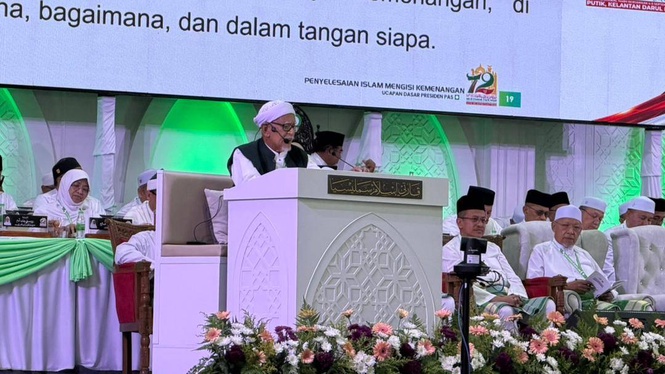
KOTA BHARU — Pas President Tan Sri Abdul Hadi Awang has accused the Unity Government of practising selective enforcement in corruption investigations while turning a blind eye to alleged wrongdoing involving its own allies.
In his policy speech at the party's 72nd annual muktamar, Abdul Hadi claimed that anti-corruption efforts in Malaysia were increasingly being used as political weapons against opponents rather than as genuine measures to uphold integrity.
He alleged that investigations and legal action appeared disproportionately directed at opposition figures, while misconduct involving politicians aligned with the government or their associates was often overlooked.
"Unfortunately in Malaysia, corruption issues have become a political campaign tool to destroy rivals rather than a crime that must be prevented," he said.
Abdul Hadi said corruption allegations were frequently amplified for political effect instead of being addressed through proper legal channels and institutional reforms.
He also criticised the management of public funds and government-linked companies (GLCs) under the current administration, arguing that financial controversies were often turned into political campaigns aimed at shaping negative public perceptions.
Referring to the Royal Commission of Inquiry (RCI) into Tabung Haji, he said issues involving governance and financial management should be dealt with through the courts based on evidence rather than being used as political ammunition.
"If there is wrongdoing, bring it to court and prove it with evidence. Do not turn it into a political spectacle," he said.
Beyond governance issues, Abdul Hadi voiced concern over what he described as challenges facing Islam under the current federal leadership.
He argued that the government's political composition, which includes non-Muslim parties, could pose risks to maqasid al-shariah — the higher objectives and principles of Islamic law.
To navigate what he described as a difficult political environment, Abdul Hadi urged party members to adhere to Islamic legal principles that prioritise preventing greater harm over pursuing lesser benefits.
"Warding off a greater evil takes priority over bringing about a benefit," he said, citing a well-known Islamic legal maxim.
He said the principle should guide Pas in making political decisions and responding to developments that could affect the position of Islam and Muslims in the country.