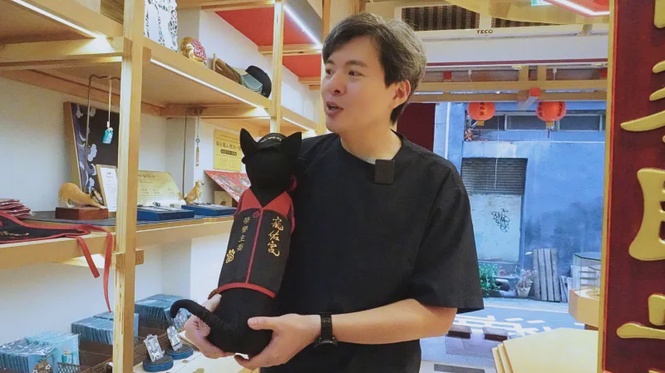
Most Taiwanese temples expect worshippers to know which god handles what. Cho Yuu Temple, on Taipei's Dihua Street, writes it on the wall. Each of its 11 deities has a plain-language job description posted beside it, and read together they look less like a pantheon than a veterinary care plan.
The building has been blessing animals since December 2025, though the plaque over the door still reads "preparatory office" — registering a temple in Taiwan takes eight to 10 years.
There is a god for animals that startle at thunder and cannot sleep: Guanyin, known here as the Reassuring Guanyin Mother. There is one for chronic illness and long-term care, the Medicine Buddha, with the Sun Buddha working the day shift for energy and the Moon Buddha the night shift for rest and recovery. There is Dizang, renamed the Buddha of Good Passage for the Departed, for animals that have died.
And there is Manjusri, the bodhisattva of wisdom, whom the temple calls the Wisdom-Opening Buddha. In practice, said Boz Lu, who founded the temple, he draws a particular kind of visitor: owners of border collies who have realized the dog is smarter than they are, and have come to ask for help keeping up.
Plain Language for People Raised Outside Temples
Lu was not raised in temple culture. Before building one, he said, he worshipped the way most Taiwanese do — a wealth temple when business was slow, the Earth God for safety — and was usually lost. "All you can do is Google it, and Google gives you different versions," he said. So the temple spells out the order of worship, what each god is for, and a nickname for anyone who does not recognize the formal name.
The Wisdom King Who Rules the Animal Realm
The most striking god here is one few Taiwanese temples house at all. Hayagriva, the Horse-Headed Wisdom King, is the wrathful form of Avalokitesvara — the single fierce face on a figure otherwise defined by compassion. His territory is the animal realm, one of the six realms of Buddhist rebirth, where tradition says he rescues the souls that have fallen into it.
He is better known in Tibet and in Japan, where, Lu noted, livestock farmers have long prayed to him for their animals' health and to honor the ones that become food. At Cho Yuu Temple his posted remit is blunter: break evil, uphold justice, protect pets' rights.
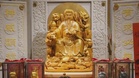
He stands here twice, in two separate carvings, and the difference is visible at a glance. The first, titled Lord Horse-Head of Justice, is the wrathful version: three eyes, bared fangs, armor, skulls worked into the crown and the breastplate. The second, which the temple calls the Horse-Headed Buddha and titles Mother Horse-Head, is the opposite — eyes lowered, elaborately crowned, a seal held in one raised hand, the bearing of a bodhisattva rather than a guardian. One is addressed as a lord, the other as a mother. The Horse-Headed Buddha is the one that oversees the temple's charity work, which runs adoption days and planned talks on pet behavior.
Lu's account of how the pantheon came together is that he did not choose it. He had planned to invite Judge Bao, the Song-dynasty magistrate who stands in Chinese folklore for incorruptible justice. Instead, he said, the gods arrived through dreams and divination; Guanyin herself, he said, arranged for Hayagriva to come.
Carving all 11 statues, rather than the two he needed to open, felt like an expensive mistake at the time. It stopped feeling like one after opening day. The need he had most underestimated, Lu said, was for the dead — which is why the third floor now holds a god whose whole job is a good passage out.
Hayagriva, the Horse-Headed Wisdom King
- A wrathful manifestation of Avalokitesvara; the one fierce face in an otherwise compassionate figure.
- His remit is the animal realm — one of the six realms of Buddhist rebirth — and the souls that have fallen into it.
- Venerated in Tibetan Buddhism and in Japan, where livestock farmers pray to him for their animals' prosperity and to honor those that become food.
- Cho Yuu Temple's sign gives his job as breaking evil, upholding justice, protecting pets' rights.
This is one of four reports from Cho Yuu Temple published as Taiwan at Prayer, a Storm Media series introducing Taiwanese folk religion through the animals people bring to it.