
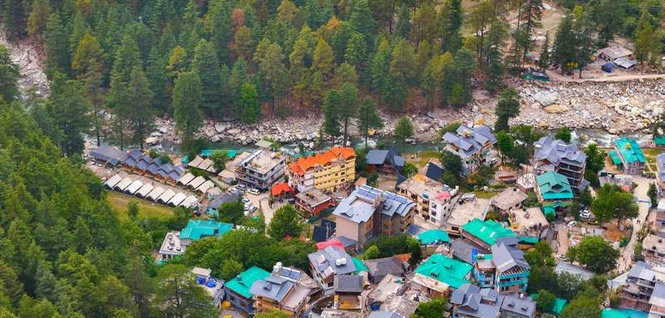
On some evenings in Kullu’s Parvati valley, the sound reaches you before the river does. It begins as a faint pulse against the mountains, a bassline that seems at first like distant thunder. Then it thickens, acquiring synth and cheer and the unmistakable rhythm of a party happening just out of sight.
If you follow it, you might find a forest clearing lit up in impossible colours, a DJ console where a shepherd used to sit, and a crowd that looks like it has been assembled by an overenthusiastic passport officer.
Stand still long enough and you will also hear something else: the practised, soothing murmur of denial. Everyone in Kasol is having a wonderful time. Nobody is doing anything illegal. The rave party you can hear from the highway? What rave party. The DJ found dead in her homestay washroom after a multi-day forest gathering? Tragic, but unrelated. The young man who wandered off the trail and was never found? The mountains are unpredictable, bhai.
This is the official soundtrack of Kasol: denial on repeat, with the administration on vocals and tourism on backup chorus.
Chillum to check-in
Kasol did not arrive at its present condition overnight. It took roughly five decades of careful neglect, enthusiastic counterculture and spectacularly bad governance to get here.
The story begins on the beaches of Goa in the 1960s-70s, when cheap living, permissive attitudes and then-legal hashish turned the state into a laboratory for the global hippie trail. By the late 1980s, Goa trance had emerged. By the mid-1990s, as beach parties drew both foreign media and local regulation, the scene did what most Indian businesses eventually do: it looked for a hill station. Geography shifted north, and upward. Kasol in Himachal Pradesh, spectacular and under-policed, was waiting.
Youth & altitude problems
To understand Kasol today, you have to understand the young people who keep arriving here with backpacks packed in equal parts with fleece, power banks and unresolved feelings. For many, Kasol is not simply a destination. It is a pause button with better scenery than a therapist’s office. A 23-year-old Israeli backpacker, fresh out of mandatory military service, states, “I came to Kasol to feel nothing for a while. Back home, everything is loud. Here, even the silence feels like something.”
A local 20-something from Kullu, who insists on anonymity, is the only one without romance in his voice: “Pehle log shanti dhoondhne aate the. Ab log khud se bhaagne aate hain. Farq bahut hai.”
Kasol has become India’s unofficial Emotional Processing Centre: for post-army Israelis, burnout techies from Bengaluru, semi-employed creatives from metros and students undecided on whether their major is psychology, philosophy or avoidance. The Valley absorbs what the plains produce: exhaustion, confusion and a surprising amount of disposable income.
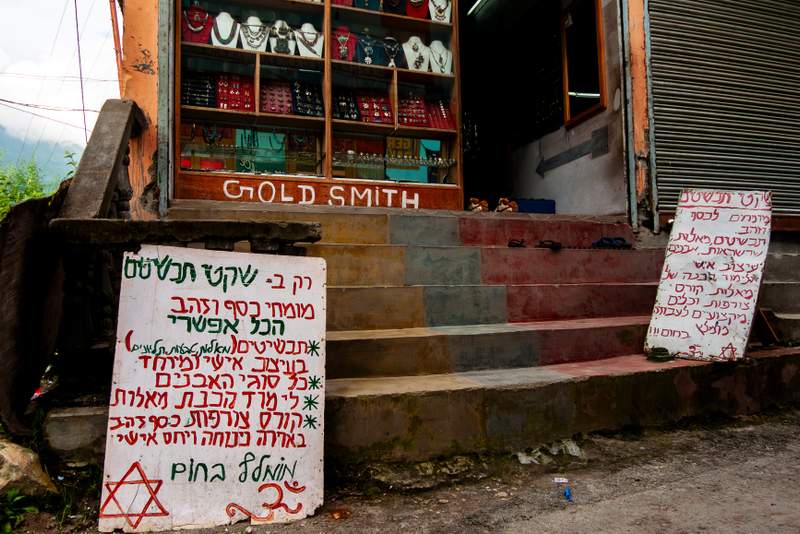
Backpackersfrom Israel began arriving in the 1990s, and Hebrew signboards soon emerged. Photo: Istock
Mini Israel, and dissonance
Israeli backpackers began arriving in significant numbers in the 1990s, looking for a place to decompress after years of uniformed life. They brought falafel recipes, Hebrew signboards and the conviction that a three-day “psy experience” could double as a spiritual retreat. Kasol obligingly rearranged itself.
In peak season, thousands of tourists could be seen in a multilingual crowd that looked more like an airport waiting area than a Himalayan village. Between cafés and homestays, a quiet understanding holds: everyone is here looking for something, and nobody wants to ask too many questions about what that something is, in case it turns out to be illegal.
Rave vs trance
In the current moral panic, “rave” and “trance” are used interchangeably by television anchors, the way “jeans” and “pants” are treated as synonyms. They are not.
A rave, classically defined, is any large gathering organised around amplified electronic music in a space like a forest or the occasional orchard whose owner will later insist he thought it was a “cultural programme”. The genre is flexible; the attitude or the container is what matters. Trance, on the other hand, is the liquid you pour into that container. Goa trance was the pioneering ancestor. Once it migrated to the mountains, it mutated to forest psy, dark psy, hi-tech-subgenres distinguished chiefly by how enthusiastically they assault your nervous system.
The drugs? Think of them as the label: the part everyone pretends not to read but somehow always recognises. Officially, nobody knows what’s in the bottle. Unofficially, everybody has a favourite brand.
Malana myth and margins
Twenty minutes from Kasol, in a village that has declared itself a sovereign entity and strongly discouraged outsiders from touching its walls, sits Malana. Its best-known export, Malana Cream — hand-rolled charas from a cannabis strain that grows with the unhinged confidence of something that knows it is famous — has become a luxury product.
Depending on quality and distance from source, Malana Cream can fetch several thousand rupees per 10 grams. Malana’s other, older claim to fame is of a different sort. Local lore insists its residents descend from soldiers in Alexander the Great’s army — men who wandered off during the retreat, liked the view and never reported back. Their supposed descendants now specialise in a product that makes it hard to match anywhere at all.
Charas was banned under the NDPS Act in 1986. The plants, however, did not receive the memo. The Kullu-Parvati region continued to grow, refine and export its most famous product with the efficiency of a cottage industry politely ignored for decades. Over time, the menu expanded — opioids, synthetic pills, powders.
The forest party is the perfect retail environment: concentrated demand, cash economy, music loud enough to blur the line between “recreational” and “medical emergency”. For locals, the economics is devastatingly simple. “Why,” as one young man asks, “should I spend a season guiding tourists up treacherous trails when a single night’s work on the supply side promises more?”
Valley that ‘eats’ guests
Since 1991, at least 19 foreigners have been officially recorded missing in Kullu district, most in the Parvati valley. Several Indian tourists have also not been traced. The region has earned the sobriquet of “India’s Bermuda Triangle for backpackers”, popularised by journalist Harley Rustad in his book, ‘Lost in the Valley of Death’.
The pattern is numbing: a spirited backpacker, a final sighting at a village teashop, an anguished family and questions that outlast the monsoon. The reasons are less mystical than the nickname suggests. Steep, unstable slopes. Rivers that look photogenic until the current takes you. Half-marked trails. The occasional criminal element operating behind the vocabulary of “healing retreat” and “off-grid experience”. Layer onto this a population routinely sleep-deprived, chemically adventurous and convinced that nothing truly bad can happen in a place this beautiful — and the statistics start to look like tragic arithmetic.
The Valley does not eat people. It simply declines to rescue them from themselves. Nature, unlike tourism brochures, is not in the hospitality business.
Fiction tried to warn
In 2004, Tigmanshu Dhulia released ‘Charas: A Joint Effort’, a thriller set in and around Kasol, with Irrfan Khan playing a shadowy drug lord nicknamed “Policeman”. At the time, its depiction of foreigners outnumbering locals, cannabis replacing vegetables as the main cash crop, and international mafias operating in thin Himalayan air was dismissed as “too filmi”.
Two decades on, the Valley has worked hard to catch up with the script.
Writer Karan Madhok, in his book ‘Ananda’, on cannabis culture in India, tracks this pipeline from Himalayan charas fields to Indian cities and global party circuits. He points out how eagerly India has imported the aesthetics of rave culture — neon, psytrance, the Instagram mythology of “forest psychedelic” — while stubbornly refusing the accompanying infrastructure: harm-reduction services, conversations about addiction, medical support at events, and the basic acceptance that someone has to clean up when the music stops. Kasol may be the place where that gap is easiest to see, and hardest to ignore.
Dazura’s last set
A few days ago, a multi-day rave was held in the forests of Kasol. Among the performers was Daria, a 29-year-old Russian DJ and producer known professionally as DashAlien and Dazura. Days later, she was found dead in her homestay in Manikaran valley.
The post-mortem examination indicated excessive consumption of narcotics. Two FIRs have since been registered. On the psytrance circuit, this barely disrupts the touring schedule. The scene is organised around seasonal migration — beaches in winter, mountains in summer — with DJs following the temperature gradient from Goa to Kasol like migratory birds, except with more equipment and fewer survival instincts.
HC pulls the plug
The Himachal Pradesh High Court, declining to pretend that nothing is happening, has taken suo motu cognisance of media reports on large-scale rave activity in Kasol. The DC and SP were directed to file personal affidavits — a judicial move that signals, politely but unmistakably, that the court does not entirely believe the administration’s reassurances.
The High Court asked what every taxpayer in Himachal has wanted to for years: Who gave permissions for these gatherings? Who checked for narcotics? Who benefits? Why does the state appear to know so little about something so loud?
Shiva’s valley
The Parvati valley has never promised anything except altitude and beauty. In local cosmology, this is also Shiva’s realm, where the ascetic god is believed to roam high meadows. Somewhere along the way, that idea turned into a kind of spiritual pass: if the Valley belongs to Shiva, then a little smoke and a lot of psytrance feel more like “alignment”.
The misunderstanding is entirely human; Shiva is Neelkanth, but most visitors discover very quickly that their own throats are not designed for divine dosage.
The village did not choose to become a franchise of altered states. The rave came to the mountain because the mountain could not say no, and because the administration found it easier to look the other way.
Shutting the music off will not cure the Valley. But neither can the fiction hold: that this is all harmless bohemian tourism; that the missing-person posters are unrelated to the party scene; that a DJ dying after a five-day forest rave is simply one of those things.
In the end, Kasol is not a villain so much as a mirror with very good lighting. If you come here looking for escape, it will show you how far you are willing to go to avoid your own life. If you come as a state functionary, it will reveal how much noise you can ignore before a court hands you a pair of headphones and a notice.
At sunrise, when the music finally thins and the Valley remembers its original soundtrack — the river, the wind in the deodars — the place briefly becomes what the brochures promised.
The hills need a different kind of high: one that comes from clean air, hard climbing, cold water and work that does not end in a chargesheet; one that does not generate court orders, cremation certificates and FIRs as its primary outputs.
Until that arrives, Kasol will remain what it has become. The real question is no longer what the mountains are doing to us, but how long we will keep using them as an alibi for what we insist on doing to ourselves.
— The writer is founder-director of the Himalayan Institute of Cultural & Heritage Studies
