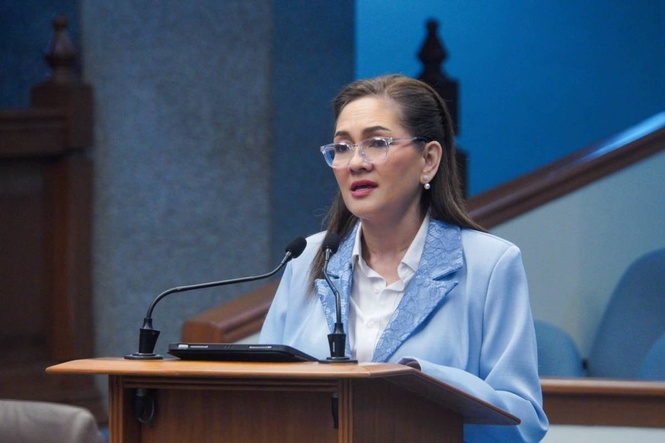
SEN. Risa Hontiveros is pushing for a super El Niño-ready and responsive 2027 national budget, calling on government agencies and local government units (LGUs) to strengthen measures to protect the public from extreme heat, water shortages and threats to public health.
In an interview with DZBB radio on Sunday, Hontiveros said her proposal for LGUs to establish public cooling spaces and provide free drinking water in crowded areas was part of preparations for the expected effects of El Niño.
She said that public cooling spaces could include shopping malls where people could seek temporary relief from extreme heat without being required to buy anything.
She also called for free drinking water stations in crowded areas, particularly transport terminals, noting that access to water could sometimes mean the difference between life and death.
As vice chairman of the Senate budget panel handling the Department of Environment and Natural Resources (DENR) and the Department of Social Welfare and Development (DSWD), Hontiveros said she was pushing for additional funding for programs addressing water conservation, environmental protection and livelihood development.
She specifically cited the DENR’s Lawa at Binhi initiatives, which she said should receive stronger support as the country prepares for the climate phenomenon.
On water security, Hontiveros said the government must identify, develop, protect and rationalize the use of available water sources.
CATHERINE VALENTE
She also underscored the need for closer coordination between the DENR and the Department of Agriculture (DA), particularly in ensuring adequate water supplies for agricultural irrigation.
“We have to make sure that our farmers really have a source of water,” she said.
Hontiveros also vowed to actively participate in the budget deliberations of the Department of Health (DoH) to ensure the implementation of Universal Health Care (UHC), with particular attention to public health preparedness and protection during El Niño.
She added that the Department of Labor and Employment should closely coordinate with the DENR and DSWD in generating jobs and livelihood opportunities as part of the government’s response.
Hontiveros said that the government had repeatedly discussed the creation of a Super El Niño task force, stressing the importance of a whole-of-government approach to preparations.
She said the Senate will also exercise tighter oversight over government spending as it reviews the proposed 2027 national budget, drawing lessons from its investigation into flood control projects.
Hontiveros said that Congress must ensure that government agencies properly use their allocations, citing its constitutional authority over the national budget.
On possible sources of funding for priority programs, Hontiveros cited the commitment of Senate President Sherwin Gatchalian to continue budget reforms.
She also pointed to Gatchalian’s announcement that more than P7 billion in items lacking sufficient justification would be removed from the proposed budget.
The initiative was part of efforts to make budget deliberations more transparent and participatory, particularly through the increased involvement of civil society organizations (CSOs).
She said she would pursue proactive budget interventions in light of the flood control controversy and the need to prepare for El Niño.
Asked whether allocations for flood control projects or farm-to-market roads could be reduced to finance climate preparedness measures, Hontiveros said: “We will look at the big picture in the Senate and determine how we can come up with a Super El Niño-responsive budget within the rules.”