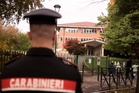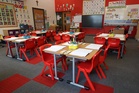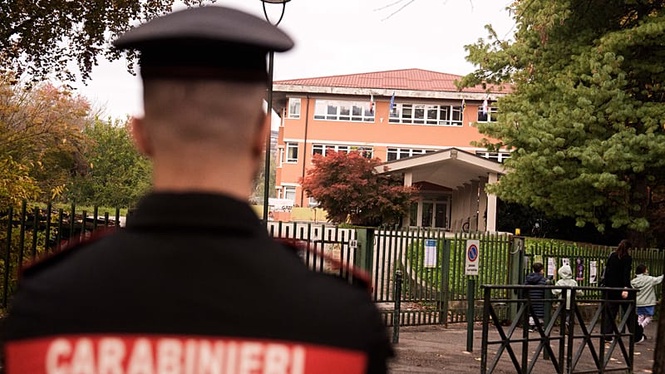
More than 300 schools across Italy were evacuated on Wednesday after receiving emailed bomb threats, which also claimed that an explosive device had been planted in Prime Minister Giorgia Meloni’s car.
Meloni said there was no "concrete danger" and called a government meeting for later in the day.
"At present, based on the checks carried out, no element has emerged that would suggest there is a concrete danger," she said on Facebook.
"The reports instead appear to be linked to a strategy aimed at generating alarm and concern, which is currently the subject of all the necessary in-depth investigations," Meloni said.
Italian media reported that 312 schools had received threats. Education Minister Giuseppe Valditara said around 300 alerts had been recorded across the country, adding that "it is clear that there is a strategy".
The emails began: "We have come to annihilate you. We will carry out genocide against the Italians." They claimed a "powerful explosive device" with a "remote trigger" had been placed in each building.
"We have placed a bomb in the engine of your prime minister’s car," the emails continued. They were signed "Mikhail Andropov, leader of the Vilayat of Misoginistan".
Bomb threats sent to media outlets in Ireland and Bulgaria in the past week were signed with the same name. Similar hoax threats were also reported at schools in Britain and Ireland on Wednesday, prompting some evacuations.
Defence Minister Guido Crosetto said he would report to parliament on the incident and on wider security issues.
"It is part of a strategy that is now clear, which is to sow terror or to create concern. Any one of us could, with the means and tools that exist, send an email to a school, a nursery or an airline saying there is a bomb," he said.
‘Damage and disruption on a large scale’
Antonello Giannelli, president of the ANP association of Italian school heads, said the threats were “clearly fake”.
But he added: "This episode shows how much irresponsibility, when combined with the extraordinary communicative power of the tools we have today, can cause damage and disruption on a large scale".
"We hope that full light will quickly be shed on the origin of these threats and that those responsible will be identified," Giannelli said.
The threats follow a series of hoax bomb alerts on flights across Europe in recent weeks. In the same period, there have been cyber attacks on supermarket refrigeration systems in several European countries, including Italy.
On Saturday, Foreign Minister Antonio Tajani said he was being targeted by “cyber criminals” who were sharing his personal data online because of Italy’s support for Ukraine.
The attacks have prompted warnings about hybrid warfare.