
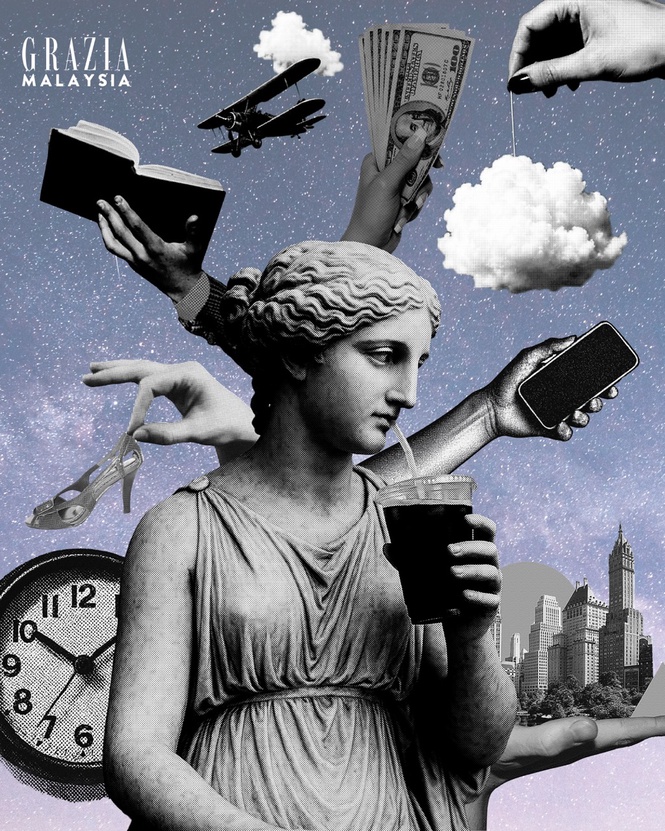
When was the last time you allowed yourself to feel bored in the little pockets of spare time you had? You go through your messages in those 60 seconds in the lift. Your daily train commute is a chance to work on your laptop. Eating time equates to doomscroll time. Look around at other drivers in traffic, and 80% of them are on their phones—even though it is illegal. Our fashion editor has even confessed to having TikTok set to auto-scroll while she’s showering and getting ready for the day. All the free time we have is screen time. Even when we’re swearing off our phones, we’re redirecting our attention towards something else because we just can’t stand not optimising our time. Welcome to the modern world, where everything is aimed at hyper-optimising.
It’s not just the little minutes that we have in the day. Look at the bigger picture—or your Google calendar. We are booked out months in advance, with every hour accounted for. There is a whole Pinterest niche on colour-coding your Google Calendar to make it look “aesthetic”. Our to-do lists have gone from being written on paper to having a full Gantt chart, a Notion-powered task list, or a painstakingly drawn-on bullet journal. There is an entire meme category on how to fill every moment with noise so you won’t overthink, but the catch is that we end up not thinking at all. We are optimising our day so thoroughly that we have left zero room in our minds to wander off and come back with something.
Dr Sandi Mann, a psychologist at the University of Central Lancashire who has spent over a decade studying boredom, ran an experiment in creativity research: one group of participants completed a tedious writing task before a creative challenge, another didn’t. Unsurprisingly, the bored group came up with more inventive answers. Boredom, she’s said, is essentially “a search for neural stimulation that isn’t satisfied.” When the outside world stops supplying that stimulation, the mind goes looking for it internally—and daydreaming is where new connections get made.
It makes you wonder how much of our so-called creative dry spells are really just scheduling problems. We treat every unfilled minute as a leak to be plugged—a queue to scroll through, a commute to podcast over, or a weekend to “make the most of”. We have become so afraid of the discomfort of boredom that we think it’s a sign of personal failure, that we haven’t optimised hard enough.
That perspective—boredom as failure—is what researchers are now pushing back on. For most of the productivity, girlboss-alpha-male era, idle time was treated as waste: hours that weren’t generating output, ideas, or content were hours lost. But work from Mann and her colleague Rebekah Cadman suggests the opposite may be true—that boring stretches create the mental space daydreaming needs to act as a bridge between unrelated ideas. We used to ask, “How do we eliminate this free time?” But now, we wonder what we have to lose when we do.
For that, we look to neuroscience for more concrete answers. Dr Ben Shofty, a neurosurgeon whose team at the University of Utah recorded brain activity directly from patients during mind-wandering and creative-thinking tasks, found that a specific system—the default mode network, or DMN—activates when attention isn’t pinned to an external task. It’s the network responsible for daydreaming, recalling the past, and imagining the future. Most importantly, when Shofty’s team used electrical stimulation to disrupt this network mid-task, participants’ creative output measurably dropped—not their ability to wander, but the originality of what they produced once they did.
Stanford cognitive scientist Vinod Menon, who helped define the DMN in 2003, has described daydreaming as sitting at the very core of how we generate new ideas and even how we form our sense of self. You can see the pattern that follows here: every notification that interrupts breaks your flow, switching off the network your brain uses to make anything new. If you feel like you’ve been lacking in creativity or experiencing a sort of “mental block”, you might have just found your answer. We have engineered our days so efficiently that there are no unstructured minutes left for the DMN to switch on. We simply have no time to daydream.
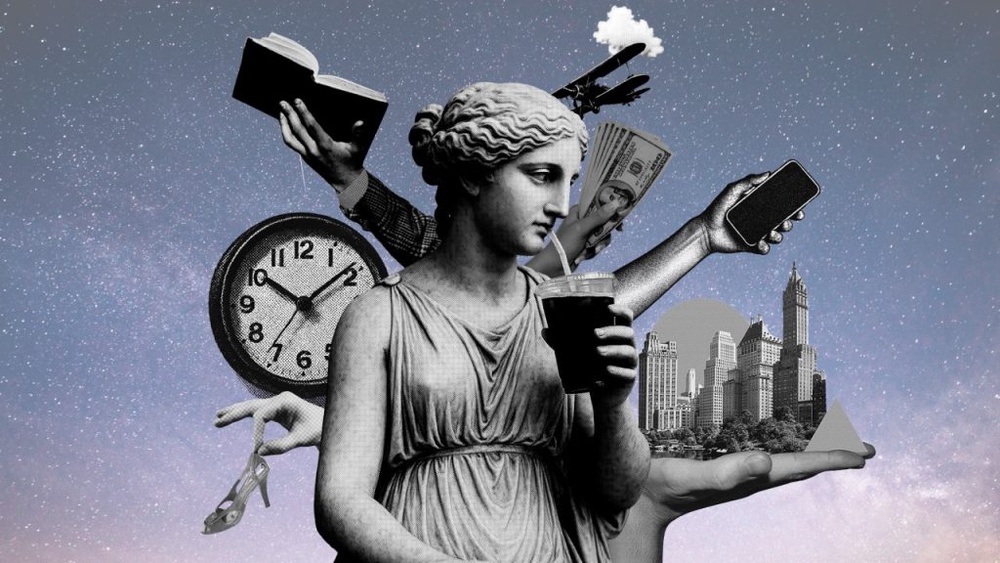
Author Oliver Burkeman, whose book Four Thousand Weeks became an unlikely manifesto against productivity culture, names the trap plainly: chasing efficiency doesn’t create more spaciousness in a life; it just raises the bar for how much you feel you should be cramming in. Becoming more efficient, he argues, only makes people busier, because the freed-up time is immediately reabsorbed into the next task rather than left open. Now apply that to creative work, and the trap looks like this: the more efficiently we clear our schedules of “wasted” time, the less raw material we leave for the very process—undirected thought—that creative work actually depends on.
But this isn’t to say that you should throw all structure out the window and embrace chaos. No—structure still has its value. Setting deadlines ensure tasks get finished, and not every minute of free time means you need to daydream your way to creativity. Mann herself notes that boredom’s usefulness seems to depend on what follows it—daydreaming that leads somewhere versus daydreaming that curdles into rumination, then overthinking and anxiety. The cure for this isn’t abandoning routine but instead leaving routine with edges. Think a commute without a podcast, standing in a queue without a scroll, or an evening with nothing scheduled into it.
One tip I found whilst doom scrolling—the irony—is putting my phone on “Do Not Disturb” mode, which I have personally taken to heart. Take it a step further to customise it to only receive important notifications such as text messages and calls from important people, and you can pretty much set this mode on for the entire day. It has significantly helped my focus because I’m not seeing my phone light up every other minute with Instagram notifications from a mutual sending me yet another meme. I’ve also started leaving my phone in another room in the mornings so I’m not tempted to check my emails and “catch up on work” before the actual work day begins. My mornings are mine again—to sip on coffee and allow my mind to awaken and ease into the day without a mental barrage of things to do.
You should try it sometime.
This story first appeared in the GRAZIA Malaysia September 2026 issue.
READ MORE
- All The Asian Stars Making A Pit Stop In Singapore For The 2026 Grand Prix
- Hyper-Optiverse: The Culture of Doing Too Much
- 6 Iconic Ballets Everyone Should Know — and the Surprisingly Dark Stories Behind Them
The post Hyper-Optiverse: The Culture of Doing Too Much appeared first on Grazia Malaysia.