Two years ago, I was stuck in a literary dry spell. It had been months since I’d finished a novel, and even longer since I actually enjoyed doing so. And so, as any resourceful woman would, I turned to a friend for advice.
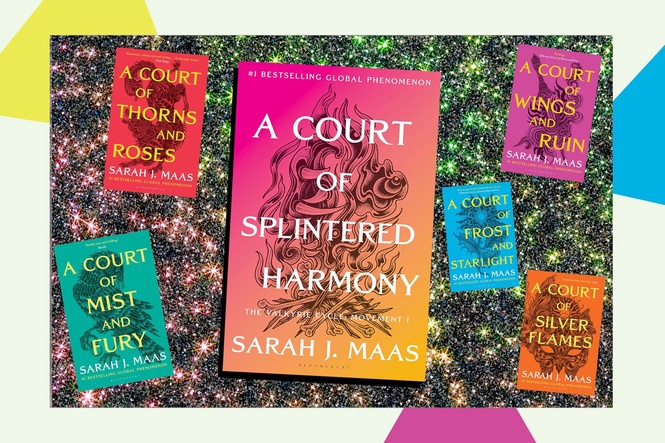
“Have you heard of ACOTAR?” she asked me over a glass of wine at her house, before proceeding to hand over a stack of brightly coloured books that would soon take over my life, as they have tens of millions of others. For the uninitiated, ACOTAR refers to the sexy and steamy romantasy series by American author Sarah J Maas, named after its first entry, A Court of Thorns and Roses, published in 2015. In the 11 years since, Maas has written a further four novels in the series, sold more than 75 million books worldwide, and emerged as the biggest literary phenomenon since JK Rowling. Richard Osmond called it “porny Lord of the Rings” and, to be fair, the plot about warring faerie realms having to join forces or risk annihilation is indeed a bit like Jilly Cooper’s Rivals if everyone had wings and magical powers.
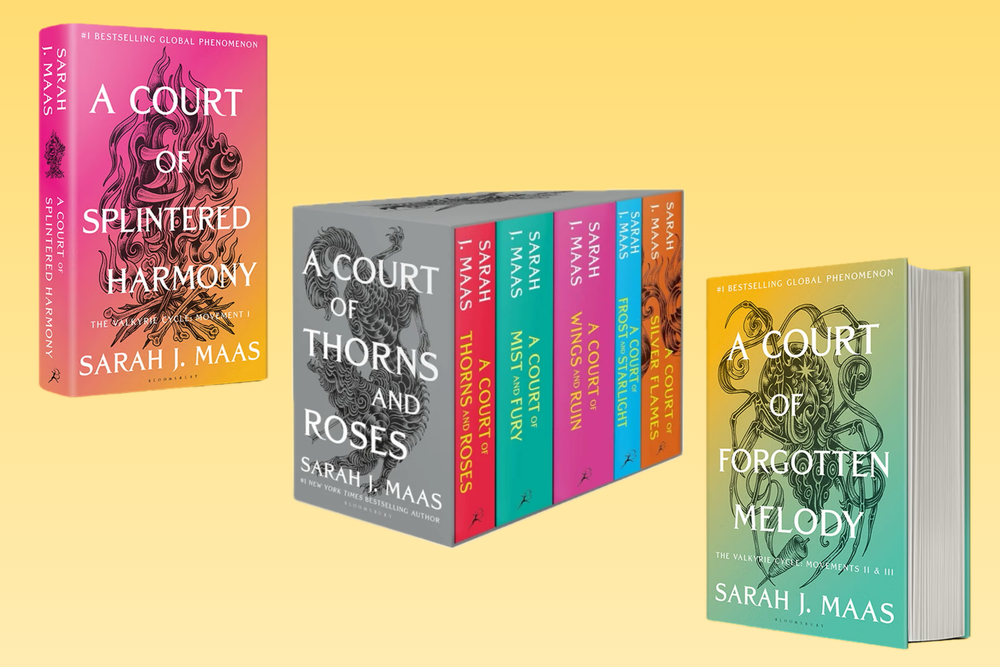
That number is set to soar again as A Court of Splintered Harmony, the sixth book in Maas’s franchise, is finally out after a five-year hiatus. Around the world, queues are forming outside bookstores and parties are being thrown to celebrate the book’s arrival (costumes optional, but encouraged) with some fans going so far as to take time off work to focus solely on reading. Sadly I can’t blag a day off work to do the same, but I know the second I get the time, my life will be temporarily consumed by this new book and the pure joy of reading – a feeling that seemed out of reach not so long ago.
ACOTAR arrived at a time in my life when my love of books felt like a thing of the past. A busy job and social life alongside a pesky phone addiction made focusing on the page in front of me nearly impossible. Even worse was the fact that it wasn’t always like this. Quite the opposite, in fact. Look up “bookworm” in the dictionary and you may see a photograph of me, aged 10, head buried in a novel. I read a book a day, sometimes two. The habit persisted all the way up till I was in my early twenties and I landed my first job at The Independent. Work and music – the two went hand in hand – took over my life. Suddenly, I was in my thirties and reading had become something that I used to enjoy. A pastime to look back wistfully on.
It was some comfort to know that I wasn’t alone. A poll in 2025 found that 40 per cent of Britons hadn’t read a book in the past year, while a particularly gloomy piece in The Atlantic this summer declared “the end of reading is here”, citing falling levels across age groups, gender and education. The government even launched a nationwide campaign this year in the hopes of getting people reading again.
But all the initiatives in the world couldn’t have done for me what ACOTAR did. A little late to the party – my friend introduced me to the series that fateful day in 2024 – I was keen to make up for lost time. Within a week, I’d finished all five books, devoured close to 600,000 words and flipped over 2,900 pages. I’d barely slept from staying up every night. I was elated, transported back to those childhood days when I would lose days to a novel, immersed for hours on end. I loved the escapism it brought, the silliness and the chance to be swept up in an entirely different world. Certainly there’s also an appeal, particularly now, in cheering on a character who has the power to topple evil forces and save the ones she loves.
I know that millions of other women have credited Maas’s books with reigniting their love of reading – my friends among them. (I can’t convey to you the explosion of glee felt upon discovering a fellow ACOTAR addict: “What book are you on?! Who’s your favourite character?! Why is Rhysand so hot?!”) And yet this cause of celebration has become mocked by some who are baffled by the grip the series has on its fans.
Snobbery around Maas and her peers largely comes down to two things: the lack of critical approval for both the romance and fantasy genres, and the consistent underestimating of women in commercial terms. It’s almost comical how analysts and industry experts still express surprise when something like ACOTAR turns out to be a phenomenon, as if female fans didn’t drive the success of The Beatles, Taylor Swift, the Twilight franchise or, more recently, Greta Gerwig’s record-breaking Barbie movie. Literary giants like Jilly Cooper and Barbara Cartland have similarly faced the scorn of self-appointed literary connoisseurs, whose tendency to dismiss popular fiction as intellectually inferior overlooks the cultural significance of their work.
And yes, the writing often leans into the hyperbolic (Maas is known as a pantser, someone who writes “by the seat of her pants” and therefore with little regard for precision or literary finesse), and occasionally her books invite affectionate parody, so heavily do they rely on tropes from the fantasy and romance genres – think brooding, tortured men with strong jaws, enemies-to-lovers story arcs, physically tiny women with astonishing powers, and the inevitable moment two characters are forced to share a bed and realise, woah, they really want to shag one another. And certainly, the faeries are horny, but they’re also busy trying to save the world from evil. In most of the books there’s actually very little time for said shagging.
It is worth noting, too, that fantasy has historically been a genre marketed almost exclusively at men. I still remember being crestfallen, aged 13, over a promotional sticker on the new book from one of my favourite childhood series, Artemis Fowl by Eoin Colfer: “The perfect books for boys!” Fans jokingly refer to books by Maas and other romantasy bestsellers like Rebecca Yarros – who last year enjoyed the biggest opening week for a hardback fiction title in the UK since Harper Lee’s Go Set a Watchman a decade ago – as “fairy smut”. But only because they know that there’s much more to it than that. For one thing, Maas is superb at world-building: her fantastical realms feel immersive and layered, dictated by their own mythology and ancient histories. She draws you in so completely that before long, even a faerie with wings growing out of his back and centuries-old magical beef with his neighbours seems entirely plausible.
It is no wonder that readers around the world are coming together today to celebrate the release of A Court of Splintered Harmony. Girls and women rarely treat entertainment they enjoy as a solo endeavour; they form communities around it and make it bigger, stronger. And while I have no plans to don a fairy gown just yet, I’m still grateful that there are writers like Maas getting us glued to the page once more, fairy smut and all.
Read MoreHarry Potter’s parents cast in TV series as book character makes screen debut
Warwick Davis speaks out on Harry Potter series backlash after JK Rowling comments
Dua Lipa on her desert island reads: ‘I gift that book a lot’