
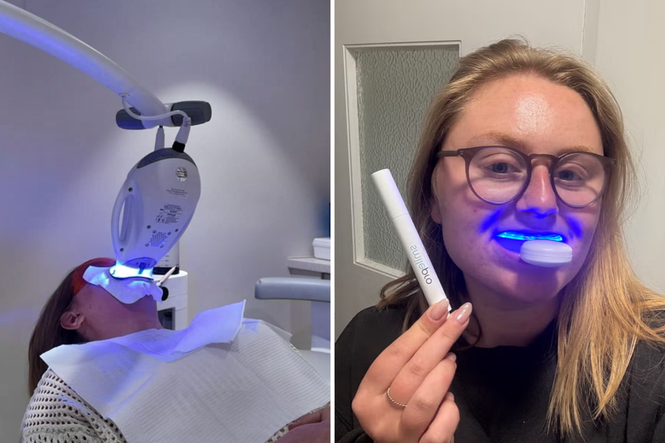
Philips Zoom is one of the best-known names in professional teeth whitening and promises a noticeably brighter smile in a one-hour dentist appointment. But as someone who’s tested (and always been impressed by) at-home whitening treatments, which rarely cost more than £150 (some cost less than £10), I wondered whether a £850 in-clinic appointment could really be worth it. In a bid to find out, I went to the Chelsea Dental Clinic to try Philips Zoom myself.
The appointment starts with a quick clean if there’s any plaque or build-up, followed by a 3D scan of your teeth to create personalised trays for the at-home part of the treatment. Your lips and gums are then protected before whitening gel is applied and activated with a blue LED light. The one-hour appointment can involve up to four 15-minute sessions, with fresh gel applied between each, although you may need fewer depending on your starting shade. Afterwards, a desensitising gel is applied before you’re shown how to use the take-home trays and syringes for future top-ups.
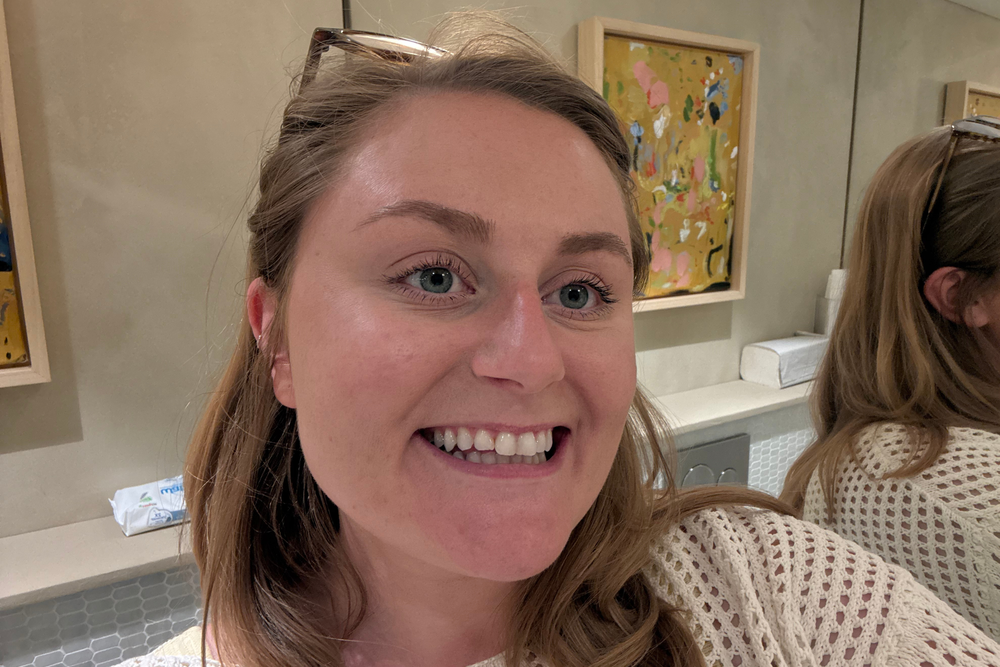
Prior to the treatment, the shade of my teeth was A1. This is the second lightest shade, with B1 being the whitest natural teeth can achieve before they reach saturation.
Read more: Best at-home teeth whitening kits, reviewed
“Professional dental whitening is designed to penetrate through the enamel and reach the dentine underneath, where we can actually change the underlying colour of the natural tooth.”
So what exactly are you paying £850 for? The biggest difference between professional and at-home whitening is the strength of the whitening agent. In the UK, products sold directly to consumers are limited to 0.1 per cent hydrogen peroxide, while Philips Zoom uses a six per cent concentration under dental supervision.
“Most at-home whitening products primarily tackle surface staining on the enamel, whereas professional dental whitening is designed to penetrate through the enamel and reach the dentine underneath, where we can actually change the underlying colour of the natural tooth,” explains Dr Elvis Law, dentist at Dr Wyman Chan.
It doesn't necessarily mean professional whitening is the right choice for everyone. At-home treatments can lift surface stains from food and drink, and I've spent more than a decade using them with good results. But I started to think my teeth had reached a plateau, particularly the bottom ones, which have always been harder to target with strips.
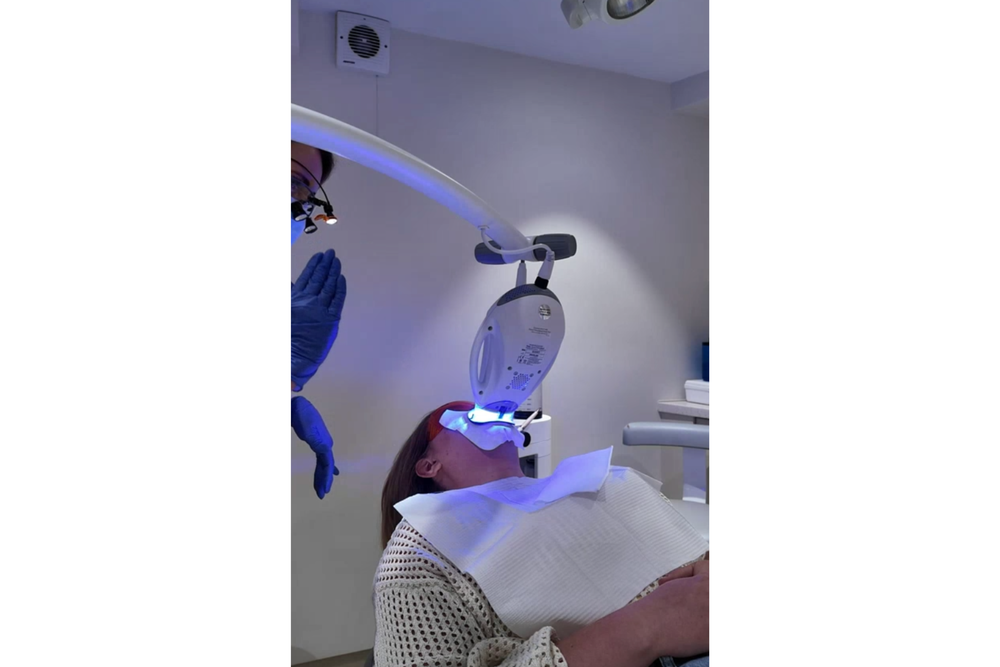
The treatment itself isn't painful, although it is more cumbersome than at-home whitening. Lip retractors hold your mouth open throughout, while cotton wool and a liquid sealant protect your gums from the peroxide. The blue LED lamp is attached to a mechanical arm, so it isn't heavy and feels more like the warmth of a fan heater than anything particularly intense. My main challenge was staying completely still for the duration, rather than any discomfort from the light itself.
That said, I was most interested in seeing how sensitive my teeth would feel during the treatment. According to Dr Law, professional whitening “can” cause sensitivity. This is because, “we want the whitening agent to penetrate through the clear-glass-like enamel and reach the spongy dentine layer underneath, because that’s where much of the colour we want to change sits.” But he caveats, “we don’t want the whitening process to irritate the nerve at the centre of the tooth”. Dr Law explains that an individual’s teeth composition and condition are assessed “before prescribing a tailored wear time”.
I don't generally have sensitive teeth and can happily bite into a spoonful of ice cream, although I've experienced some sensitivity from whitening strips in the past. The first 15-minute session was pain-free, but as more gel was applied, I developed a dull, surface-level ache across my teeth. It never became severe, and in the 24 hours afterwards I experienced just one sharp twinge after – you guessed it – eating ice cream. This was reassuringly similar to my experience with at-home whitening, rather than being the ‘dramatically more painful’ treatment I'd somewhat expected.
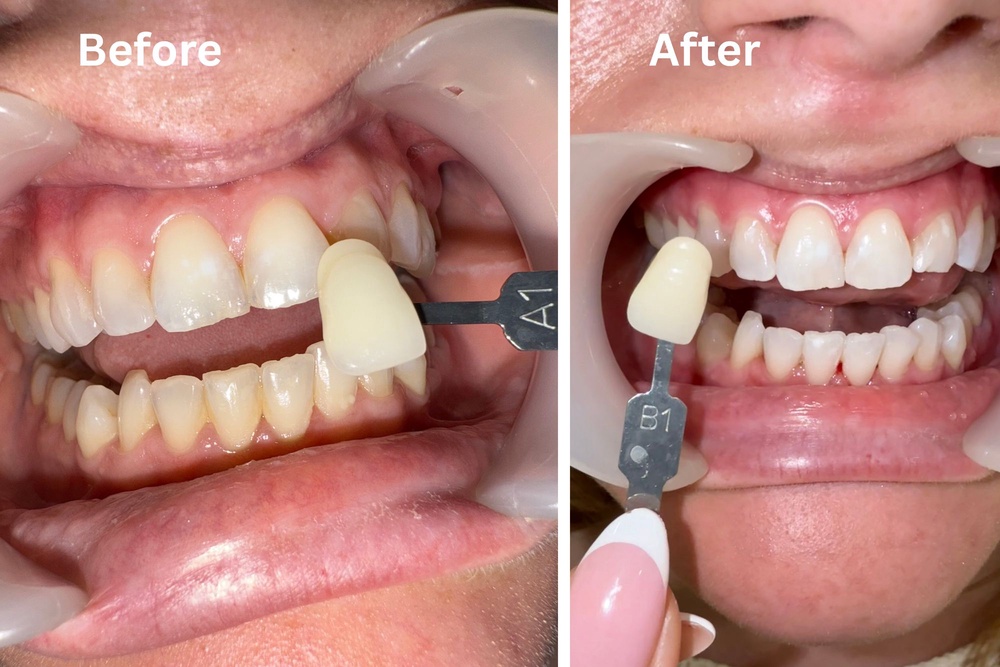
Then came the bit that justifies the price tag: the results. My teeth went from A1 to B1, the lightest natural shade on the chart, with the most noticeable change on my bottom teeth. I was impressed by the before-and-after photographs, although the difference wasn't so dramatic that my family or partner immediately noticed it when they saw me afterwards.
The improvement also made me reconsider how much of the £850 price is about achieving a result that an at-home kit simply can't. On my top teeth, the difference was comparable to what I've achieved with the £55 Smilepro advanced teeth whitening kit, which I rated the best at-home whitening treatment. Despite costing a fraction of the price, I could see my teeth getting brighter after just one 30-minute session.
Smilepro uses PAP (phthalimidoperoxycaproic acid) rather than hydrogen peroxide, with a choice of three LED settings. Blue light is designed to speed up the whitening process, red light is intended to minimise sensitivity and support gum health, or you can use both simultaneously. The treatment is straightforward: apply the formula directly to your teeth, insert the mouth tray and leave it to work for between 10 and 30 minutes. I found the tray comfortable and, even better, experienced no sensitivity during testing. Compared with spending more than an hour largely unable to move in the dentist's chair, it was considerably easier, too.
The Philips Zoom treatment was able to push my teeth from shade A1 to B1, which is something I hadn't managed with strips, gels or LED mouthguards.
There was still a difference in how far the two treatments could take my teeth. The combination of Smilepro strips and an LED mouthguard gave me a visible overall lift and remains the most effective at-home kit I've tested. And probably surprised me more than the Philips Zoom appointment. But after years of home whitening, I suspect I'd already taken my lower teeth as far as they could go. By comparison, the Philips Zoom treatment was able to push my teeth from shade A1 to B1, which is something I hadn't managed with strips, gels or LED mouthguards.
This is where I'm conflicted about the £850 price. I don't think there's any world in which professional teeth whitening can be described as good value in the conventional sense, particularly when I've tested at-home kits for less than £10 that have produced visible results. But if your teeth have plateaued with home whitening, repeatedly spending £50 or £100 on DIY kits that can't take you any further may not be the smartest use of your money either.
For me, Philips Zoom has delivered results I hadn't achieved at home. My top teeth weren't transformed beyond recognition, and I'd happily recommend the £54.50 SmilePro kit to anyone looking for a more affordable way to brighten their smile, particularly if sensitivity is a concern. In fact, based purely on the changes I saw to my upper teeth, I couldn't justify spending £850 on Zoom.
The results on my lower teeth changed my mind slightly. But if your teeth are already relatively white and you want to lift them by a shade or two, I'd save the £795.50 difference and start with a good at-home kit instead.
After all, my own experience is proof that you don't necessarily need a dentist's chair to get a whiter smile. Sometimes you just need the right kit.
Read more: Best electric toothbrushes, tried and tested