
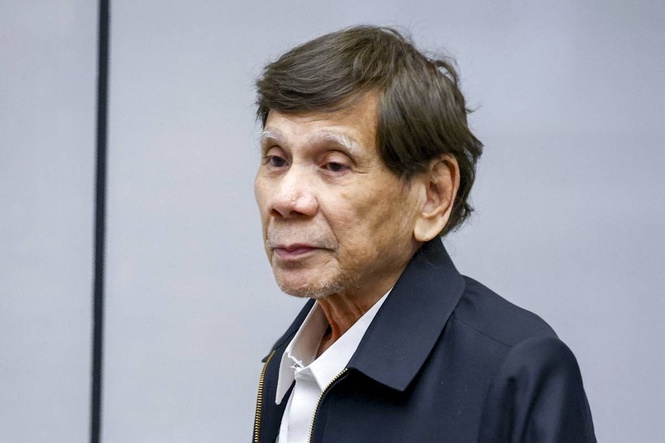
(UPDATE) THE HAGUE, Netherlands — Former Philippine president Rodrigo Duterte is fit to stand trial on charges of committing crimes against humanity during a crackdown on the drug trade, the International Criminal Court said Thursday.
"The chamber was satisfied that the accused is able to effectively exercise his fair trial rights in the proceedings," the court said of the 81-year-old, whose trial is due to start on Nov. 30, 2026.
The judges' decision was based on the findings of an independent panel of experts and submissions from other interested parties and participants.
The three-judge panel also rejected the defense's requests for additional medical examinations and an opportunity to question the court-appointed medical experts, finding their reports sufficiently clear and their conclusions unsupported by contradictory evidence from the defense.
Duterte had the capacity to "understand the charges, understand the purpose and consequences of the proceedings, follow the course of the proceedings," said the experts, quoted in the court ruling dated Sept. 28, 2026 and made public on Oct. 8.
He could also "understand the evidence, and instruct counsel in the preparation and conduct of his defense," they said.
The ruling, however, provides for special measures to accommodate Duterte's age and health needs during hearings, including hourly breaks, hearing aids or over-ear headphones, access to nursing staff and assistance with medication.
The court also ordered continued monitoring of his medical condition, with the possibility of reassessing his fitness if changes in his health warrant a new evaluation.
Noting physical and mental slowing consistent with his age and frailty, the experts found no reliable evidence of significant cognitive decline based on formal testing.
They reported an apparent improvement in his health since an earlier assessment, attributing it to the high standard of medical and nursing care provided at the ICC detention center, including diagnostic monitoring and adjustments to his medication.
The panel noted inconsistencies in Duterte's test performances and concluded that indicators of cognitive deficiency could be explained by underperformance. Any cognitive impairment was characterized as mild, incipient or preclinical and insufficient to render him unfit for trial.
The defense had argued that Duterte suffered from significant memory impairment and cognitive deficits that prevented him from retaining recent information and reliably recalling memories.
It asked the Chamber to direct the neurologist on the expert panel to conduct additional examinations or, alternatively, allow the parties to question the experts about their findings.
The judges rejected both requests, saying the panel had been instructed to conduct examinations it considered necessary to assist the Chamber, rather than exhaust every available medical test.
The Chamber stressed that fitness to stand trial does not depend on whether an accused has particular medical conditions, but on whether those conditions affect the person's ability to exercise fair trial rights.
The judges declined to require hearings to begin at a fixed time of 11 a.m. Instead, they accepted the ICC Registry's proposal to assess sitting hours on a case-by-case basis, taking into account the need to accommodate witnesses testifying by video link from the Philippines and the time difference between the Philippines and The Hague.
The measures are intended to help Duterte participate in the proceedings while addressing his physical limitations and medical needs.
The Chamber appointed a three-member expert panel in June to assess whether Duterte was fit to stand trial. In reports submitted in August, the experts unanimously found that he retained the mental capacity needed to participate effectively in the proceedings.
The former leader appeared in person at the court for the first time in mid-September, faces charges over his "war on drugs" that killed thousands.
Duterte, who ruled the Philippines between 2016 and 2022 and before that was mayor of the southern city of Davao, is the first Asian former head of state to face trial at the ICC.
The tribunal prosecutes individuals for the world's worst crimes such as war crimes and crimes against humanity.
Duterte faces three counts of crimes against humanity, with prosecutors alleging his involvement in at least 76 murders during his offensive from between 2013 and 2018, during his time as mayor and president.


-copy.jpeg?width=1200&auto=webp&trim=0%2C0%2C0%2C0)