M.Krishnamoorthy
A media coach, adjunct professor and author
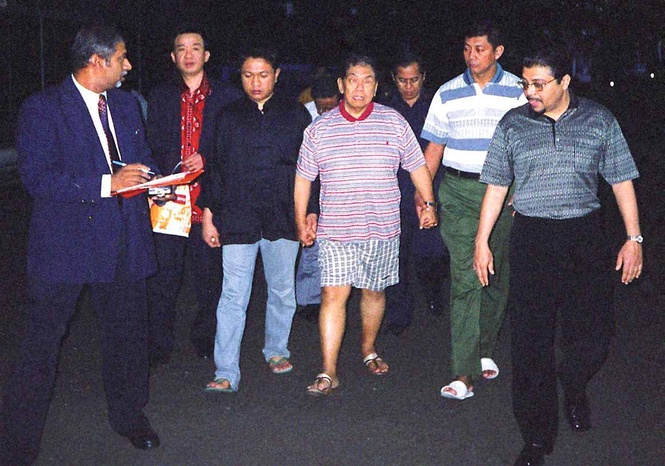
It was the turning point of my life as we entered the new millennium. In mid-March 2000, I had the greatest scoop when I had an exclusive interview with the late Indonesian President Abdulrahman Wahid (Gus Dur). Early in the morning (4.30 am), I walked around the Merdeka Palace and interviewed Gus Dur while he exercised walking around the palace grounds for about one hour.
This was #BackinTime 24 years ago. Following my scoop, former Bernama Editor-in-Chief and chairman Datuk Seri Azman Ujang has nicknamed me “Gus Dur”. Until today, laughingly reminds me of how I scooped every other media that followed Prime Minister Dr Mahathir Mohamad.
Azman and the top editors of the Malaysian media followed Mahathir. The press group arrived at the Merdeka Palace at about 11 am, following Mahathir for the talks with Gus Dur. Some in the media asked the president’s press official for an exclusive interview with Gus Dur. They were shocked that Gus Dur had already been interviewed by The Star in a pre-dawn walkabout with him in the palace at 4.30 am.
They got angry and fumed with the Palace officials “There was no way Gus Dur could be interviewed because they all came on the same plane.
A palace press officer told them: "Krishna got here yesterday, stayed in the palace and interviewed Gus in a pre-dawn walkabout. He was not on your flight." Then, the journalists gave up asking for an exclusive with Gus Dur. Almost blind, Gus Dur, is indeed “a great philosopher, thinker, and most of all, someone who had great love and warmth for the people.”
Here is the beginning of the two-page feature in The Star, 12 March 2000.
It was midnight, and I travelled in a chauffeur-driven Mercedes Benz from the Istana (palace) with my friend Datuk Ravi Dharan, Indonesian President’s Adviser.
I arrived at the Pan Pacific Hotel in Jakarta a little after midnight, and Ravi had earlier called me from the palace to say that my appointment with President Gus Dur was at 4.30 am, about four hours away.
Ravi, who had arranged the appointment, asked me to stay at the palace because the gates open at 9 am.
I had a power nap at 3 am and was woken up an hour later by Ravi. He walked me through three security posts into the Presidential Palace conference room which which was in a building adjacent to the state guest rooms.
While we waited, I rehearsed the scene of greeting the president in my mind repeatedly. At 5 am, President Abdurrahman Wahid dressed casually in a red and white striped T-shirt, Chequered Bermuda shorts and slippers. He was munching on a Chinese herbal biscuit.
In the room, palace staff were busy rearranging furniture used for the previous night's dinner function.
They were preparing the room for the bilateral talks scheduled at noon between the president and Malaysian Prime Minister Datuk Seri Dr Mahathir Mohamad and his delegation.
Comfortably seated in an arm-visitor’s room, which was in a chair, he picked up another of his energising biscuits from a plate and chewed on it.
"Hello," he said, extending his hand when Ravi introduced me.
"Good morning, Mr President. It's an honour, to meet you, Sir."
"Please sit down," he gestured towards the chair beside him while eight plainclothes security and police officials positioned themselves behind him.
"You don't mind, I munch my biscuits. This is good for health, you know. I eat this every morning at this time and then walk around the palace for about an hour," he spoke softly in fluent English.
Mr President, you are looking fine and healthy. Raising his head and looking directly at me, Indonesia's fourth President, who is suffering from near blindness (about 20% vision) following a stroke, said, "Call me Gus Dur."
I continued, "Gus Dur, the public's perception of you through the media is that of a frail person walking around, held by your daughter's arm, and with officials flanking you." He laughed exuberantly at that comment I made.
His laughter was so contagious that his security personnel, Ravi and I could not help but join in. Switching on my tape recorder, I continued: “Yesterday, a news report in the Middle East stated that you had been admitted to hospital."
"I don't know where they got that news and what the report was trying to achieve," he laughed again. "Certainly, this place does not look like a hospital.” At this point, his ADC stepped forward to signal that it was time to move on. Gus Dur continued to joke about politicians and diplomats without heeding the signal.
Gus Dur, the first freely chosen president in Indonesia, described himself as a follower of Gandhi, who believed in the philosophy of Ahimsa (non-violence).
"I am also a firm believer of Satyagraha (truth) or passive resistance that Gandhi started," he said.
The president spoke without inhibitions, was bright and chirpy, and laughed after every anecdote.
He talked about his father, Indonesia's third Minister of Religion. "I learned a lot from my father and mother, who influenced my life and thinking."
His ADC soon returned and politely whispered it was time to walk and exercise. Outside the palace, it was still dark, but it was a lively walkabout as we were all kept in high spirits by the president's wisecracks, wit and wisdom.
His answers to my questions as we were walking were spontaneous and candid, even compassionate questions like why he wavered in firing General Wiranto or why a Muslim nation is establishing economic relations with Israel.
It was clear that Gus Dur was open and flexible in democratising Indonesia. Gus Dur's broadmindedness was cultivated from his studies in Baghdad and Cairo and his visits to several European universities before returning home to a knowledgeable person in the mid-70s.
He began his career as a Jakarta-based social activist and wrote a series of remarkable columns in Tempo magazine. As a young man struggling to be a leader, he had a sharp mind, which led him to question existing institutions and practices even within his Islamic organisations.
When asked about his transition from a military regime to a democratic nation, he reiterated that he wanted to demonstrate that a people's fair government would take shape. "Human values and people-minded fair practices are necessary to transition towards a modern and just society."
His concept of East and West traditions of democratic practices will be gradually introduced.
An adept political tactician, he has carved out and defended his position as the leading protagonist of democracy in the repressive and Reformasi days of the Suharto Government.
The interview continued and was one of the shining moments in the long historical Pentium wave of my career. Whatever I pursued as a journalist for 35 years, I always wanted to be different—always thinking big, using the BHAG (Big Hairy Audacious Goals) principle with courage. This is how, as a student leader in the United States, I got to invite President Jimmy Carter. At the 1982 World’s Fair held next to the University of Tennessee, Knoxville, I chaired the meeting with him sitting next to me. The meeting with 20 student leaders was up close and personal with the president.
Freelance Writer M. Krishnamoorthy (www.imkrishna.net) is a media coach, adjunct professor and undercover journalist. He has freelanced with Bernama, NST, The Star, and Malaysiakini. He also freelances as a fixer/coordinator for CNN, BBC, German and Australian Television networks and the New York Times. As an undercover journalist, he has highlighted society's concerns.

Submit your #BackInTime stories that revolve around the theme of nostalgia and stand a chance to win prizes worth up to RM8,000! Find out how you can participate here.
M. Krishnamoorthy is a content creator under the Newswav Creator programme, where you get to express yourself, be a citizen journalist, and at the same time monetize your content & reach millions of users on Newswav. Log in to creator.newswav.com and become a Newswav Creator now!
The User Content (as defined on Newswav Terms of Use) above including the views expressed and media (pictures, videos, citations etc) were submitted & posted by the author. Newswav is solely an aggregation platform that hosts the User Content. If you have any questions about the content, copyright or other issues of the work, please contact Newswav.