
JAKARTA - Everyone keeps saying Jakarta is “not for beginners.” Bukan untuk pemula. The phrase is everywhere: among ojol drivers starting ‘on bid’ before dawn and office workers fighting through the CSW TransJakarta hub, Manggarai, or Tanah Abang at rush hour.
In the 1981 comedy Kejamnya Ibu Tiri Tak Sekejam Ibu Kota, Ateng arrives in Jakarta chasing a better life and eventually says, “Ternyata kejamnya ibu tiri tak sekejam Ibu Kota,” which roughly translates, “Turns out, even a stepmother isn’t as cruel as the capital.”
Writer Rugun Sirait gives the phrase another form: Jakarta keras, or “Jakarta is tough.” In a 2025 essay, she describes the capital as a “tough city to survive in,” pointing to high living costs and pressure at work.
Jakarta is too crowded, everyone says, while the economy keeps giving people perfectly rational reasons to stay close.
That is the trap and the bargain. Jakarta’s hustle culture comes with a simple rule: step up or step aside. Once people step up, the next demand is to keep up. A 2026 study of employees working in Jakarta found that hustle culture was significantly associated with greater conflict between work and leisure. In other words, the grind follows (or haunts) people home.
The researchers warned of ‘workaholic norms’ and ‘the normalization of excessive work practices that may undermine employees’ opportunities for leisure and recovery.’
Jakarta’s Uneven Economic Pull
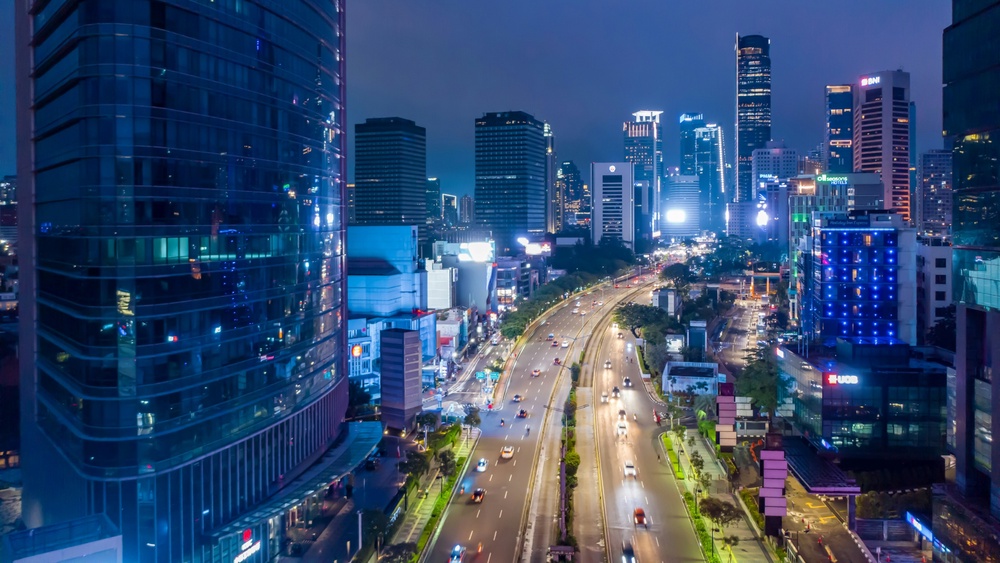
Traffic cuts through Sudirman after dark, surrounded by office towers and high-rises in one of Jakarta’s most concentrated economic corridors. Photo: Rifki Kurniawan / Unsplash.
Calling Jakarta “overpopulated” is simply too inaccurate. People tend to gather where livelihoods concentrate. Ancient Egyptians settled along the Nile because water and fertile land were there. Today, Jakarta’s density follows the same basic logic. Opportunity has accumulated here, so people follow it.
In 2025, BPS data put Jakarta’s contribution to Indonesia’s economy at 16.61 percent, ahead of East Java and West Java. That is nearly one-sixth of Indonesia’s economy packed into an area of about 664 square kilometers, where BPS data put population density at around 16,129 people per square kilometer in 2026, or roughly 62 square meters per person.
The imbalance looks stranger beside the population numbers. The same BPS data estimate that Jakarta contains only 3.72 percent of Indonesia’s population in 2026. Its share of the national economy is about 4.5 times its share of the population.
That’s also one capital region carrying more of the national economy than entire provinces with far larger populations, land, industries, universities, and political constituencies. The market in Jakarta is simply too big and too attractive to miss. That market pulls workers, firms and ambition toward it.
That concentration itself is not automatically bad. The World Bank has argued that urban agglomeration can raise productivity by putting workers, firms, services, and markets closer together. The problem is what it calls “congestion forces”: pressure on infrastructure, basic services, land, housing, and the environment that starts eating into those gains.
Jakarta, however, manages to produce plenty of both.
In daily life, this means a fresh graduate tiptoeing through an AI slop- and nepotism-filled job market can still attend several interviews in one week without leaving Greater Jakarta. Or, when one recruiter ghosts them, another office, agency, NGO, startup, newsroom, ministry, bank, or foreign-owned company is still somewhere along the same train line or bus corridor.
There’s an imbalance that’s larger than Jakarta itself, too. BPS recorded that Java island contributed 56.93 percent to Indonesia’s economy in 2025. More than half of national output sits on one island. So when people leave Makassar, Banjarmasin, Medan, Kupang, or Palembang for Jakarta, the decision is practical.
There is nothing irrational about moving to a place that promises a better life. To a lot of Indonesians, Jakarta is the least risky bet. The first salary that can make their parents proud is mostly here. The first boss who’d bet on a fresh graduate is also (mostly) here.
Jakarta’s migration story makes the “overpopulated” label even messier. The Long Form 2020 Population Census found that roughly 31 out of every 100 Jakarta residents were born in another province. But the 2025 Intercensal Population Survey found more recent migrants moving out of Jakarta than into it, with net recent migration at -5.40 percent.
That said, living *in *Jakarta and depending *on *Jakarta are increasingly two different things.
Commuting Is the Price of Opportunity
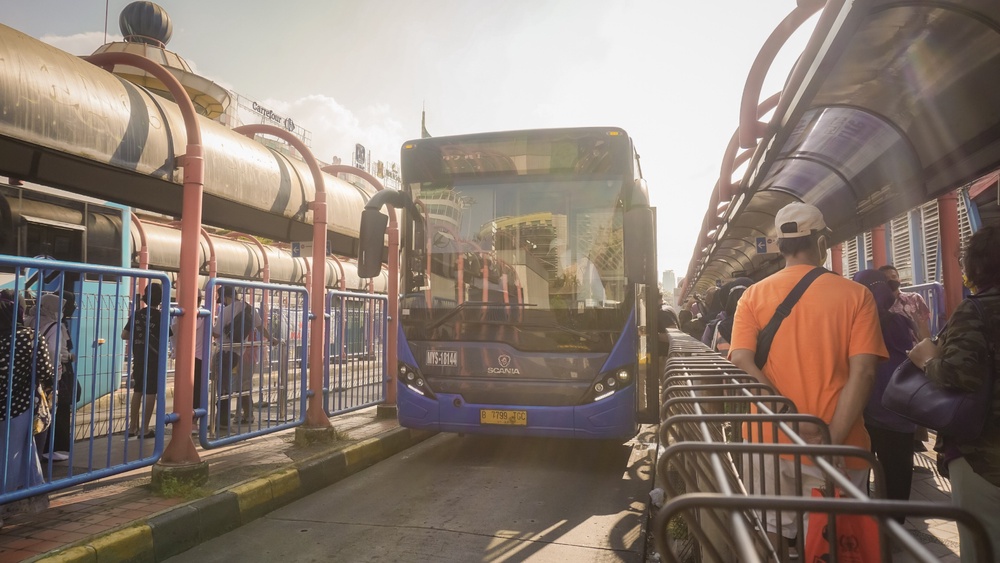
Passengers queue for TransJakarta at Blok M, part of the daily movement that sends millions of commuters across Greater Jakarta for work and study. Photo: Atmawinanda / Wikimedia Commons, CC BY-SA 4.0.
In Jakarta, missing one train or bus can mean losing another hour of life.
The city also punishes the last mile, because walking itself is made irrational. The heat is real, but so are the missing sidewalks, broken pavements, parked motorcycles, and kaki lima also trying to survive in this brutal economy.
The 2023 BPS Jabodetabek Commuter Survey has a number for this chaos. Using that publication, the Rujak Center for Urban Studies counted over 4.4 million commuters in Jabodetabek, including 3.6 million worker commuters.
Another Universitas Indonesia study analysed conversations involving 160 Jabodetabek residents and commuters across six WhatsApp groups. Its conclusion was unusually blunt for an academic paper: congestion “leads to increased costs and losses and causes distress.”
In Jakarta’s mornings, that number becomes a crowd. Millions of lives cross invisible administrative lines just to make rent, answer emails, sit in meetings, serve customers, attend classes, or keep a job with a “competitive salary” that’s competing against their basic needs.
The health effects show up too. A 2025 study of Jabodetabek commuters linked commuting stress with poorer self-rated health and sleep quality, while longer travel times were associated with greater stress.
Jakarta has spent years improving how people move across the city.
TransJakarta, the world’s longest bus rapid transit system, now reaches far beyond its original corridors. The MRT has made the trip between South and Central Jakarta faster and more predictable, and its northward extension is already under construction, with Bundaran HI–Monas targeted for 2027 and the line to Kota for 2029.
The LRT networks have added other links, while free Mikrotrans feeders under the JakLingko system reach neighbourhoods where full-sized buses often cannot.
But mobility is still shaped by where people can afford to live.
Pick a Struggle: Housing or Distance?
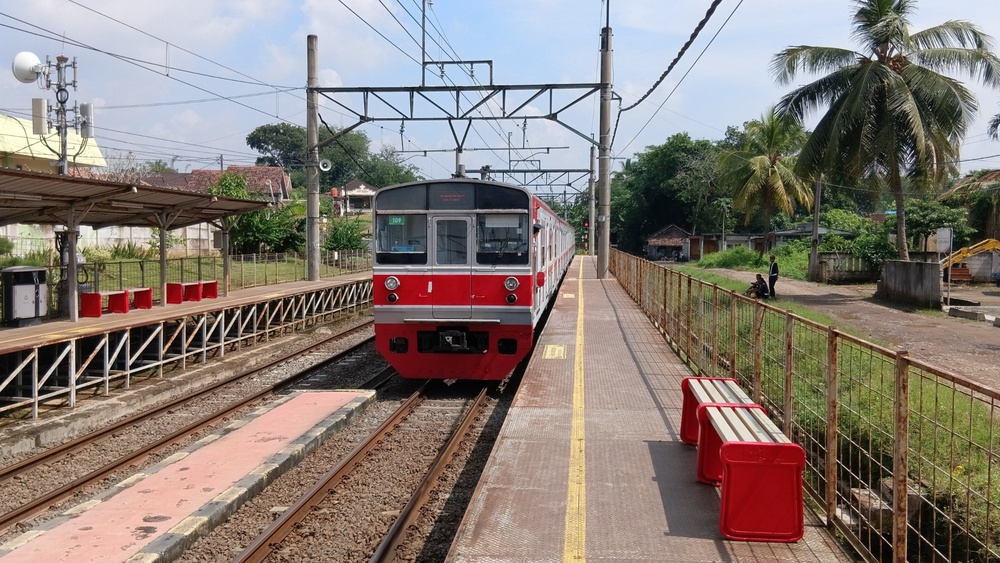
A KRL train leaves Tenjo in western Bogor, one of outer Jabodetabek’s housing areas where a lower property price can come with a longer commute. Photo: Jauhsekali / Wikimedia Commons, CC BY-SA 4.0.
Why not move closer to the office? The answer is partly carved into the capital’s geography, because closer usually costs more.
In Jakarta, money can buy a better home and a shorter commute. That sounds obvious, but in Jakarta it shapes entire working lives. The office may be in Sudirman, Kuningan, Thamrin, or another employment centre. The housing that fits the salary may be somewhere else entirely.
That gap is where the commute comes from.
People with more money have more ways to close it. A 2022 study on spatial sorting of rich and poor residents in Jakarta found that “the urban rich tend to live in the city centre.” Under Jakarta’s congestion, the researchers found, the cost of time spent commuting rises sharply with income. Money, in other words, can buy proximity.
Further down the income ladder, the calculation works differently. Research involving 400 low-income residents in suburban Greater Jakarta found proximity to work was one of the main things people wanted from housing. Yet many still chose homes outside urban Jakarta because they could not afford a suitable living environment inside it.
So distance is often what remains after the affordable options are counted.
That mismatch is still visible among younger workers today. A 2026 study of 450 people aged 20 to 39 in metropolitan Jakarta found that 57 percent commuted across municipal boundaries. The researchers called it a “persistent spatial mismatch between residential and employment zones.” Middle-income respondents earning Rp5 million to Rp15 million were particularly sensitive to both housing affordability and proximity to mass transit.
The job and the affordable home are often not in the same place. Even the government’s subsidised housing programme runs into the same geography. Under the current rules, the maximum sale price for a subsidised landed home in Jabodetabek is Rp185 million, with a minimum land area of 60 square metres.
At that price, housing becomes easier to build where land is cheaper. BP Tapera’s own listings show Rp185 million subsidised housing projects across outer Jabodetabek, where cheaper land makes the programme easier to build but can leave buyers far from Jakarta’s main employment centres. A Tenjo project listed through SIKUMBANG platform, for example, offers a 30-square-metre house on 60 square metres of land at the Rp185 million ceiling.
The Housing Ministry has urged developers to build subsidised homes closer to public transport, while newer plans have increasingly turned to vertical and transit-oriented housing near railway stations, state land and industrial areas.
For many buyers, affordable housing means accepting a longer commute.
Jakarta’s wider housing numbers make that gap harder to ignore. In April 2026, BPS said 40.59 percent of households in Jakarta did not own their homes, the highest provincial homeownership backlog in the country. In Central Jakarta, the figure reached 55.83 percent.
Renting close to work may solve the distance problem, but it still leaves workers exposed to Jakarta’s wider housing costs.
The World Bank’s June 2025 report found that about one-quarter of people in Jabodetabek and Jakarta City live in overcrowded homes. Someone seeking opportunity in Jabodetabek would need to devote roughly another 10 percentage points of their budget to move there. For Jakarta City, the additional cost rises to around 20 percentage points.
The same World Bank report says Indonesians are moving out of high-income areas because affordable housing is missing, the opposite of the pattern commonly seen elsewhere, where people move toward richer places for better jobs.
And this is not a small urban housing gap. The report says nearly 80 percent of Indonesia’s new-housing backlog is concentrated in urban areas, with Jabodetabek among the largest shortages. In Jabodetabek, commercial housing can cost around four to five times the price of subsidised housing.
A lot of people live far because distance is what they can afford.
A Fair Country Needs More Doors Outside Jakarta
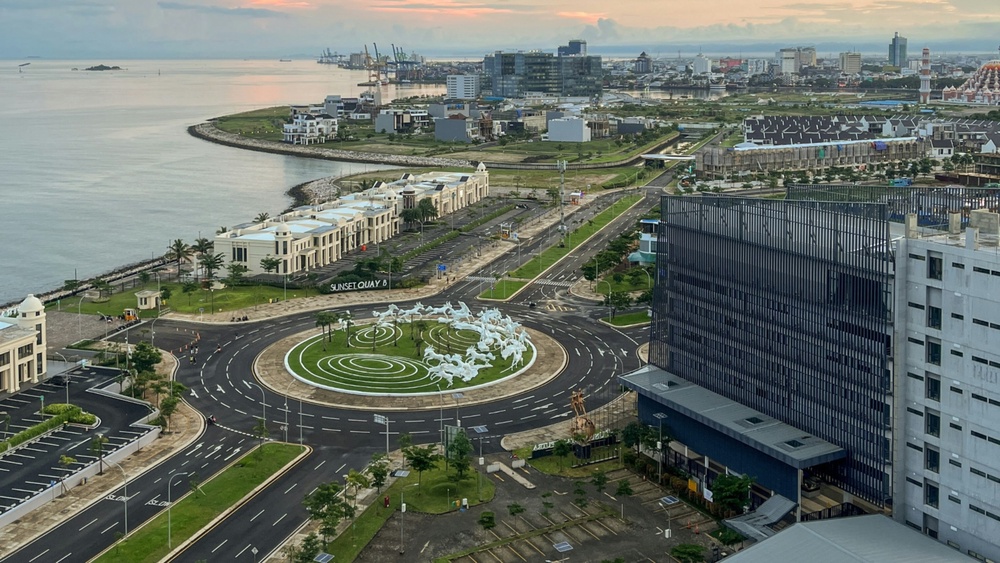
Makassar’s waterfront and growing urban core in South Sulawesi, one of the cities Indonesia has identified as a metropolitan growth centre beyond Jakarta. Photo: Farhan Syam / Unsplash.
Indonesia has Nusantara, at least as a national plan that may change the country’s administrative and political geography. But in May 2026, the Constitutional Court affirmed that Jakarta remains Indonesia’s capital until a presidential decree transfers that status to Nusantara.
But economic geography? That’s something else, because moving economic opportunities is harder than moving a capital.
Brazil already learned that distinction. It moved its capital from Rio de Janeiro to Brasília in 1960, a case Bappenas itself studied while preparing Indonesia’s own capital relocation. Brasília became the political centre. São Paulo remained the economic giant; its metropolitan region still accounts for more than one-fifth of Brazil’s economy.
Germany shows another possibility. Berlin is the political centre of Europe’s largest economy, but it produced only about 4.8 percent of German GDP in 2024. The country’s economic weight is spread across cities that developed different strengths: Frankfurt, Munich, Hamburg, Stuttgart and others. The OECD describes Germany’s urban system as polycentric.
Berlin gets to be Germany’s capital without having to be Germany’s everything. That said, Indonesia does not need to become Germany, and Nusantara does not need to become Brasília. The point is that political centrality and economic centrality are choices that can be separated.
And once too much accumulates in one place, untangling it gets difficult. South Korea has spent decades trying to untangle Seoul’s dominance, including through Sejong and the relocation of public institutions to regional cities.
Indonesia already recognises the same problem on paper.
Bappenas has identified 10 metropolitan regions as national growth centres: Medan, Palembang, Jakarta, Bandung, Semarang, Surabaya, Denpasar, Banjarmasin, Makassar and Manado, together with their surrounding urban areas. Last year, it also launched the National Urban Policy 2045, which puts more balanced urban development and stronger connections between cities at the centre of long-term planning.
What matters now is whether people *actually *believe they can build a life in them.
Makassar, Medan, Surabaya and Manado need the things that make Jakarta become economically attractive: employers willing to hire, universities that lead somewhere, access to capital, decent infrastructure, and professional networks that do not require a move west.
Staying should feel like a choice. The World Bank’s June 2024 report identified slowing progress in reducing regional income disparities, alongside limited geographic mobility that makes it harder to match workers with jobs and places offering better living standards. Its urbanisation work also projects that around 220 million Indonesians, more than 70 percent of the population, will live in urban areas by 2045.
For decades, Indonesians have moved toward opportunity. More of that opportunity could start moving outward too.
That future cannot only mean more people joining the same queue at Dukuh Atas, Manggarai, Jatinegara, or Tanah Abang. Public transport is great, and Jakarta is better because of it. But right now, it still feels like a patch, tambalan, over a country that keeps sending everyone to the same city for a fair shot.
Indonesia needs more doors where staying is a serious option.
Jakarta will keep mattering. It is where Indonesia declared independence, and where *Reformasi *happened in 1998. The reform needed now, however, is to stop asking every ambitious Indonesian to pay in time, rent, sleep, and distance just to have a slightly fairer shot at a decent life.
Jakarta should also be friendly to beginners.