
URDU has always been known as the language of adab, romance and culture. Initially called the ‘lashkari zuban’, interestingly this language of ‘ishq’ originated in military camps around the time of North-west India’s conquest by Muslim rulers, and takes its name from the Turkish word ‘Ordu’, meaning army. An amalgamation of various languages, including Persian and Arabic, Urdu also has words from vernacular languages and dialects like Khadi Boli and Braj Bhasha.
Till Partition, it remained the lingua franca and even the medium of instruction in many parts of India. Partition not only divided the subcontinent but also its languages, culture and even religious identities. Urdu disappeared from our schools, literature, and our hearts too, branded as the language of the Other.
For the next few decades, it barely survived, confined only to scholarly and reclusive circles. The knowledge about its script faded but the romance and attraction of Urdu and its adab remained in public consciousness, as Bollywood carried its torch forward through Muslim Socials, including classics like ‘Chaudhvin Ka Chand’, ‘Mere Mehboob’, ‘Pakeezah’, ‘Umrao Jaan’, etc. Most of these films had melodious ghazals and qawwalis which are popular till today.
Ghazal artistes like Begum Akhtar, Mehdi Hassan, Farida Khanum, Ghulam Ali, Jagjit Singh and others kept the flame alive, as did efforts by Hindi publications like Rajpal & Sons, Vani Prakashan and Rajkamal Prakashan to popularise Urdu literature and poetry among the masses by publishing it in the Devanagari script.
The language limped along on the margins till one man’s passion and love for it changed its fortunes. In 2012, entrepreneur Sanjiv Saraf, founder of Polyplex Corporation Limited, returned to his first love: Urdu.
In one of his articles in The Tribune in 2023, Saraf wrote that he started learning the language at 52 to “discover the original Urdu content not published in Devanagari or Roman; there was not much available online as well”. The IIT passout started the Rekhta Foundation (named after one of Urdu’s earliest names) more as a passion project in 2013, but it took on a life of its own. The website has become the largest online repository of Urdu literature in the world. “Urdu is such a beautiful language, specially the poetry. I felt it should reach everyone. The initial idea was to provide a platform where reliable and complete content is accessible to people who can’t read Urdu,” says Saraf.
Urdu poet and academic Farhat Ehsas has been part of the foundation’s journey since its inception. “Before Rekhta, there was no website that had Urdu poetry and literature available simultaneously in Urdu, Devanagari and Roman in an authentic form,” says Ehsas, who along with a large team, is also digitising Urdu books available in libraries and private collections, many of them rare and last surviving copies.
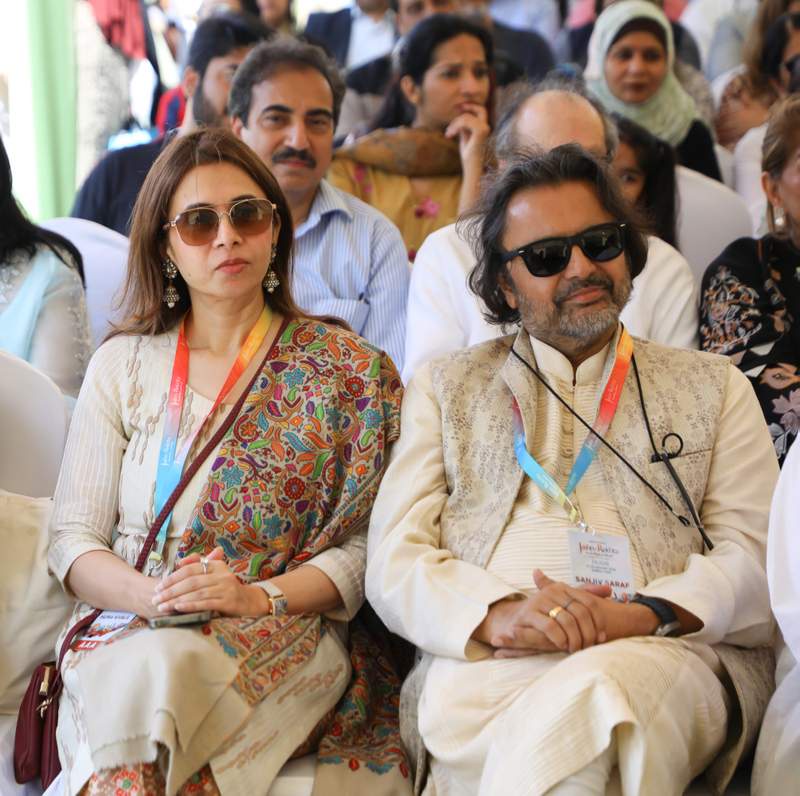
Huma Khalil and Sanjiv Saraf.
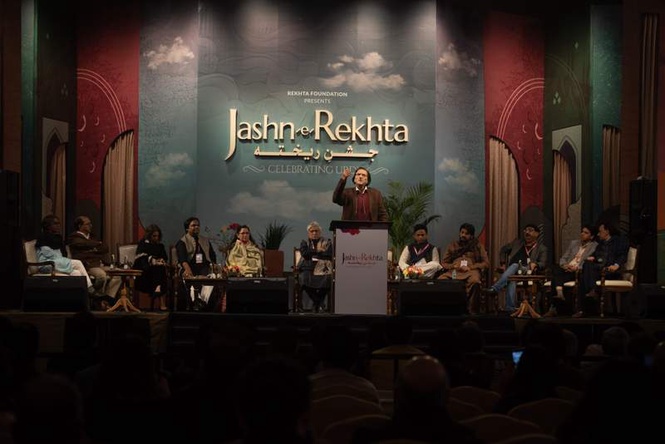
Jashn-e-Rekhta, first held in Delhi in 2015, was a game-changer in terms of lending a mass appeal to Urdu. “It has become a huge cultural and revolutionary movement that has changed the ownership of Urdu. Not only non-Muslims, but a large number of young poets have also learnt the language and script and are writing poetry in Urdu,” adds Ehsas. Besides a Grand Mushaira for established names, the festival also hosts a Young Poets Mushaira to showcase these emerging voices.
Rekhta’s creative director and Saraf’s spouse, Huma Khalil, says Jashn-e-Rekhta may have become the face of the foundation but the website remains its biggest contribution to Urdu’s preservation and spread. “More than three lakh books are freely accessible. Another significant feature of the website is an inbuilt dictionary which provides the meaning of any word at a click in Urdu, Devanagari and English, along with its origin, grammar, etc,” adds Huma, who has also made two documentary films, and is writing the script of her next film, a biopic on a major progressive writer.
Constant change and improvisation remain core values at Rekhta, says Huma. “Two years back, we also launched a ‘Qafiya’ dictionary where upcoming poets check if their shayari is in the correct metre and rhyme or not.”
The foundation’s publishing wing, which started full time in 2018, has brought out 250 books till date, starting right from Amir Khusro’s works to Rumi, Kabir, Mir, Ghalib and the new, upcoming contemporary poets.
Rekhta also has a learning division which offers online courses in learning script, pronunciation, ghazal writing and poetry appreciation. “There are students from all parts of the world. The youngest is 20 and the oldest perhaps 90,” says Mahendra Kumar Sani, a poet who quit a corporate job, and has been teaching at the foundation for nearly three years.
Rekhta started its YouTube channel in February this year. Within four months, it has more than 24 lakh subscribers. “By leveraging technology, we seek to preserve the language. The idea is to keep Urdu experiential on a day-to-day basis in engaging formats so that it stops being perceived as an inaccessible, alien language,” says Huma.
There are plans to soon start a Rekhta Studio on the lines of Coke Studio. “We have already shot a 50-song album using lesser known forms of Urdu poetry like manqabat or naat, which we should start releasing soon,” adds Huma, who also plans to introduce more content like short films, documentaries, biopics, etc.
In this journey to make Urdu relevant to the next generation, the foundation has also come under criticism from purists, in particular about Jashn-e-Rekhta turning literally into a mela, inviting Bollywood stars to attract crowds.
Khushbir Singh Shaad, a Jalandhar-based poet whose 12 books of Urdu ghazals are a part of the website, calls it ‘something necessary’. “Even if youngsters are coming to listen to these celebrities, they are also being exposed to all kinds of poets and poetry.”
Accessible in 120 countries, Rekhta is equally popular in Pakistan. US-based Pakistani poet Ikram Basra dubs the website’s contribution second only to John Gilchrist’s English to Urdu dictionary (1790). “I use it a lot for reference. For readers in Pakistan, whether they are students, researchers, or writers, this is an important literary medium, and a valuable source. Rekhta has secured our joint literary heritage.”
Rekhta Punjabi
Rekhta has replicated its preservation model for other languages, including Hindi, Gujarati and Rajasthani. In the next few months, the foundation will be launching its Punjabi website to document and preserve the rich and diverse literary heritage of undivided Punjab. It will be available in Gurmukhi and Roman. Shahmukhi would be added later.
Poet Imroz Mann, part of the editorial team which includes many Punjabi scholars, researchers, translators and eminent writers, says the website will have contributions of Sikh Gurus such as Guru Nanak Dev and Guru Arjan Dev, Punjabi Sufi poets including Baba Farid, Hazrat Sultan Bahu, Waris Shah, and many more. The platform will also feature modern Punjabi voices such as Prof Puran Singh, Dhani Ram Chatrik, Prof Mohan Singh, Amrita Pritam, Shiv Kumar Batalvi, Paash, Surjit Patar, Lal Singh Dil, Tanvir Bukhari, Afzal Sahir, Rauf Sheikh, etc.
It will also feature the works of contemporary writers and poets like Gurtej Koharwala, Dr Vanita, Jaswinder, Swaranjit Savi, Mohanjit, Surjit Sakhi and Shahmukhi poets like Zafar Iqbal, Samina Asma, Zubair Ahmad, Ahmad Saleem, and others.
Amarjit Chandan, a UK-based Punjabi poet, whose works will also feature on the website, is helping the team curate works of many Punjabi poets from both sides of the border, including Najam Hussain Sayed, Mazhar Tirmazi and Munir Niyazi. He feels, though, that Punjabi literature should not be limited to Gurmukhi or Shahmukhi languages, but categorised as literature written by Punjabis in any language.