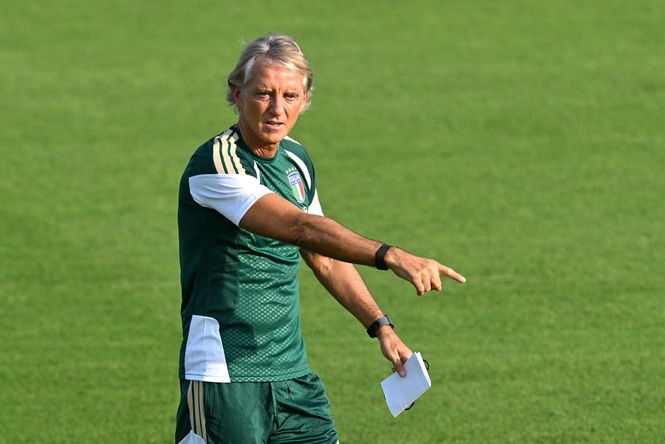
ROME: After months of controversy, uncertainty and calls for change, Italy are ready to turn their attention back to football as Roberto Mancini begins his second spell as national team coach.
The Azzurri will launch their UEFA Nations League campaign on Friday when they host Belgium at the Stadio Olimpico in Rome.
The match will be Italy’s first competitive outing since their play-off defeat by Bosnia and Herzegovina in March, a result that condemned the four-time world champions to a third consecutive absence from the World Cup.
Since that painful defeat in Zenica, Italian football has undergone major changes.
Mancini, who guided Italy to European Championship glory at Euro 2020, has returned to lead a revamped squad containing several young and inexperienced players.
“We have to take the national team back to where it deserves to be,” Mancini said on Monday.
“I’m here to win and I’m sure we’ll enjoy some great moments.”
There have also been significant changes behind the scenes.
Claudio Ranieri has taken up the position of technical director, while former Italy international Gianfranco Zola has been appointed youth projects coordinator. Giovanni Malago, who headed the Milan-Cortina Winter Olympics, became president of the Italian Football Federation (FIGC) in June.
The overhaul followed widespread demands for fundamental changes to Italian football after the latest failure to qualify for the World Cup, meaning another generation of supporters will grow up without seeing their national team compete at the tournament.
The changes, however, have not come without further turmoil.
Coach Gennaro Gattuso, delegation chief Gianluigi Buffon and FIGC president Gabriele Gravina all departed following the defeat in Bosnia.
After taking over at the FIGC, Malago’s first major decision was to appoint AC Milan great Paolo Maldini as technical director and task him with finding a new head coach.
Maldini’s search for a coach
Maldini initially approached Brazil coach Carlo Ancelotti before turning his attention to Pep Guardiola.
“We went to meet him in Barcelona, we had lunch together, we talked for an entire day. He was very tempted,” Maldini told Corriere della Sera.
“He came very close to accepting. He even started writing line-ups down on sheets of paper.”
Maldini said financial considerations were not a factor, claiming Guardiola’s decision was instead influenced by exhaustion following the end of his decade-long tenure at Manchester City this summer.
Maldini then considered former AC Milan team-mate Andrea Pirlo for the position.
However, Pirlo withdrew from consideration amid controversy surrounding his role as a global ambassador for a Russian betting company. The former midfielder said the position was “exclusively commercial and sporting in nature”.
The episode ultimately resulted in Maldini and his adviser Leonardo leaving their positions after only 16 days.
Maldini later said the pair had departed because “the conditions of trust no longer existed” with Malago, leaving the FIGC to restart its search.
Mancini subsequently became the preferred candidate and was appointed in July, although his return proved controversial.
The 61-year-old has an impressive record with Italy, but his decision to leave the national team in August 2023 for a lucrative position in Saudi Arabia remains a source of anger among some supporters.
Following the announcement of his return, Rome-based newspaper Corriere dello Sport published an open letter accusing Mancini of “betrayal” and arguing that “apologies are not enough”.
Sky Sport pundit Paolo Condo similarly criticised his previous departure, saying that leaving the national team for a lucrative contract should have represented a “road of no return”.
Mancini addressed the criticism directly when he was presented as Italy coach.
“I’m very sorry. The Italy shirt was always very important to me. It was like losing the love of my life,” he said.
His first squad also signalled a clear shift in direction, with nine new players included in a 34-man selection.
Among the newcomers were youngsters Alessandro Romano and Eddy Kouadio, along with players based outside Italy, including Sporting Lisbon midfielder Issa Doumbia, Brentford’s Michael Kayode and Nuernberg striker Mohamed Ali Zoma.
“I think it’s right to have young players so we can get to know them directly, because that’s the most important thing to have a very strong squad in the future,” Mancini said.
“We have to be quick to understand who could be the players that could be with us for the next four years.”
After Friday’s meeting with Belgium, Italy will face Turkey twice, with a trip to France under Zinedine Zidane sandwiched between the two fixtures.