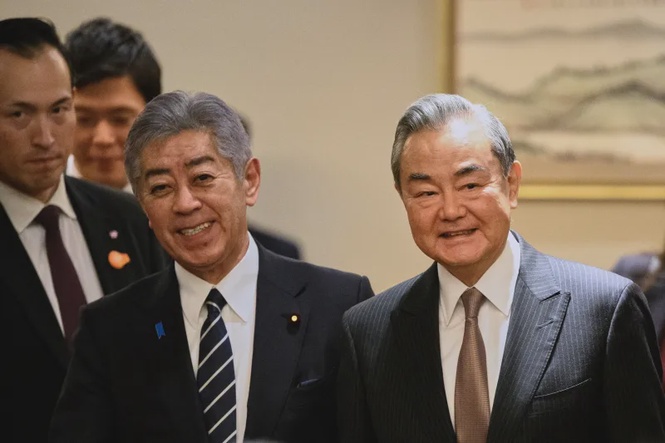
Former Japanese Foreign Minister Takeshi Iwaya met Chinese Foreign Minister Wang Yi in Beijing on September 28, then met Vice Premier He Lifeng at the Great Hall of the People the following day. Iwaya traveled as chairman of the Japan Association for the Promotion of International Trade (JAPIT), one of seven Japanese groups known collectively as the Japan-China friendship organizations, a post he took up after the death of longtime chairman Yohei Kono. Kyodo News, in a dispatch carried by the Sankei Shimbun, reported that the meetings marked the first time China's leadership had met a Japanese lawmaker since relations soured last November over Prime Minister Sanae Takaichi's remarks on a Taiwan contingency, and called the scheduling of talks on two consecutive days unusual; both Wang and He sit on the Communist Party's Politburo. It was not, however, the first contact between Chinese officials and Japanese Diet members this year: Vice Foreign Minister Hua Chunying met lawmaker Gaku Hashimoto, then JAPIT's acting chairman, in June, and Lu Kang, a vice minister of the Communist Party's International Department, met a cross-party group of three Japanese lawmakers in late August.
What Triggered The Rift Was A Parliamentary Answer On Taiwan
The dispute traces back to a parliamentary answer Prime Minister Sanae Takaichi gave last November, in which she said a Chinese attack on Taiwan involving warships and the use of force could constitute what Japanese law calls a "survival-threatening situation." Under Japan's security legislation, that designation applies when a country with close ties to Japan comes under armed attack in a way that clearly threatens Japan's own survival and its people's fundamental rights, allowing Japan to exercise its right of collective self-defense; it is not limited to formal treaty allies, and it does not automatically mean Japan would take joint military action alongside another country. Beijing read the remarks as suggesting Japan would intervene militarily in a Taiwan Strait contingency and soon after demanded Takaichi withdraw them.
Wang Yi's Three Conditions, And How Much Actually Changed Since November
China's own account of the September 28 meeting, published by China's embassy in Tokyo, quotes Wang Yi telling Iwaya that China-Japan relations need to achieve normalization once again, and laying out three requirements he called urgent, important, and fundamental: swiftly correcting the erroneous words and deeds of Japan's leader on the Taiwan question, adopting a correct stance on historical issues, and building an objective and rational understanding of China. Wang also noted that this year marks the 80th anniversary of the opening of the Tokyo war crimes tribunal, and said that if Japan refused to learn from history, challenged its postwar "pacifist constitution," or even sought to overturn the verdict on its wartime aggression and rehabilitate war criminals, it would be unable to face the world and would have no future.
One word choice has drawn notice in Japan: China's statement asked Japan to "correct" the remarks and did not use "withdraw," the term Beijing's foreign ministry used when the dispute first broke out. A commentary on Yahoo News Japan's expert platform ran under the headline "'Retraction' Has Vanished". But the Jiji Press wire on the meeting, as republished by Nippon.com, does not suggest Beijing is softening its demand or leaving Tokyo more room to maneuver, and a softening reading is hard to square with the public record. Beijing has used both words from the start: the foreign ministry demanded a retraction on November 13, 2025, and the next day Vice Foreign Minister Sun Weidong again urged Japan to "reflect on and correct its mistakes" and "take back" its remarks. On November 23, Wang Yi himself called on Japan to "reflect on and correct its mistakes as soon as possible." And barely a month before this meeting, in late August, Lu Kang told a visiting group of Japanese lawmakers that Takaichi's remarks still needed to be withdrawn, Kyodo News reported. Whether Wang Yi's choice of "correct" in this meeting reflects a genuine shift in China's position, or simply a difference in phrasing from one official to another, is not clear from the record so far.
He Lifeng Faults "Some Japanese Politicians" Over Taiwan, Then Talks Up Trade
Japanese news outlets differ on exactly how He Lifeng characterized China's position when he met Iwaya on September 29. ANN reported that he attributed the difficulties in relations to some Japanese politicians seeking to revive militarism and touching China's line on the Taiwan issue. TBS rendered the same remarks as touching a "red line," while Jiji Press described them as attempting to challenge China's "bottom line." In the same meeting, He also said, according to a Xinhua account carried by Chinese financial outlet 21jingji, that China and Japan are important economic and trade partners and that China has always welcomed Japanese companies to develop in China. Xinhua's account did not mention his criticism.
Iwaya Presses On Rare Earths, But Only For Civilian Use
Iwaya told reporters he had asked He Lifeng to speed up export licenses for rare earths for civilian use, Kyodo reported; TBS said he also raised the issue with a Chinese vice minister of commerce. According to Kyodo, He replied that civilian use posed "no problem." That distinction matters: since January 2026, China has banned exports to Japan of dual-use items for military end use and tightened controls on dual-use goods more broadly, Kyodo reported at the time, so a request confined to civilian use, answered with a reply confined to the same, leaves restrictions on military-related rare earth exports untouched. After his meetings, Iwaya told reporters that China was "by no means negative" about economic and people-to-people exchanges with Japan and was "forward-looking and positive," adding that it is precisely when diplomatic ties are strained that continued dialogue matters.
How Much Of This Points To A Real Thaw Remains Unclear
The signals from Beijing run along two tracks. On one, it is signaling openness: He welcomed Japanese companies, called civilian rare earth exports "no problem," and, according to Jiji Press, said he was confident the two sides could "overcome wrong words and actions" and advance economic ties. On the other, Wang Yi made correcting Takaichi's Taiwan remarks the most urgent of his three conditions for normalizing relations. Kyodo News described the warm reception as an effort by Xi Jinping's leadership to court Japanese politicians and business leaders who value ties with China and so press the Takaichi government to change its stance, ahead of the Asia-Pacific Economic Cooperation leaders' summit China will host in Guangdong in November. Taken together, the word choice in one meeting and a single visit by a former foreign minister do not amount to confirmed evidence that Beijing has softened its underlying position. The more consistent signal across the reporting is a two-track approach: openness on trade and private exchanges, while political and government-level ties stay conditioned on Takaichi correcting her remarks.