Robot dogs and drones are helping Malaysian rescue teams assess disaster sites faster and safer during an urban search and rescue exercise in China
NANNING: Robotic technology, including robot dogs and drones, is among the latest innovations helping rescue teams assess disaster sites more quickly and effectively.
The use of robot dogs for preliminary assessments in high-risk areas was among the technologies that drew the attention of Malaysian Fire and Rescue Department (JBPM) personnel while taking part in an urban search and rescue exercise here.
Sharing his experience, JBPM Senior Fire Superintendent II Mustakim Rimon said robotic systems and drones could help rescue teams assess conditions at disaster sites more quickly without exposing personnel to direct risks.
“When conducting an assessment, it is much faster and safer. This helps the operation commander plan and take action more quickly and systematically,” he told Bernama during a training session at the Guangxi Fire and Rescue Training Centre (Nanning) here yesterday.
He said that during a tunnel rescue exercise, the Chinese team used a robot dog to assess the situation at the site before personnel were sent in.
“From what we have seen, the equipment is quite suitable for use in Malaysia, although its application may be limited to certain areas,” he said.
Mustakim said the technology could also support operations at collapsed buildings or unstable structures, including for monitoring and locating victims before personnel enter the area.
“In the past, if we wanted to check a distant area, we would send someone to scout it. Now we can fly a drone and it gets there,” he said.
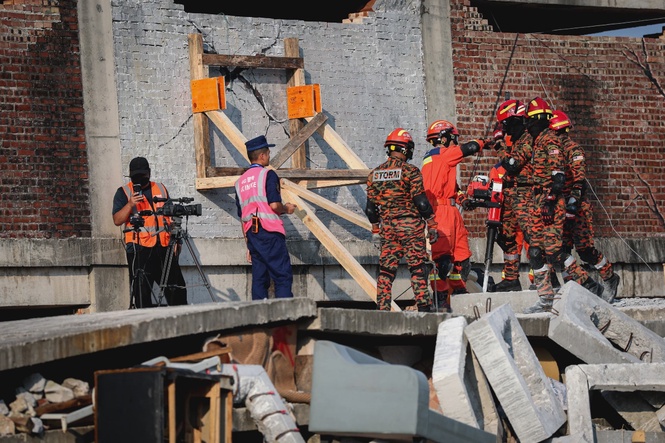
Mustakim, who is also the team leader, said seven JBPM personnel took part in the exercise, comprising two special units, namely the Special Tactical Operation and Rescue Team (STORM) and the Water Rescue Team (PPDA).
He said the practical training was conducted over two days, while earlier sessions focused more on classroom instruction and the exchange of experience among rescue teams from various countries.
“This was not just a routine exercise, but also an opportunity for us to meet new colleagues from other countries and exchange experience and knowledge.
“Our languages and countries may be different, but our mission remains the same, which is to save lives,” he said.
The exercise was part of the Multi-Hazard Response Field Exercise held in conjunction with the 3rd ASEAN Regional Forum (ARF) Workshop on Urban Emergency Rescue in Nanning, Guangxi.
Meanwhile, Mustakim said the exercise also provided an opportunity to exchange expertise in specific areas, including water rescue operations.
He said Malaysia had extensive experience in water rescue operations and scuba diving expertise given the country’s surrounding waters.
“China has also previously sent personnel to undergo training in Malaysia, so we can share our expertise in water rescue as well,” he said.
Mustakim said the exercise also exposed participants to the International Search and Rescue Advisory Group (INSARAG) mechanism for international assistance missions, including the process of coordinating rescue teams from their arrival through to operations at disaster sites.
He said China had two INSARAG-accredited teams that could be deployed for international rescue missions, while Malaysia also had the SMART team recognised by the organisation.
He said exercises such as this were important in enabling rescue teams to understand the capabilities, expertise and skills of teams from other countries that could be deployed during disasters.
“Once we are familiar with each other’s expertise and skills, it will facilitate cooperation in the future, not only when helping other countries but also when we need assistance,” he said.
The joint technical and field exercise was held from Sept 18 to 20 and brought together more than 300 personnel from 21 Chinese and international rescue teams from 11 countries, including China, Russia, Singapore, Malaysia and Laos.