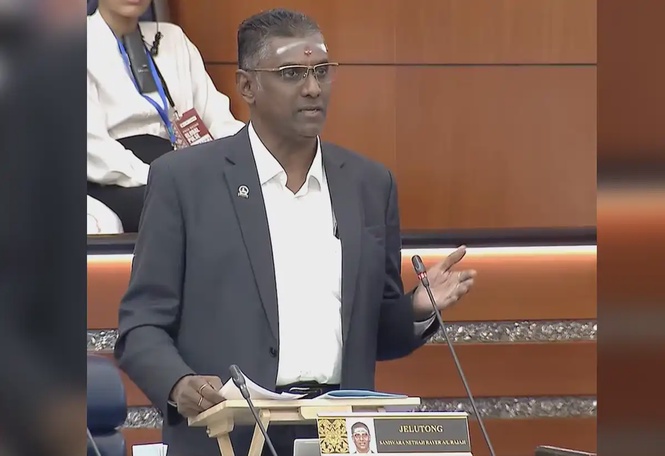
KUALA LUMPUR: A Malaysian lawmaker hopes the Sports Development (Amendment) Bill 2026, passed by the Dewan Rakyat yesterday, will bring closure to last year’s doctored documents scandal involving seven footballers.
The Bill was tabled by Youth and Sports Minister Dr Mohammed Taufiq Johari.
Jelutong MP RSN Rayer, who voted in favour of the amendments, said he was perplexed that no one had been brought to justice more than a year after the scandal was exposed.
“We need to know who the people behind it are. I mean, their (seven players) citizenships were forged,” Rayer told Twentytwo13.
Fifa had on Sept 26, 2025, sanctioned FAM and the seven players – Gabriel Felipe Arrocha, Facundo Tomás Garcés, Rodrigo Julián Holgado, Imanol Javier Machuca, João Vitor Brandão Figueiredo, Jon Irazábal Iraurgui and Hector Alejandro Hevel Serrano – after revealing that documents related to their origins had been forged.
“You are talking about a forgery case. We’re talking about birth certificates, and by virtue of the forgery, they have all become citizens of this country. Who carried out the forgery?
He questioned why it was taking the authorities so long to get to the bottom of the scandal.
FAM lodged a police report over the matter on Dec 24, 2025. However, the status of the investigation remains unclear. No one has been hauled up over the episode.
“Until today, nobody has taken responsibility. Why is nobody talking about it?” Rayer asked.
“Hopefully, with the power given to the minister, he can get to the bottom of it, find out who was actually behind the naturalisation and falsification of the citizenship of these players.”
During the debate, Rayer and several other MPs – Azli Yusof (Shah Alam), Ahmad Fadhli Shaari (Pasir Mas) and Datuk Shahelmey Yahya (Putatan) – said they hoped the amendments would strengthen governance in national sports and prevent a repeat of the doctored-document scandal.
Newly elected FAM president Datuk Ab Ghani Hasan has apologised to Malaysian football supporters over the episode and pledged that it would not happen again.
Azli Yusof also questioned the number of naturalised players in the national men’s football squad.
He highlighted the Indonesian team that had just won the Fifa Asean Cup, adding that the team looked like the Netherlands rather than Indonesia.
“We don’t want Malaysia to become like that as well. We should tighten the rules somewhat in terms of the number of naturalised players who can be included in the national squad.”
Ahmad Fadhli agreed, saying: “We don’t want people who cannot speak Malay to wear the Malaysian national team jersey. This is very embarrassing.”
Governance and accountability
Ahmad Fadhli also raised the issue of governance and accountability, adding that the central word in the legislation should be “development”.
“Talking about powers and governance, let us not forget that we are talking about the most important word in this Act, namely development. What is the outcome of our sports development?” he asked.
“Compare Malaysia’s football ranking with that of Uzbekistan and Jordan, which both qualified for the 2026 World Cup.
“What have they done in terms of academies, youth leagues, coaches, sports science and player development?” he said.
“I hope the (Youth and Sports) minister can focus on matters such as these, and I hope the Bill achieves two things: good governance with proper checks and balances; and development that produces results and a strong pipeline of successors.”
Shahelmey said financial stability was also critical to the development of sport, warning that financial difficulties continued to burden sports associations and clubs.
“Whenever we talk about the future of sport, the first thing that naturally comes to mind is money,” he said.
“Financial difficulties frequently burden the country’s sports industry. Sports associations and clubs, whether at Federal or state level, often struggle to secure financial support to continue competing in their respective sporting disciplines.”
He lamented that, in football, many local clubs had over the years lacked transparency in disclosing their financial position.
“As a consequence, players, coaches and employees registered with football clubs are not paid their salaries.
“Salary arrears accumulate over several months, and they and their families have been forced to tighten their belts and face the risk of having their personal assets seized.”
Shahelmey said the Youth and Sports Minister should take a more active role in monitoring the financial position of domestic football clubs and the welfare of professional athletes.
He said the power to cancel the registration of a sports body should be used as a deterrent rather than only as a punitive measure.
Among other provisions, the amendments empower the Sports Commissioner to direct registered sports bodies to amend their constitutions, while enforcement officers will be given powers to investigate, seize documents and apply for search warrants.
The Bill also introduces provisions allowing sports bodies to be declared unlawful and deregistered in circumstances involving national security, public order or morality.
Dr Taufiq Johari said the provision could not be used to punish sports associations simply because they disagreed with the government.
He said any order to declare a sports body unlawful would have to be gazetted, made only after consultation with the Sports Commissioner and remain subject to judicial review.