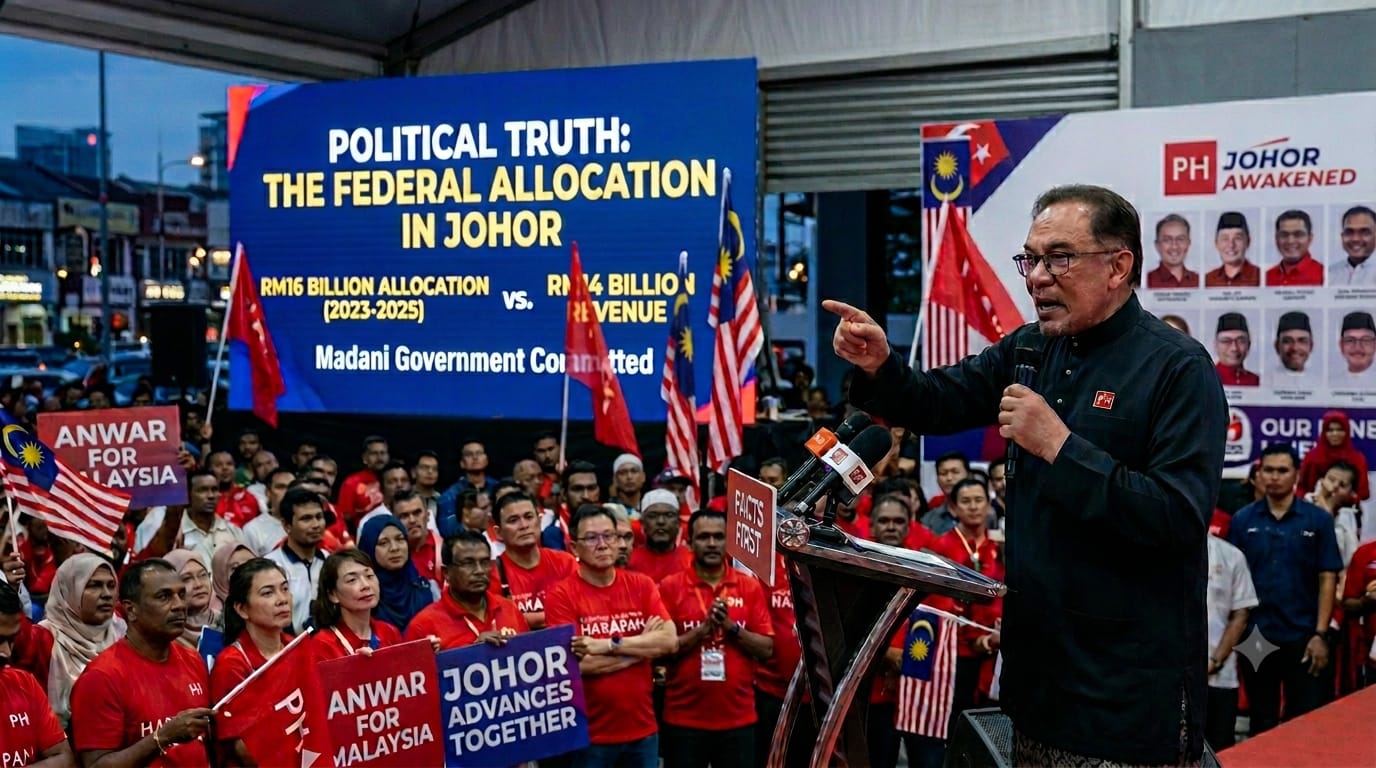
As Johor heads into a crucial state election, a growing debate over federal allocations and state contributions has become one of the most talked-about political issues in Malaysia.
Prime Minister Dato' Seri Anwar Ibrahim has now stepped forward to counter claims that Johor is receiving less than it deserves from the federal government, insisting that the public deserves a “true picture” of the financial relationship between Putrajaya and the southern state.
Speaking during the unveiling of Pakatan Harapan’s 56 candidates for the Johor state election, Anwar revealed that Johor received approximately RM16 billion in federal allocations between 2023 and 2025. According to records from the Ministry of Finance, Johor contributed around RM14 billion in revenue to federal coffers during the same period.
The Prime Minister stressed that the figures demonstrate the federal government’s commitment to Johor’s development and welfare.
Anwar stressed that Johor had received RM16 billion through various development projects, administrative expenditures and government programmes, arguing that public debates should be guided by comprehensive and accurate data rather than selective figures.
His remarks came in response to comments made by Johor Regent and Crown Prince Tunku Ismail Sultan Ibrahim, who recently argued that Johor contributes over RM40 billion to federal coffers each year, yet receives only about RM2 billion to RM3 billion in allocations in return. Speaking during a youth engagement session in Muar, Tunku Ismail questioned the fairness of the arrangement and suggested that between 25 and 30 per cent of revenue collected from Johor should be reverted back to the state for development and public welfare projects.
The issue is not new. For several years, Johor leaders and members of the royal institution have voiced concerns about infrastructure development, project delays, and the perceived imbalance between what the state contributes and what it receives from Putrajaya.
However, Anwar sought to provide broader context by highlighting that federal support extends beyond direct development grants. He pointed out that Johor currently receives significantly higher operating expenditure allocations compared to previous administrations.
According to Anwar, Johor previously received between RM6 billion and RM7 billion annually in operating expenditure, but under the Madani administration, the figure has increased to RM8.7 billion. He also noted that Johor ranks among the largest recipients of both operating and development expenditure allocations, trailing only Sabah and Sarawak in certain categories.
Beyond infrastructure and administrative spending, Johor has also benefited substantially from federal welfare programmes. Anwar noted that the state is the second-largest recipient of Sumbangan Tunai Rahmah (STR) and Sumbangan Asas Rahmah (SARA) assistance after Selangor, reflecting the government’s efforts to ease cost-of-living pressures on lower and middle-income households.
Despite the public exchange over financial matters, relations between the federal government and Johor’s royal institution appear to remain cordial. On the same day, Anwar was granted an audience with Tunku Ismail, where both leaders discussed issues affecting the welfare and well-being of Johoreans.
Following the meeting, Anwar described the discussions as taking place in a “friendly and harmonious atmosphere,” adding that both sides agreed to strengthen cooperation between the federal and state governments.
The Prime Minister also cautioned political parties against dragging the royal institution into partisan political battles during the election campaign.
“We contest as political parties, don’t relate it to the royal institution,” he said, reminding political actors that democratic competition should have clear boundaries and respect established institutions.
With Johor’s legislative assembly dissolved and campaigning set to intensify ahead of polling day on July 11, 2026, the debate over revenue sharing, state rights, and federal development priorities is likely to remain a central issue.
Whether voters are persuaded by calls for greater state autonomy or by the federal government’s defence of its record could play a significant role in shaping the outcome of one of Malaysia’s most closely watched state elections.
By: Kpost
Information Source:
Kpost (ckhorsk@gmail.com) is a content creator under the Newswav Creator programme, where you get to express yourself, be a citizen journalist, and at the same time monetize your content & reach millions of users on Newswav. Log in to creator.newswav.com and become a Newswav Creator now!
The User Content (as defined on Newswav Terms of Use) above including the views expressed and media (pictures, videos, citations etc) were submitted & posted by the author. Newswav is solely an aggregation platform that hosts the User Content. If you have any questions about the content, copyright or other issues of the work, please contact creator@newswav.com.