.jpg)
By Mihar Dias June 2026
Long before politicians begin hanging banners and erecting giant faces on lamp posts, elections are often decided quietly in coffee shops, hawker stalls and old housing estates.
A widely circulated message from a Batu Pahat son, written in simple language and devoid of political slogans, may tell us more about Johor's coming state election than a hundred ceramahs.
"I am a Batu Pahat boy," he begins. https://www.facebook.com/share/p/18nkxxhXxB/
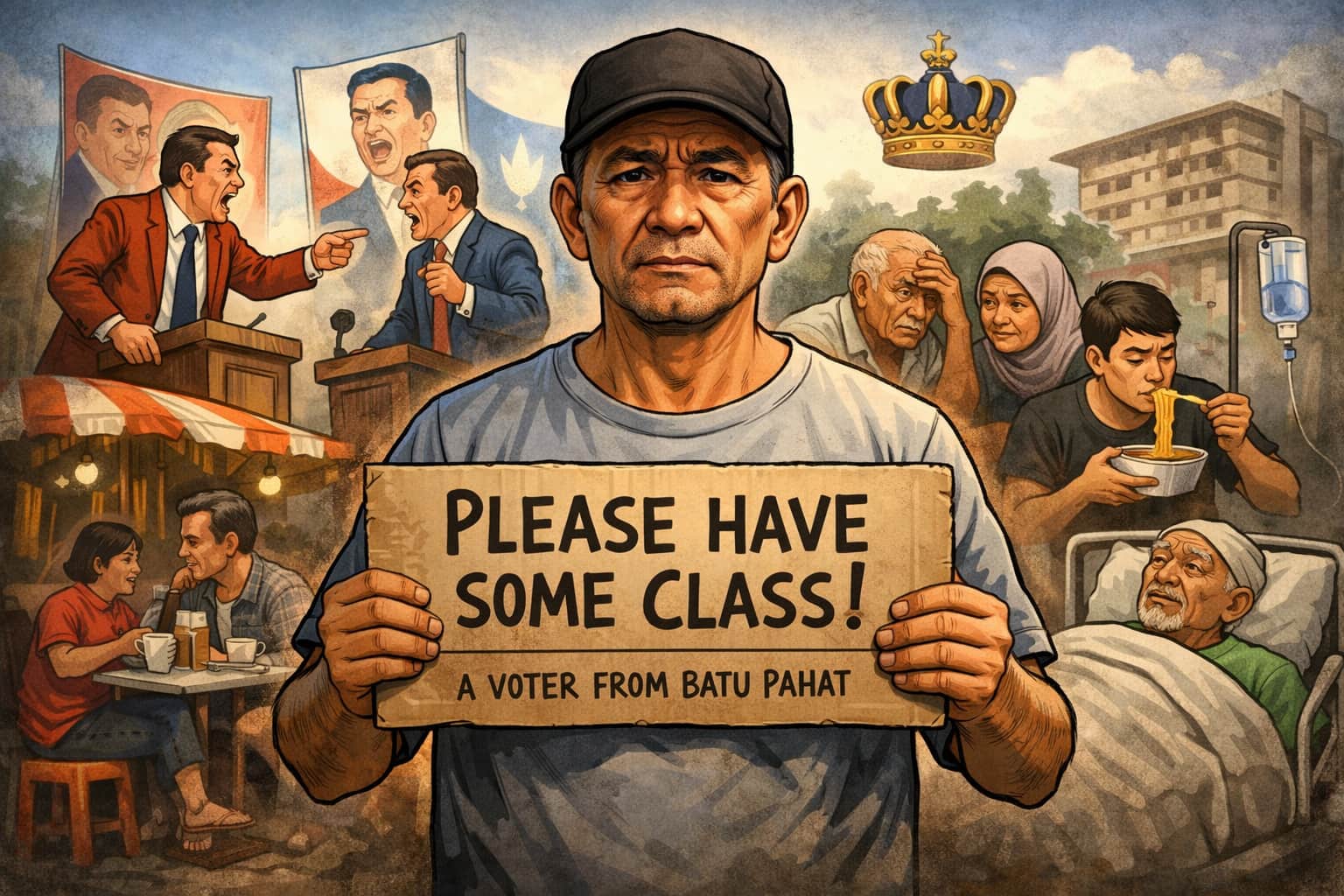
What follows is neither an endorsement nor an attack on any political party. It is, instead, an inventory of worries: aging parents, struggling hawkers, university students surviving on instant noodles, cancer patients unable to afford diapers, elderly couples living alone and families fearful that sudden policy changes could destroy livelihoods.
The writer asks a devastatingly simple question: if you lose office, will you still serve?
That question may become the defining issue of Johor politics.
For decades Malaysian elections were fought over grand themes. Race. Religion. Corruption. Reform. Loyalty. Betrayal. Today many Johoreans appear exhausted by political theatre. The shouting no longer excites them. The insults no longer persuade them.
Batu Pahat, Muar and other mixed constituencies have long served as political weather vanes. What emerges from these areas often spreads across the state. The concerns expressed in the message are not uniquely Chinese, nor uniquely urban. Malays, Chinese and Indians alike increasingly worry about healthcare costs, elderly care, job security and the rising expense of education. https://www.facebook.com/share/p/18nkxxhXxB/
The author speaks of Chinese prayer dinners requiring approvals and concerns over shrinking cultural space. Yet the larger issue is not ethnicity. It is predictability.
Business owners fear sudden regulatory changes. Parents worry about educational disruptions. Small traders ask for transition periods instead of abrupt directives. People are less concerned about ideology than whether government decisions allow them sufficient time to adapt.
This reflects a larger political evolution taking place in Johor.
The state once represented political stability. It was the birthplace of Umno, the fortress of Barisan Nasional and the embodiment of traditional political loyalty. But Johor today is changing rapidly. Younger voters commute to Singapore, older voters worry about retirement, and middle-class families struggle with rising costs despite apparent economic growth.
At the same time, tensions between various political actors have become increasingly public. Palace influence, party rivalries, coalition disagreements and leadership contests have all surfaced in recent years. Voters observing these disputes may reasonably ask whether politicians are solving problems or merely rearranging positions.
The Batu Pahat message rejects politics of humiliation.
"We are not so stupid," the writer says repeatedly. https://www.facebook.com/share/p/18nkxxhXxB/
That sentence should alarm every political strategist.
When voters begin telling politicians they are not stupid, it means they believe politicians have started treating them as if they are.
Character assassination, social media attacks and endless accusations may generate headlines, but they seldom answer practical questions. How many nursing homes will be built? How will isolated elderly citizens receive support? What happens to workers displaced by economic changes? Who helps the family whose breadwinner suffers a stroke?
These are not ideological questions.
They are housekeeping questions.
And voters often trust the person who appears willing to do housekeeping over the one delivering grand speeches.
There is also another subtle message embedded within the letter. The writer does not ask for heroes.
Malaysia has spent decades searching for saviours. Strongmen. Reformers. Modernisers. National leaders. Political giants.
The Batu Pahat voter simply asks for empathy. https://www.facebook.com/share/p/18nkxxhXxB/
A leader who understands a hawker waking at 2 a.m. A student cutting a packet of instant noodles into two meals. An elderly widow with no income. A cancer patient worrying more about funeral expenses than treatment.
Such concerns may appear mundane compared to constitutional debates or political intrigues. Yet elections are often won by the mundane.
Johor's coming state election may therefore become a referendum not on personalities but on reassurance.
Can political parties guarantee stability?
Can businesses plan with confidence?
Can ordinary families survive sudden policy shifts?
Will elected representatives continue serving after losing office?
The final irony is that the author himself proudly declares that he never completed Form Five.
Yet in a few pages of plain language he articulates what many highly educated politicians often fail to understand.
People do not necessarily demand perfection.
They ask for dignity.
They ask for predictability.
And above all, they ask to be heard.
As Johor moves toward another election, politicians may continue attacking one another from stages and social media platforms.
But somewhere in Batu Pahat, an old estate boy has already written the campaign manifesto many voters may secretly share.
“Please have some class in your ceramahs.” https://www.facebook.com/share/p/18nkxxhXxB/
Perhaps that is the simplest and wisest political advice Johor has received in years.
Mihar Dias (mihardias@gmail.com) is a content creator under the Newswav Creator programme, where you get to express yourself, be a citizen journalist, and at the same time monetize your content & reach millions of users on Newswav. Log in to creator.newswav.com and become a Newswav Creator now!
The User Content (as defined on Newswav Terms of Use) above including the views expressed and media (pictures, videos, citations etc) were submitted & posted by the author. Newswav is solely an aggregation platform that hosts the User Content. If you have any questions about the content, copyright or other issues of the work, please contact creator@newswav.com.