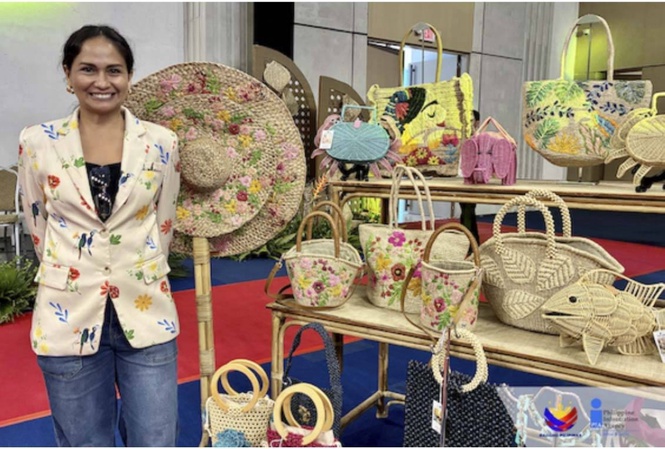
Joann Comedido
Founder
Arte ni Juana
Joann Comedido did not plan to become a bag maker. She planned to run a restaurant.
The 45-year-old Mandaue City native had built a food business from the ground up — until the Covid-19 pandemic forced it to close in 2020, leaving her at home with no income and no clear next move.
“It’s a long story of ups and downs sa akong negosyo (in my business). I used to have a restaurant, and then in 2020, the pandemic hit,” Comedido said.
What came next started almost by accident. Scrolling through social media during the lockdown, she spotted a former university professor selling Tikog grass bags from Samar. She bought one, resold it, and discovered something unexpected: people wanted more.
“Closed ang restaurant, I was at home, then I saw my professor at the university. She’s posting and selling Tikog bags from Samar,” she recalled.
She attempted to revive her food business, but found it physically and financially draining. She let it go. The bags, it turned out, fit her better.
“I think it fits me, you know, this is me. The vibrant colors are me… my childhood was fun,” she said.
That feeling shaped her brand name — Arte ni Juana — partly inspired by her grandmother’s name.
Six years in, Arte ni Juana is no longer a one-woman operation. Comedido now partners with seven weaving communities, working with materials including rattan, Tikog grass, banig, abaca, raffia, shell inlay, wood beads, and locally painted designs sourced from Bohol, Samar, Bicol, and the Cebu towns of Danao and Borbon.
Persons deprived of liberty in Lapu-Lapu City, Cebu City, Danao City and Talisay City also collaborate on the bags, contributing paintings to the designs. Comedido, who says she cannot draw, describes her design ideas to the weavers rather than sketching them.
Around 80 men are among the community partners who benefit from the business, alongside a majority of women weavers. Comedido personally delivers materials to the communities, with payments based on the number of bags produced.
Her products are on consignment at Crimson Resort and Spa Mactan, Sheraton Cebu Mactan Resort and Amorita Resort in Panglao, Bohol, with Shangri-La Resort and Spa in Boracay coming on board soon. She also employs staff to sell at the Radisson Blu Hotel Cebu. Many of the bags take a month to complete.
That reach expanded in April when Comedido was among fewer than 10 Cebu MSMEs selected to exhibit at the inauguration of the Mactan Expo Center — and to showcase her products directly to President Ferdinand Marcos Jr. during his walkthrough of the booths.
“The Mactan Expo is a very important platform for artists, artisans and MSMEs to come together,” she said. “We have this Mactan Expo to showcase what we have, not just locally, but globally. This is a perfect place to see more about Cebu, and more about the Philippines in general.” She sees the venue as exactly what small Filipino producers have long needed.
“There are so many talents in the country, but they need a venue, they need a space, they need a very big space, which is perfectly the Mactan Expo,” Comedido said.
The President underscored the convention center’s role in strengthening Philippine tourism.
“Mactan Expo is one of the projects that will further enhance our tourism sector,” the President said, adding that infrastructure development is key to giving visitors smoother, more memorable experiences.
The Mactan Expo Center is a two-level, stand-alone convention center capable of accommodating up to 3,000 guests in a theater-style setup, with two mezzanine meeting rooms. It is a private initiative of Megaworld Corporation, developed in partnership with government support and modeled in part on Asean infrastructure developments in Indonesia.
The center is designed for large-scale meetings, incentives, conferences and exhibitions events, and recently hosted the Asean Travel Exchange, the major business-to-business trade event under the Asean Tourism Forum that brings together international and local tourism stakeholders for global exposure.
“We recognized that there are things that the government does well and there are things that the private sector does well. And to partner with the private sector, ito nga ang nagiging resulta,” Marcos said.
For Comedido — who joins three to four exhibits a year — the Mactan Expo is more than a sales venue. It is a stage for the communities whose hands make every bag.
Comedido noted that MSMEs make up 99 percent of all business establishments in the country — making them, in her words, “the backbone of the Filipino economy.” “The Philippines is highly regarded in terms of art in Asia and globally. So, if they support us, why can’t we support our very own?” she said.