
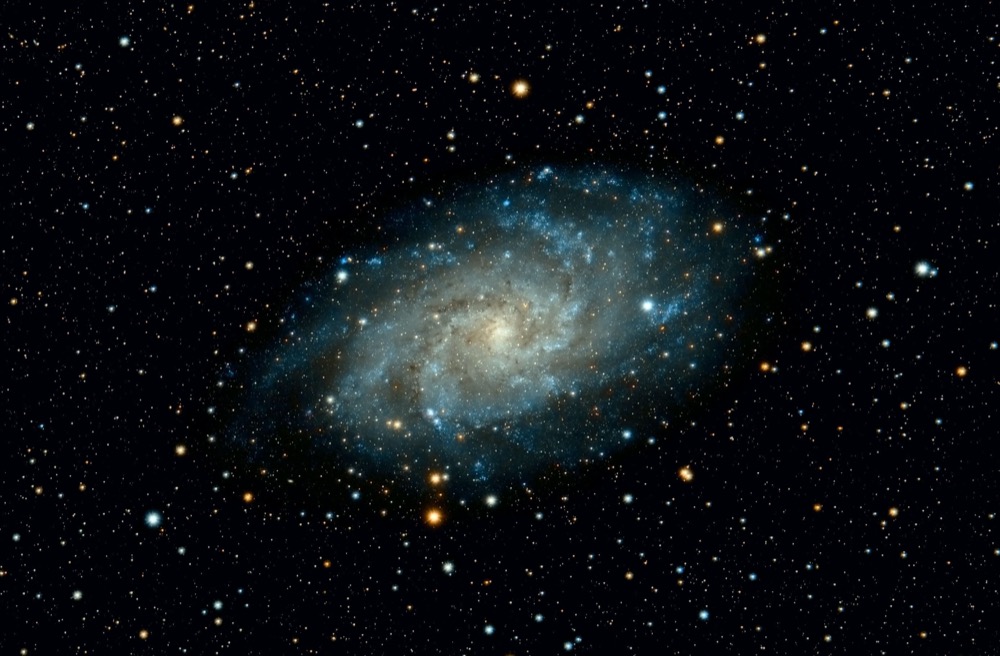
The James Webb Space Telescope (JWST) has uncovered a barred spiral galaxy unlike any seen before. Known as M1149-BSG-z5, it sits at a redshift of 5.1, making it the most distant barred galaxy ever identified. The discovery pushes back the timeline for when these striking galactic structures first appeared, as astronomers had long expected stellar bars to be rare in the chaotic conditions of the early universe.
An international team led by Xiaohan Wangof Tsinghua University spotted the galaxy using JWST’s Near-Infrared Imager and Slitless Spectrograph (NIRISS) during the telescope’s Cycle-2 observations.
The galaxy was found in the imaging parallel field of the Medium-band Astrophysics with the Grism of NIRCam in Frontier Fields program, as detailed in a paper posted on the arXivpreprint server on June 23.
A Barred Galaxy from the Epoch of Reionization
Stellar bars are among the most recognizable features ofspiral galaxies. Astronomers consider them closely linked to the long-term evolution of galaxies because they redistribute gas and stars across galactic disks.
While bars are common in nearby galaxies, they were expected to be much less frequent in the early universe, where galaxy assembly was taking place under very different conditions. The researchers note that observations made with JWSThave already revealed barred galaxies at redshifts of about 4.0, representing between 3% and 7% of galaxies observed at a redshift of 3.5.
M1149-BSG-z5 extends that record. The newly discovered galaxy contains a stellar bar measuring approximately 14,700 light-years in length, making it the highest-redshift barred spiral galaxy known so far.
A Massive Galaxy With an Active Nucleus
The study describes M1149-BSG-z5 as a massive system. Its effective radius is estimated at about 8,500 light-years, while its spiral arms extend to roughly 17,900 light-years. Researchers estimate the galaxy’s stellar mass at approximately 28 billion solar masses. It is also producing stars at a rate of about 144 solar masses per year, highlighting significant ongoing star formation despite its early place in cosmic history.
The team also identified an active galactic nucleus (AGN). Its black-hole-to-stellar mass ratio is estimated at around 0.001, a value lower than that measured in many high-redshift AGNs and comparable to ratios found in nearby active galaxies, the study reports.
A Chemically Evolved Galaxy
M1149-BSG-z5 is remarkable not only for its barred structure but also for its chemical makeup. The galaxy has a metallicity of about 50% of the Sun’s, showing that earlier generations of stars had already enriched its gas with heavier elements despite its young age.
The researchers also examined where the galaxy falls on the Baldwin, Phillips, and Terlevich (BPT) diagram, a tool used to determine whether a galaxy’s gas is mainly ionized by vigorous star formation or by an active galactic nucleus (AGN).
As described in the paper, its metallicity, its position on the BPT diagram, and its overall physical properties point to M1149-BSG-z5 being a massive, chemically evolved galaxy at high redshift
Compared with other galaxies from the same era, M1149-BSG-z5 stands out for its size. The researchers found that it is larger than most galaxies observed at a redshift of about 5, yet similar in size to barred galaxies seen between redshifts 2 and 4. They also identified a neighboring galaxy about 69,000 light-years away, suggesting that interactions between the two systems may have helped trigger the formation of the stellar bar.