The MBTI test is widely used in society, particularly in the workplace, because it is thought to be related to personality and a personal indicator of a person. Some people are concerned about a person's MBTI type because it is said to help them communicate and socialize appropriately based on their personality. The question is whether it is relevant to measure someone's personality solely through the MBTI test. Let's embark on the history of the MBTI test.
To begin with, the MBTI was created by Isabel Briggs Myers and her mother, Katherine Briggs. Katherine Briggs developed an interest in type theory after reading Carl Jung's book Psychological Type. Isabel Briggs Myers, who shared her mother's interest in type theory, developed the MBTI as a personnel selection test in the early 1990s. Myers believed that different occupations favoured different personality orientations, and Jung's theory suggested a connection between personality and job performance.
In 1957, the Educational Testing Service (ETS) began distributing the MBTI for research purposes.ETS spent significant time and resources deciding whether to include the MBTI in its proprietary test library. Following an unfavourable internal review of the test, ETS decided not to continue development and ended its partnership with Myers.
In 1975, Consulting Psychologists Press obtained the license to sell the MBTI. Since then, the test has been successfully marketed to a large audience.
The MBTI test is now available to licensed counsellors and psychologists, as well as college instructors and personnel with graduate training in testing theory and short courses on administration and interpretation. Several professional organizations support the study of type.
The Journal of Psychological Type is a scholarly journal that publishes original and review articles on type theory. Several professional organizations exist for those who use the MBTI in their work. The Centre for Applications of Psychological Type offers training on administering and interpreting the test, scoring services, and an MBTI profile database. The Association for Psychological Type (APT) represents professionals who use the MBTI. The APT offers workshops for qualified non-psychologists to purchase and perform the MBTI in nonclinical settings.
The MBTI theory is based on the idea that each person's personality can be classified into one of 16 types.
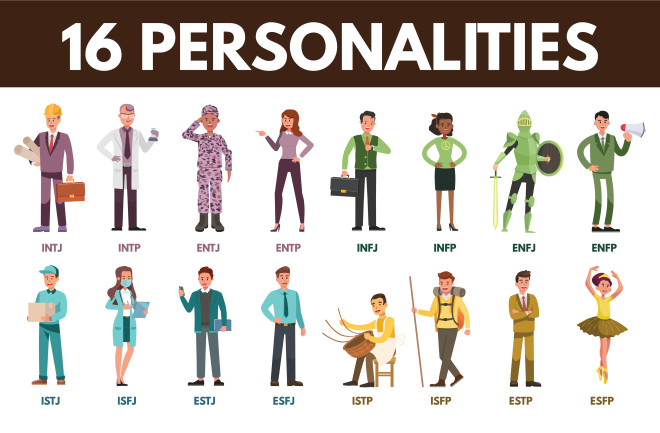
These categories are based on four personality traits, each with two opposing preferences. The theory suggests that individuals have an innate preference that guides their behaviour in any situation. There are four dimensions:
Extroversion (E) versus Introversion (I). This dimension reflects the individual's perceptual orientation. Extroverts respond to both immediate and objective conditions in their environment. Introverts focus on their internal and subjective reactions to their environment.
Sensing (S) vs. intuition (N). Individuals with a sensing preference tend to focus on perceived reality. Individuals with an intuitive preference rely on non-objective and unconscious perceptual processes.
Think (T) vs. Feel (F). A preference for thinking involves using logic and rational processes to make decisions and take action. Feeling refers to the preference for making decisions based on subjective processes, such as emotional reactions to events.
Judgment (J) versus Perception (P). Briggs and Myers developed judgment-perception preferences to determine whether rational or irrational judgments are dominant in interactions with the environment. The judgmental person makes decisions based on their thoughts and feelings, while the perception person relies on their senses and intuitions.
Because the MBTI is a type theory, each person can only have one preference. Individuals can develop complementary styles, such as becoming more extroverted when speaking in groups, but their primary preference will always take precedence. The MBTI score determines a person's type, which is based on their dominant preferences in each of the four dimensions. With two preferences in each dimension, there are 16 possible personality types.
According to David J. Pittenger, an Associate Professor and Chair in the department of Psychology at Marietta College in Marietta, Ohio, reliability is critical when measuring a test because it ensures consistency and predicts the same outcome every time. The MBTI, which measures an INTJ personality type, is expected to be extremely reliable because it is believed that once an INTJ is born for example, they will remain an INTJ. The test's reliability is assessed using test-retest reliability, which can last from several weeks to over a year. However, studies show that even with a short test-retest interval, up to 50% of people can be classified as a different type. This calls into question the test's stability and the meaningful differences between preference categories. The standard deviation and test-retest reliability influence the standard error of measurement, which is a statistic used to determine the significance of differences between test scores. However, the MBTI method obscures this distinction by categorizing people into a rigid contrast, allowing for close-to-one scores but distinct classifications. This contradicts the MBTI theory and may result in people with similar scores being assigned different personalities.
The validity of the MBTI test is critical to determining its reliability and validity. Researchers can use factor analysis to determine the test's validity by examining the correlations between questions. David J. Pittenger said if the MBTI theory is correct, the results should reveal four clusters or factors of questions, each with a high correlation to the other questions in the factor. These factors should be related to the measured MBTI dimension and explain most of the differences between individuals. However, research on factor analysis has yielded inconclusive results due to a high level of measurement error and inconsistent results with the MBTI theory.
The relationship between MBTI type and occupation has also been investigated, but there are significant issues. For example, the proportion of ESTJs in the teaching profession matches the proportion of ESTJs in the general population. Furthermore, there is no evidence to support a positive relationship between MBTI type and occupational success, such as whether ESFPs are better or worse salespeople than INTJs, or whether certain types are more satisfied in specific occupations than others.
Following that, according to David J. Pittenger, the MBTI fails to meet many of the basic standards for psychological tests. There is no obvious evidence that there are 16 distinct categories into which all people can be classified, that MBTI scores reflect stable and unchanging personality traits, or that the MBTI measures anything of value. Additional research is required to confirm or prove these findings.
Iffat Sakinah is a content creator under the Newswav Creator programme, where you get to express yourself, be a citizen journalist, and at the same time monetize your content & reach millions of users on Newswav. Log in to creator.newswav.com and become a Newswav Creator now!
The User Content (as defined on Newswav Terms of Use) above including the views expressed and media (pictures, videos, citations etc) were submitted & posted by the author. Newswav is solely an aggregation platform that hosts the User Content. If you have any questions about the content, copyright or other issues of the work, please contact Newswav.