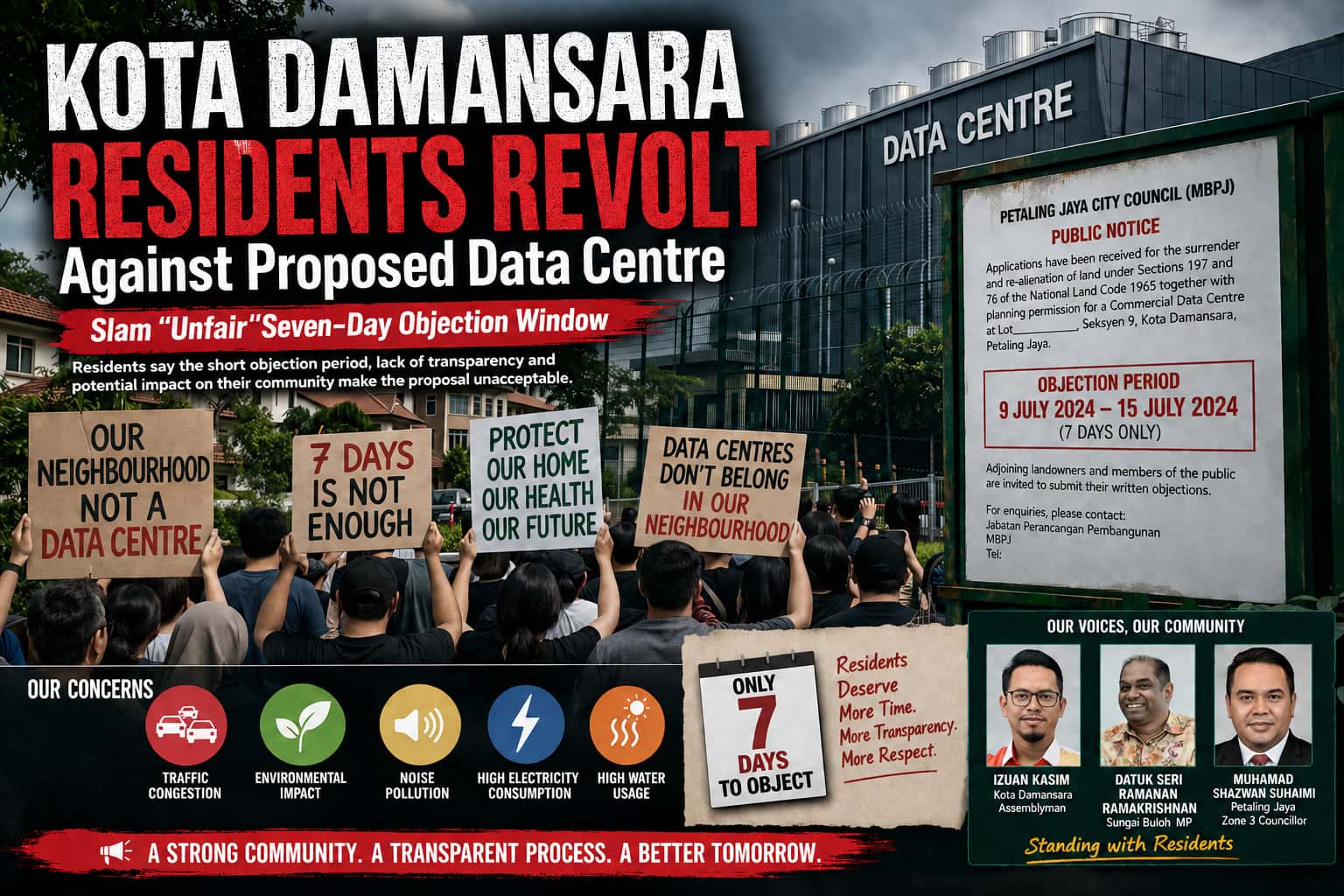
A proposed commercial data centre in Kota Damansara has sparked growing public opposition, with residents raising concerns over traffic congestion, environmental impact, noise pollution and what they describe as an unusually short public objection period that prevented meaningful community participation.
The controversy emerged after a public notice revealed that the Petaling Jaya City Council (MBPJ) had received applications for the surrender and re-alienation of land under Sections 197 and 76 of the National Land Code 1965, together with planning permission for a commercial data centre.
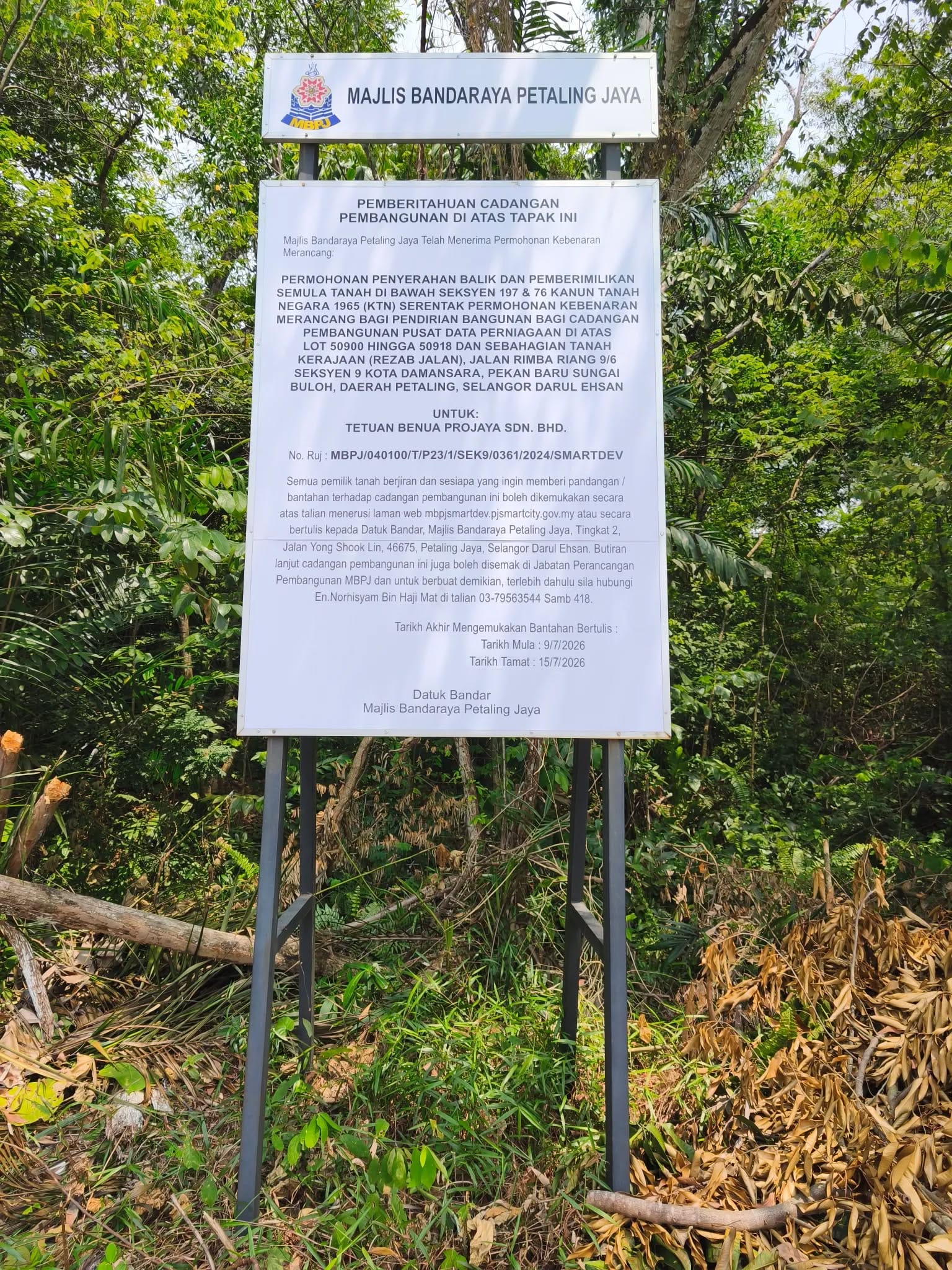
The notice invited adjoining landowners and members of the public to submit objections between July 9 and July 15, giving residents only seven days to respond.
The announcement quickly triggered widespread criticism on social media, with many questioning whether a large-scale data centre should be located so close to residential neighbourhoods.
One resident argued that data centres should not be built in housing areas when there is ample industrial land available elsewhere, such as Rawang or Sepang.
Others highlighted concerns over the operational impact of data centres, including constant cooling systems, high electricity consumption and significant water usage.
Several residents also warned that the facility could worsen the urban heat effect.
They argued that data centres generate enormous amounts of heat due to their cooling infrastructure, potentially raising surrounding temperatures and forcing nearby households to rely more heavily on air-conditioning, resulting in higher electricity bills.
Some also pointed to overseas examples where communities have expressed concerns about the environmental footprint of large-scale data centres, arguing that Malaysia should carefully assess the long-term implications before approving similar projects in densely populated areas.
Beyond environmental concerns, residents questioned the transparency of the approval process itself.
Several claimed they were unable to submit objections because the contact details listed on the public notice were invalid. Others alleged that the project reference number displayed on the notice board could not be found when searched online, fuelling suspicions that the development process lacked transparency.
The seven-day objection period became another major point of contention.
Residents argued that public consultations for developments of this scale normally allow between 14 and 30 days, while Section 21(6) of the Town and Country Planning Act 1976 (Act 172) generally provides adjoining landowners with 21 days to submit objections where no local plan exists.
They questioned why such a significant development affecting an established residential community was subjected to a much shorter timeline.
The issue has also drawn political attention.
Kota Damansara assemblyman Izuan Kasim said his office would formally object to the proposed development together with residents.
In a post on Threads, he stressed that protecting residents' interests was his responsibility regardless of whether it was an election period.
He pledged to bring all development projects opposed by residents or traders before MBPJ for further consideration, declaring that his office would stand alongside the community in opposing the proposal.
According to reports, Sungai Buloh MP Dato' Seri Ramanan Ramakrishnan and Petaling Jaya Zone 3 councillor Muhamad Shazwan Suhaimi have also reportedly submitted letters objecting to the project.
The dispute reflects a broader national debate over Malaysia's rapidly expanding data centre industry.
While the country has attracted billions of ringgit in investment as global technology companies establish digital infrastructure, communities are increasingly questioning where these facilities should be located and whether environmental, traffic and social impacts are being adequately addressed.
For many Kota Damansara residents, the issue extends beyond the proposed data centre itself.
They argue that developments with potentially significant consequences for surrounding neighbourhoods should be accompanied by transparent public engagement, adequate consultation periods and accessible channels for residents to voice their concerns before any final decision is made.
By: Kpost
Information Source:
Kpost (ckhorsk@gmail.com) is a content creator under the Newswav Creator programme, where you get to express yourself, be a citizen journalist, and at the same time monetize your content & reach millions of users on Newswav. Log in to creator.newswav.com and become a Newswav Creator now!
The User Content (as defined on Newswav Terms of Use) above including the views expressed and media (pictures, videos, citations etc) were submitted & posted by the author. Newswav is solely an aggregation platform that hosts the User Content. If you have any questions about the content, copyright or other issues of the work, please contact creator@newswav.com.