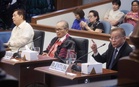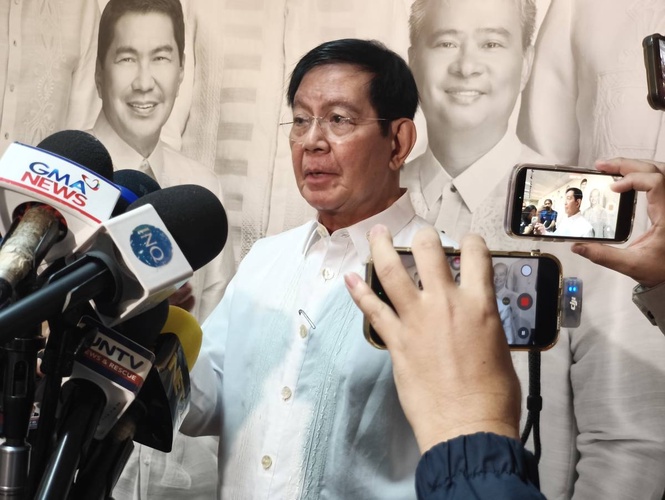
THE insights shared by three former Supreme Court justices who served as “amicus curiae,” or friends of the court, will serve as a guide for Sen. Panfilo Lacson when the Senate impeachment court votes next week on the voting threshold needed to convict Vice President Sara Duterte.
In a statement on Thursday, Lacson said that he learned much from retired Chief Justice Reynato Puno’s discussion of “textual vs. contextual” interpretation, retired Chief Justice Artemio Panganiban’s emphasis on “truth and fairness,” and retired Associate Justice Adolfo Azcuna’s interpretation of the phrase “all means all” in determining the threshold.
“Engaging in open court with three of the Court’s most esteemed former justices [including two former chief justices] was an unforgettable experience. Concepts like ‘textual vs. contextual,’ ‘truth and fairness,’ and ‘all means all’ certainly left an indelible mark on my mind and conscience. These insights will directly guide my decision next week,” Lacson said in a social media post.
During Wednesday’s proceedings, Puno said he favored a “contextual” interpretation of the Constitution, saying the two-thirds requirement should not necessarily be treated as a fixed 16 votes when circumstances legally prevent a senator from functioning as a member of the impeachment court.
Panganiban said senators may interpret the Constitution in accordance with their mandate as representatives of the people, guided by “truth and fairness.” He also questioned whether senator-judges who had not participated in the trial should be included in the voting threshold.
Azcuna disagreed.
“As long as they are members of the Senate, they constitute the denominator in computing the threshold of two-thirds because all means all,” he said.
Retired Chief Justice Hilario Davide Jr., in a memorandum read during Wednesday’s proceedings, also said that the basis of computing the two-thirds must be the number of senators “who are qualified to vote.” Lacson, in his interjection on Wednesday, asked how the impeachment court can ensure the “fairness and truth” if nine senator-judges could not attend the impeachment trial, leaving only 15 — one short of the 16 votes to represent two-thirds of all Senate members required for conviction.
In response, Azcuna explained that with only 15 senators available, a conviction could not be reached based on the requirement of two-thirds of all Senate members.
He said the resulting judgment would effectively be an acquittal because of the failure to obtain the constitutionally required 16 votes, rather than because a majority of the participating senators voted to acquit.
But Lacson pointed to circumstances that the framers of the 1987 Constitution may not have anticipated circumstances such as senators being in hiding, detained without bail or abroad and unable to return. He said these developments could demonstrate why the application of the constitutional threshold could not necessarily be treated as “immovable” as circumstances evolve.
Panganiban agreed with this, saying that fairness could still be achieved through the senators who are present.
“Fairness can be rendered by two-thirds of those present. It’s not necessary that 16 should vote in favor, because it’s impossible to get 16. Fairness cannot be denied to a majority simply because of circumstances beyond the control of our people,” Panganiban said.
“Our people still deserve to be given justice because the 15 present can still act and render justice, and be able to discipline whoever is to be disciplined. I believe that senators have been empowered by our Constitution to act, and our Constitution trusts their judgment,” he added.
The senator-judges are to vote next week whether to uphold or modify the ruling of impeachment court Presiding Officer Francis Escudero that 16 votes are required for conviction, based on the Constitution’s provision that “no person shall be convicted without the concurrence of two-thirds of all the members of the Senate.” The issue was raised after Sen. Erwin Tulfo appealed Escudero’s initial ruling on the voting threshold.
Public sentiment
Manila 3rd District Rep. Joel Chua on Thursday urged senator-judges to consider public sentiment as they exercise their constitutional judgment in the impeachment trial of Vice President Duterte.
“Vote according to what you believe the people desire,” Chua, a member of the prosecution team of the House of Representatives, said in Filipino in a press briefing, stressing that the impeachment process is intended to provide accountability to the public.
Chua made the appeal as he discussed legal advice from retired Supreme Court magistrates invited by the Senate impeachment court to address a disputed voting threshold. He said the Constitution’s assignment of impeachment trials to the Senate, rather than ordinary courts, underscores the public-accountability purpose of the proceedings.
He cautioned against an overly technical approach to procedural questions, saying senator-judges should follow the rules governing the impeachment court while considering the constitutional purpose of the trial.
The lawmaker pointed to the former magistrates’ emphasis on “truth” and “fairness,” saying these principles should guide the senator-judges as they independently assess the case. The Constitution gives the Senate the sole power to try and decide impeachment cases.
“The fact that this was brought before the senator-judges — and given that the prosecutors designated by our Constitution are members of the House — means this is a trial for the people; it is about accountability,” he said.
The senator-judges remain responsible for weighing the evidence and arguments presented by both prosecution and defense before casting their votes. The Senate impeachment court operates under its own rules, alongside constitutional and due-process requirements.
Chua also said lowering the voting threshold would not violate an existing vote or prejudice the outcome because the Senate has yet to vote on the case.
Show-cause orders
The Senate impeachment court, meanwhile, has issued show-cause orders to two members of the House prosecution panel over three separate incidents involving public statements, as the court moves to enforce restrictions on litigating the Vice President Sara Duterte impeachment case outside the proceedings.
Impeachment court spokesman Regie Tongol on Wednesday, Sept. 17, said one House prosecution panel member was issued show-cause orders covering two incidents arising from interviews on Sept. 14 and 15, while a counsel for the panel faces a separate order stemming from an interview on Sept. 8.
Tongol said the identities of those covered would be disclosed once the orders have been served, after which the documents will be uploaded to the Senate website.
After the respondents submit their explanations, Escudero is expected to rule next week on whether fines or other sanctions should be imposed. Tongol said the parties have no right to appeal under the Senate impeachment rules, and any ruling will be announced in court.
The disciplinary action comes as the Senate prepares for oral arguments next week on Sen. Erwin Tulfo’s motion seeking to overturn Escudero’s earlier ruling on the threshold required for conviction.
The prosecution and defense will each have 15 minutes to present their positions on Sept. 23, with senator-judges allowed to question both sides. The impeachment court is also scheduled to vote that day, with senators allowed to explain their votes.
Tongol said Escudero, as presiding officer, will participate in the vote. The immediate question is whether to grant Tulfo’s motion to overturn the standing ruling, rather than directly voting on the ruling itself.