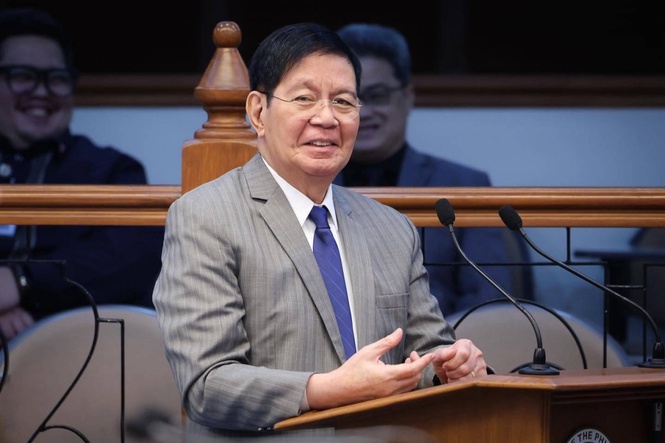
TO expand its budget transparency efforts, the Senate will push not only for continuous livestreaming of bicameral conference committee proceedings on the proposed 2027 national budget but also for transcripts of the discussions, Sen. Panfilo Lacson said Sunday.
Lacson said the transcripts would help lawmakers and the public identify who initiated amendments to the budget bill and track who pushed for realignments of its items.
"In the bicam, the minutes of the proceedings should be recorded through a transcript. The budget bill is the only measure whose bicameral proceedings do not have a transcript, so we cannot trace who made what amendment. Now there should be a transcript because for the longest time, it had none," Lacson said in an interview on DZMM radio.
"There should be a transcript containing the minutes so it will be clear who initiated amendments and who pushed for realignments," he said.
The measure seeks to address a longstanding transparency gap in the congressional budget process, particularly during the bicameral conference committee stage, when the House of Representatives and the Senate reconcile differences between their versions of the national budget.
Unlike ordinary legislative proceedings, where committee discussions and amendments are generally documented, bicameral budget negotiation transcripts are not accessible to the public, raising concerns over the traceability of budget insertions, realignments and other adjustments made during the final stages of budget approval.
The bicam is particularly significant because its reconciled version becomes the final congressional version of the appropriations bill submitted to the president for approval.
Changes made during the reconciliation process can substantially affect the distribution of public funds.
Lacson said the Senate intends to build on transparency measures introduced during deliberations on the 2026 national budget, which included identifying senators who proposed amendments to the budget bill and posting bicameral proceedings on the Senate website for public scrutiny.
For the 2027 budget deliberations, Lacson said the Senate also plans to invite budget advocacy organizations, including the People's Budget Coalition, to participate in or observe bicameral proceedings to strengthen independent oversight.
"I told the groups that vigilance is not enough and that they should resort to shaming against lawmakers who sneak in questionable realignments," he said.
Lacson also raised concerns about the practice of introducing project insertions at different stages of the budget process, which he described as "double kill."
The National Expenditure Program (NEP), prepared by the executive branch through the Department of Budget and Management (DBM), serves as the president's proposed spending plan and is submitted to Congress for deliberation.
It contains the proposed appropriations for government agencies, programs and projects for the succeeding fiscal year.
Congress then examines the proposal and may introduce amendments, subject to constitutional restrictions and the legislative appropriations process.
Lacson said some lawmakers allegedly make project insertions during the preparation of the NEP and introduce additional changes after the spending proposal reaches Congress.
"Some lawmakers made insertions in the NEP, and then again when the NEP was transmitted to the House and Senate. It's double kill," he added.
Lacson's call for greater scrutiny also followed concerns raised by budget advocacy groups over questionable geographical coordinates assigned to infrastructure projects in the proposed 2027 national budget.
On Thursday, he questioned the coordinates of a project flagged by the People's Budget Coalition, which reportedly pointed to the Celebes Sea instead of an identifiable project site in Leyte.
"I thought Leyte was already far enough, until the People's Budget Coalition flagged a project whose coordinates pointed to the Celebes Sea. So this is not a mere typo error because the projects are geotagged and should be pinpointed. That's what geotagging is for — to make it easy to locate and inspect a project so its quality can be checked and verified," he said.
"This is not an oversight. It is almost obvious that this is deliberate," he added.
Geotagging aims to provide the precise geographical location of government-funded infrastructure projects, allowing authorities, auditors and the public to verify whether projects exist at their declared locations and monitor their implementation.
Incorrect or questionable coordinates could complicate inspections and raise concerns about the accuracy and reliability of project information submitted as part of the budget proposal.
Lacson said he and his fellow senators will rely on the guidelines and requirements set by Public Works Secretary Giovanni Lopez for the funding of projects — including program of works, feasibility study, and geotagging.
He added that the Unified Account Code Structure (UACS) must be retained "all the way" throughout the budget process to ensure easier tracking of projects for implementation.
"The UACS provides codes that help track projects. The problem is that as the budget measure passes through the House and Senate, the UACS is lost," he said.