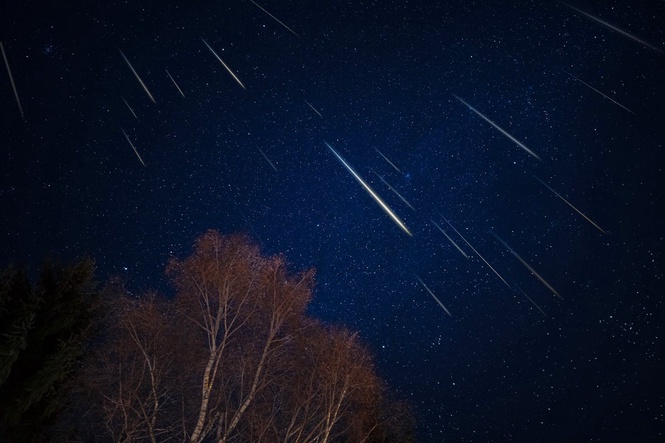
The world is about to be treated to the Leonid meteor shower, a particularly bright and fast set of “shooting stars”.
The Leonids are known for being particularly exciting, especially recently. Because the meteor shower is especially active, it can make seeing them both easier and more spectacular.
That is because the particles that cause the shower are moving especially quickly, faster than any other meteor shower, at about 71 kilometres per second. It means that the fireballs are especially bright, more prominent than every star and planet in the sky, and can leave behind long trails that are tinged with blue and green.
The Leonids will peak on the night of 17 November into 18 November. But they happen for much longer than that: starting on 6 November and carrying on until 30 November, and though they will be less prominent and regular over time they should be visible for the days following the peak.
The meteor shower happens annually, as the Earth moves through a cloud of debris left behind by the Comet 55P/Tempel-Tuttle. Those pieces of debris speed into Earth’s atmosphere, where they vaporise in a streak of light that looks like shooting stars.
The meteors seem to come out of the constellation Leo, the lion, which gives the meteor shower its name. But they should be visible right across the sky.
Actually seeing them requires no special equipment – but it does mean getting outside into a dark area, and watching for some time, so the key tools are things that help you stay comfortable and warm. Catching the meteor shower is really just about looking up and waiting for your eyes to adjust to the dark and for the bright streaks to appear in the sky.
Astronomers advise heading to somewhere where the sky is clear of both light pollution and other objects. It is then a matter of simply looking up – letting your eyes adjust and then scanning across the night sky.
The Leonids are also particularly notable for the “meteor storms” that are produced roughly every 33 years. During those, hundreds or even thousands of meteors can be seen each hour, compared with as few as five during the usual showers.
Some of those storms have produced light shows so spectacular that they have both bewitched people and dramatically progressed our understanding of meteor showers in general. In 1833, for instance, there was an especially spectacular show that brought around 100,000 meteors per hour.
Similar storms have been seen in 1799, 1833, 1966 and 1999 to 2001. The next storms may arrive around 2033 or 2034.
But those storms are notoriously unpredictable, because the dust that produces them only takes up a very small part of space, and it changes over time and because of the gravitational pull of our solar systems’ planets. That means that sometimes Earth will move right through the densest part of the stream, causing a spectacle, while at others it might miss it almost entirely.
Read MoreElon Musk among 175,000 to back reinstatement of Jensen Huang
Amazon loses 40 satellites for Leo internet constellation as Vulcan rocket crashes
SpaceX’s Starship returns to launch pad from orbit for first time