
Malaysia’s artificial intelligence ambitions are entering a more practical phase. The focus is moving beyond data centres and computing capacity towards how AI can improve industries, create jobs and deliver useful services.
At WAIC CONNECT Malaysia 2026 in Kuala Lumpur, Communications Minister Dato’ Seri Fahmi Fadzil said Malaysia AI growth should be measured by the economic value and opportunities created from the technology, rather than infrastructure alone.
That shift matters as Malaysia builds its position in Southeast Asia’s digital economy. The next challenge is turning computing resources into applications that businesses, workers and communities can actually use.
From AI Infrastructure to Economic Value
Malaysia has invested heavily in its digital foundations, but Fahmi said having infrastructure is different from becoming a place where AI is developed, deployed and applied.
He pointed to several areas where practical AI adoption could make a difference. These include semiconductor and electronics production, advanced manufacturing, logistics, supply chains, healthcare, agriculture and public services.
The government’s National AI Action Plan 2026–2030, also known as AI Nation 2030, reflects this direction.
According to figures shared by Fahmi at the conference, the plan targets an additional 0.8 to 1.2 percentage points of annual GDP growth, or roughly RM13 billion to RM20 billion a year. It also aims to create between 300,000 and 500,000 AI-related jobs.
These targets underline a wider issue for Malaysia: AI investment will have greater economic impact if local industries and workers can participate in its growth.
Talent Becomes Part of the AI Equation
Infrastructure alone cannot build an AI economy. Skills will be just as important, particularly as companies begin introducing AI into everyday operations.
Fahmi highlighted the need to ensure AI adoption creates opportunities for younger Malaysians and contributes to employment growth.
Huawei Malaysia, which supported WAIC CONNECT Malaysia 2026, has set a goal of nurturing 30,000 Malaysian AI talents and developing 200 local AI partners over the next three years through knowledge transfer, industry engagement, cloud initiatives and AI collaborations.
For Malaysia, programmes of this kind could help narrow the gap between new technology and the people needed to put it to work.
Skills development also has implications for SMEs. As AI tools become more accessible, smaller businesses may gain new ways to improve productivity and compete, provided they have access to suitable technology and trained workers.
Green Infrastructure Enters the Conversation
The rapid expansion of AI also brings an energy question.
AI computing and data centres require significant power, making energy efficiency and greener infrastructure increasingly relevant to Malaysia’s digital development plans.
Huawei Asia Pacific President Terry He said Malaysia has several advantages, including international connectivity, growing computing capacity and increasingly green power. He also pointed to Johor’s emergence as a major AI data centre location.
Huawei said its plans in Malaysia include working with local partners on secure and greener digital infrastructure across connectivity, computing, cloud, storage and energy.
The company also intends to support AI adoption in telecommunications, finance, healthcare, education, public services and SMEs.
For Malaysia, balancing AI expansion with sustainable infrastructure could become an important part of maintaining long-term digital growth rather than treating energy and computing as separate issues.
Malaysia Looks Towards a Wider ASEAN Role
The discussion at WAIC CONNECT also placed Malaysia’s AI development within a regional context.
Terry He said Malaysia could develop beyond its role as an infrastructure location and become a regional AI hub. The country’s connectivity, growing data centre ecosystem and position within ASEAN provide a base for AI services and applications that could eventually serve neighbouring markets.
China-Malaysia cooperation is another part of this picture.
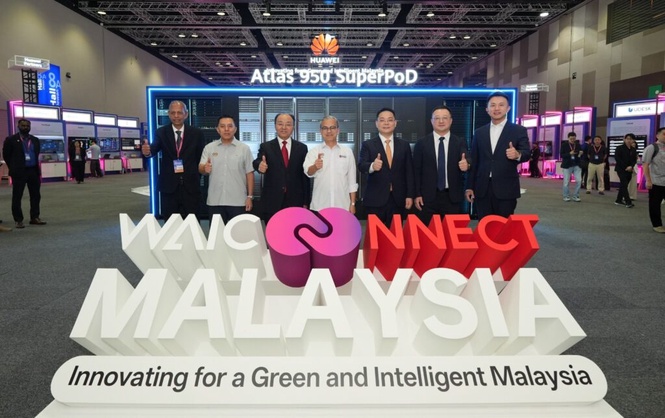
Minister of Communications, YB Dato’ Seri Fahmi Fadzil (centre) officiating the inaugural WAIC CONNECT Malaysia 2026, with him are (L to R), Honorary President of the Malaysia-China Chamber of Commerce & President of the Malaysia-China Friendship Association, YBhg. Dato’ Abdul Majid Ahmad Khan; Managing Director of MCMC, Abdul Karim Fakir Ali; Ambassador of the People’s Republic of China to Malaysia, H.E. Ouyang Yujing; President of Huawei APAC, Terry He; President, Marketing & Solution Sales Dept of Huawei APAC, Tao Jing; and CEO of Huawei Malaysia, Simon Sun.
Chinese Ambassador to Malaysia Ouyang Yujing highlighted growing cooperation between technology companies and universities from both countries in areas including AI and advanced engineering. Such partnerships could support technology transfer and the development of practical applications.
WAIC CONNECT Malaysia itself reflects this cross-border interest. Held on September 7 and 8 at the Kuala Lumpur Convention Centre, the event brought together more than 80 ecosystem partners and 1,000 industry experts from across Asia-Pacific. Its exhibition featured more than 40 showcases.
Why Practical AI Adoption Matters
The public value of Malaysia’s AI push will ultimately depend on what the technology delivers outside technology conferences and data centres.
For businesses, AI could improve manufacturing efficiency, logistics and supply-chain management. For public services, practical applications may help organisations handle information and deliver services more effectively. In healthcare, education and agriculture, the opportunity lies in applying technology to real operating needs.
There is also a workforce dimension. New AI-related jobs could create opportunities for young Malaysians, while existing workers will need new skills as workplaces change.
From an economic perspective, stronger local capabilities could help Malaysia capture more value from the infrastructure already being developed in the country.
The bigger picture is not simply about having more computing power. It is about building an ecosystem where Malaysian companies, workers, developers and institutions can turn that capacity into useful products and services.
A More Practical Phase for Malaysia’s AI Ambitions
Malaysia has built considerable momentum around digital infrastructure. The next stage will test whether that foundation can translate into wider economic and social gains.
A combination of green infrastructure, workforce development, industry adoption and regional partnerships could help move Malaysia AI growth closer to that goal.
If the country can connect computing investment with real-world applications, AI could become more than another technology sector. It could support productivity, skills and new opportunities across a much broader part of the economy.
The post Malaysia AI Growth Shifts Towards Real-World Applications appeared first on RISEMALAYSIA.my.


